
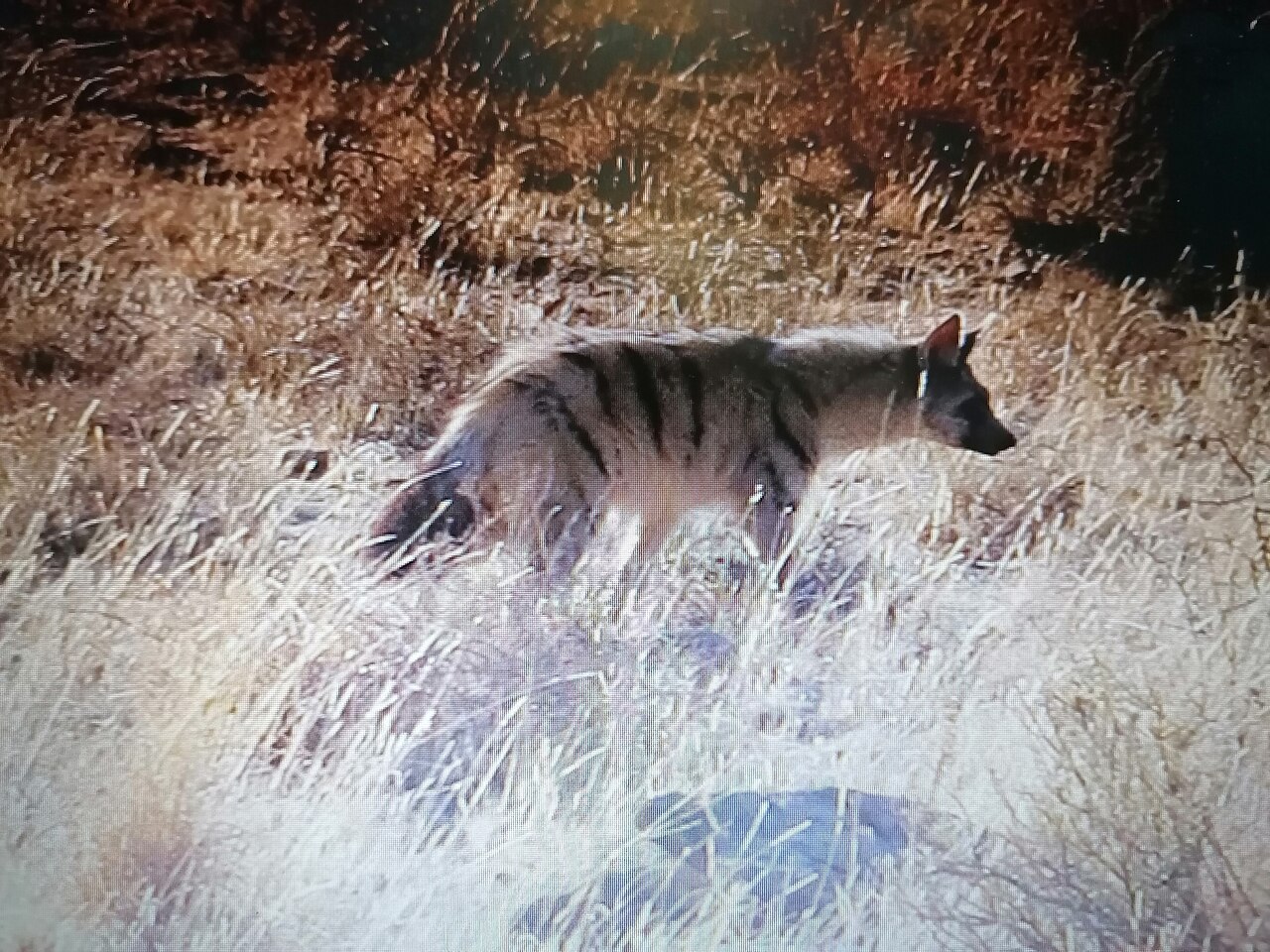
Aardwolf (Proteles cristata) is a termite-specialist member of the hyena family found in two separated regions of eastern and southern Africa. This guide separates well-supported biology from common assumptions and covers identification, range, habitat, diet, behavior, reproduction and conservation.
Identification
A slender, long-legged mammal with a sloping back, pointed muzzle, very large ears, buff to gray fur, vertical dark stripes and a black-tipped bushy tail. A long mane runs from the crown along the back and can be raised to make the animal look larger. Males and females are similar in size and coat pattern; field sexing usually depends on close views of anatomy or behavior rather than appearance.
Identification should combine body shape, markings, size, voice or movement, and location. One feature by itself can overlap with a related animal, a juvenile, or an individual in unusual light.
Photographs are most useful when they preserve scale and show several diagnostic features. Handling or repositioning a wild aardwolf for identification can cause stress and is unnecessary.
Size and physical adaptations
Aardwolf typically measures about 85–105 cm total length and weighs about 8–14 kg. The tail contributes roughly 20–30 cm of total length; body condition changes seasonally with termite availability.
Its useful adaptations include broad sticky tongue laps termites from the soil surface, reduced cheek teeth reflect a soft insect diet, large ears detect predators and termite activity, raised dorsal mane exaggerates apparent body size, strong anal-gland scent marks define territories. These traits work together in the animal’s normal setting rather than serving as isolated curiosities.
Published measurements may use different methods, life stages or sample locations. Comparing figures responsibly means checking what was measured rather than selecting the largest number available.
Range and distribution
Two broadly separated population regions occur in eastern and northeastern Africa and in southern Africa. Distribution closely follows open habitats where suitable surface-foraging harvester termites are available. The native range includes Angola, Botswana, Djibouti, Egypt, Eritrea, Ethiopia, Kenya, Lesotho, Mozambique, Namibia, Somalia, South Africa, South Sudan, Sudan, Eswatini, Tanzania, Uganda, Zambia, Zimbabwe.
A country-level map indicates broad distribution, not continuous occupation. Climate, elevation, water, vegetation, prey, breeding sites, barriers and survey effort all affect where records occur.
Records near the edge of the range deserve careful documentation because they may reflect natural movement, improved survey coverage, accidental transport or a genuine distribution change.
Habitat
Dry grassland, open savanna, scrub, karroid vegetation and semi-arid plains; it avoids closed forest and true desert.
Aardwolves forage across open ground at night and rest by day in burrows dug by other animals or enlarged for shelter. Territory quality depends more on termite abundance than on dense cover. Protecting a population therefore requires the feeding, shelter and breeding features that make a site usable, along with connections that allow movement.
Microhabitat matters. Shade, soil, current, moisture, shelter or host plants can determine whether a small area is usable even when the surrounding landscape appears suitable.
Diet and feeding
Aardwolf is a obligate insectivore specialized on termites. Important foods include trinervitermes harvester termites, hodotermes harvester termites, other surface-active termites. It walks slowly across feeding grounds and licks exposed termite workers from the soil with a flattened, saliva-coated tongue. It normally leaves mounds intact and gains much of its water from prey.
Diet changes with age, season, location and food supply. A dramatic prey record does not establish what most individuals eat most of the time; repeated field observations provide a stronger picture.
Feeding opportunities also create risk. An animal focused on prey may be less alert to predators, traffic or people, while contaminated prey can transfer pollutants through the food web.
Behavior and communication
Primarily nocturnal, shifting toward late-afternoon or daytime foraging during cold seasons when termites are active then. Adults usually forage alone within territories shared by a breeding pair. They shelter in dens by day, bury droppings in middens, scent-mark grass stems and raise the mane when alarmed.
Anal-gland paste marks, communal middens, posture and occasional calls communicate territory, breeding condition and alarm. Behavior should be interpreted in context: alarm, courtship, feeding and temperature regulation can produce very different actions from the same animal.
Daily schedules are flexible responses, not rigid rules. Weather, breeding condition, disturbance, tides or food can move activity into a different part of the day.
Reproduction and development
Pairs share a territory and den-guarding duties, although extra-pair mating can occur during the short breeding period. Usually two to four cubs, occasionally five. Cubs remain underground for roughly their first month, explore near the den at four to six weeks and later accompany an adult while learning to forage.
Young animals face different risks and may use different microhabitats or food than adults. Breeding success depends on adult condition, suitable sites and the survival of offspring through vulnerable early stages.
Counts of eggs or young describe reproductive output, not the number expected to reach adulthood. Mortality is normally greatest during eggs, larval or juvenile stages.
Predators and ecological role
A major predator of surface-foraging termites that can remove vast numbers without excavating mounds. Cubs can be prey for jackals, while adults and young are killed by dogs, road traffic and mistaken predator-control actions. Documented or likely predators include Black-Backed Jackal, Domestic Dog, Humans, Large Carnivores.
This animal is both a consumer and a food source. Its influence comes through many repeated interactions, so ecological claims should be based on measured populations rather than assumptions drawn from appearance.
Predator and prey relationships differ among places. A species can be ecologically influential without being abundant everywhere, and its role can change across its range.
Relationship with people
Aardwolves benefit rangelands by consuming termites and do not hunt livestock. Education is important because their striped coat can lead to confusion with hyenas and needless killing during predator-control operations.
Observe quietly from a vehicle or at a long distance, never chase an animal for a photograph and keep dogs controlled. A cornered aardwolf can defend itself and may release a strong anal-gland secretion. Responsible observation means keeping an appropriate distance, avoiding capture or feeding, protecting habitat and following local wildlife or invasive-species guidance.
Wildlife guidance should come from the responsible local agency because collection rules, reporting requests and appropriate responses differ between native and introduced ranges.
Conservation
The IUCN Red List assesses the aardwolf as Least Concern because it remains widespread, occupies extensive suitable habitat and has no major range-wide threat. The reported global trend is Stable overall.
Important pressures include road mortality, mistaken persecution, dogs and indiscriminate predator control, conversion of open habitat, destruction or poisoning of termite colonies. Global status can hide local decline or recovery, so current regional monitoring and habitat management remain necessary.
The most useful conservation action follows the documented pressure. Protecting breeding sites, reducing road deaths or limiting pollutants can require different tools in different populations.
