
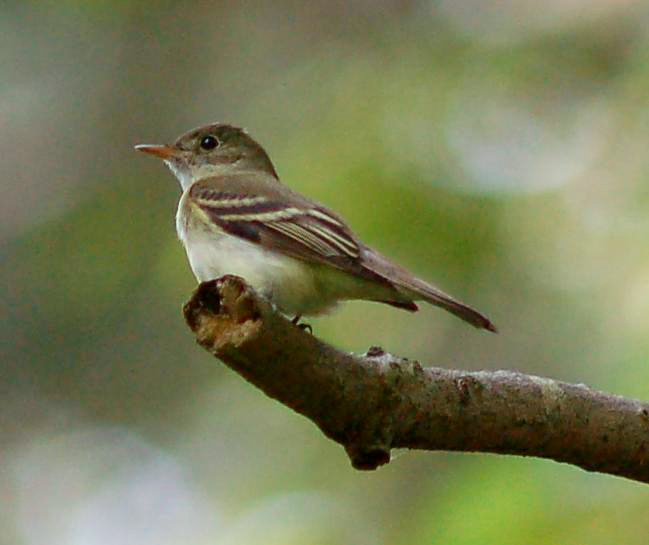
Acadian Flycatcher (Empidonax virescens) are long-distance migrant songbirds that breed in mature deciduous forests of eastern North America and spend the nonbreeding season in tropical forest from Central America into northwestern South America. This guide separates well-supported biology from common assumptions and covers identification, range, habitat, diet, behavior, reproduction and conservation.
Identification
This small flycatcher is olive-green above and pale below, often with a yellowish wash, two clear pale wingbars, a narrow whitish eye ring, long wings and a broad flat bill that is dark above and mostly orange-yellow below. Its peaked head and explosive ker-chip or peet-sah song help distinguish it. Adult males and females look alike in the field. Males are more often detected through persistent territorial singing during the breeding season.
Identification should combine body shape, markings, size, voice or movement, and location. One feature by itself can overlap with a related animal, a juvenile, or an individual in unusual light.
Photographs are most useful when they preserve scale and show several diagnostic features. Handling or repositioning a wild acadian flycatcher for identification can cause stress and is unnecessary.
Size and physical adaptations
Acadian Flycatcher typically measures 14–15 cm and weighs 11.1–13.9 g. Published values cover both sexes; age, season and body condition produce individual variation.
Its useful adaptations include broad flat bill helps seize flying insects, long wings support migration and aerial sallies, olive plumage blends into leafy forest midstory, wide gape captures prey in flight, agile flight reaches insects beneath leaves. These traits work together in the animal’s normal setting rather than serving as isolated curiosities.
Published measurements may use different methods, life stages or sample locations. Comparing figures responsibly means checking what was measured rather than selecting the largest number available.
Range and distribution
Breeds mainly in the eastern and central United States, reaching southern Canada at the northern edge. Migrants travel through Mexico and Central America to nonbreeding forests from southern Central America into northwestern South America. The native range includes Canada, United States, Mexico, Belize, Guatemala, Honduras, El Salvador, Nicaragua, Costa Rica, Panama, Colombia, Ecuador, Venezuela.
A country-level map indicates broad distribution, not continuous occupation. Climate, elevation, water, vegetation, prey, breeding sites, barriers and survey effort all affect where records occur.
Records near the edge of the range deserve careful documentation because they may reflect natural movement, improved survey coverage, accidental transport or a genuine distribution change.
Habitat
Large, relatively undisturbed mature deciduous forest, especially shaded ravines, river bottoms, swamps and streamside woods; tropical primary and second-growth forest in winter.
Birds usually occupy the middle forest layers where open perches overlook gaps beneath the canopy. Breeding territories are most successful in large forest tracts with streams, tall trees and limited edge disturbance. Protecting a population therefore requires the feeding, shelter and breeding features that make a site usable, along with connections that allow movement.
Microhabitat matters. Shade, soil, current, moisture, shelter or host plants can determine whether a small area is usable even when the surrounding landscape appears suitable.
Diet and feeding
Acadian Flycatcher is a insectivore and aerial predator. Important foods include flies, moths, caterpillars, beetles, wasps, spiders, other small arthropods. A bird waits upright on a slender exposed perch, makes a short sally to seize an insect in the air or from the underside of a leaf, then often returns to the same or a nearby perch.
Diet changes with age, season, location and food supply. A dramatic prey record does not establish what most individuals eat most of the time; repeated field observations provide a stronger picture.
Feeding opportunities also create risk. An animal focused on prey may be less alert to predators, traffic or people, while contaminated prey can transfer pollutants through the food web.
Behavior and communication
Diurnal, with territorial song strongest in the early morning. Acadian flycatchers spend long periods sitting quietly in the forest midstory, interrupted by rapid looping flights after prey. Breeding pairs defend territories, and migrants can return to the same breeding and winter sites in successive years.
The male’s short explosive ker-chip or peet-sah song is the best field clue. Birds also use sharp pwit calls, twittering notes and rapid dawn or evening song sequences during territorial and pair interactions. Behavior should be interpreted in context: alarm, courtship, feeding and temperature regulation can produce very different actions from the same animal.
Daily schedules are flexible responses, not rigid rules. Weather, breeding condition, disturbance, tides or food can move activity into a different part of the day.
Reproduction and development
The female builds a small hammock-like nest in a horizontal fork near the end of a drooping branch, weaving spider silk or cocoon material with bark, twigs and grass. She incubates, while both parents can help feed nestlings. Usually 2–3 eggs Chicks hatch helpless with sparse down, grow rapidly on insect prey and leave the nest after about 12–18 days, while parents continue care during early independence.
Young animals face different risks and may use different microhabitats or food than adults. Breeding success depends on adult condition, suitable sites and the survival of offspring through vulnerable early stages.
Counts of eggs or young describe reproductive output, not the number expected to reach adulthood. Mortality is normally greatest during eggs, larval or juvenile stages.
Predators and ecological role
By taking flying and foliage-dwelling arthropods, Acadian flycatchers connect forest insect production to avian food webs. Their preference for mature interior forest makes their presence useful evidence of habitat quality, although it is not a complete measure by itself. Documented or likely predators include Hawk, Snake, Raccoon, Brown-headed Cowbird.
This animal is both a consumer and a food source. Its influence comes through many repeated interactions, so ecological claims should be based on measured populations rather than assumptions drawn from appearance.
Predator and prey relationships differ among places. A species can be ecologically influential without being abundant everywhere, and its role can change across its range.
Relationship with people
Birders value the species as a voice of mature eastern forest, and land managers use it as one indicator when planning forest-interior conservation. People rarely interact directly with the bird beyond observation and habitat management.
Listen and watch from existing paths, avoid playback near active nests and keep distance from hanging nest cups. Protecting stream buffers, large forest blocks and winter habitat is more useful than approaching birds closely. Responsible observation means keeping an appropriate distance, avoiding capture or feeding, protecting habitat and following local wildlife or invasive-species guidance.
Wildlife guidance should come from the responsible local agency because collection rules, reporting requests and appropriate responses differ between native and introduced ranges.
Conservation
The IUCN Red List classifies the Acadian flycatcher as Least Concern. Long-term North American surveys have been broadly stable, but forest fragmentation can reduce nesting success and winter deforestation remains a concern. The reported global trend is Broadly stable over recent long-term survey periods, with regional differences.
Important pressures include forest fragmentation, loss of mature deciduous forest, tropical deforestation, brood parasitism near forest edges, streamside development, climate-driven habitat change, collisions during migration. Global status can hide local decline or recovery, so current regional monitoring and habitat management remain necessary.
The most useful conservation action follows the documented pressure. Protecting breeding sites, reducing road deaths or limiting pollutants can require different tools in different populations.
