
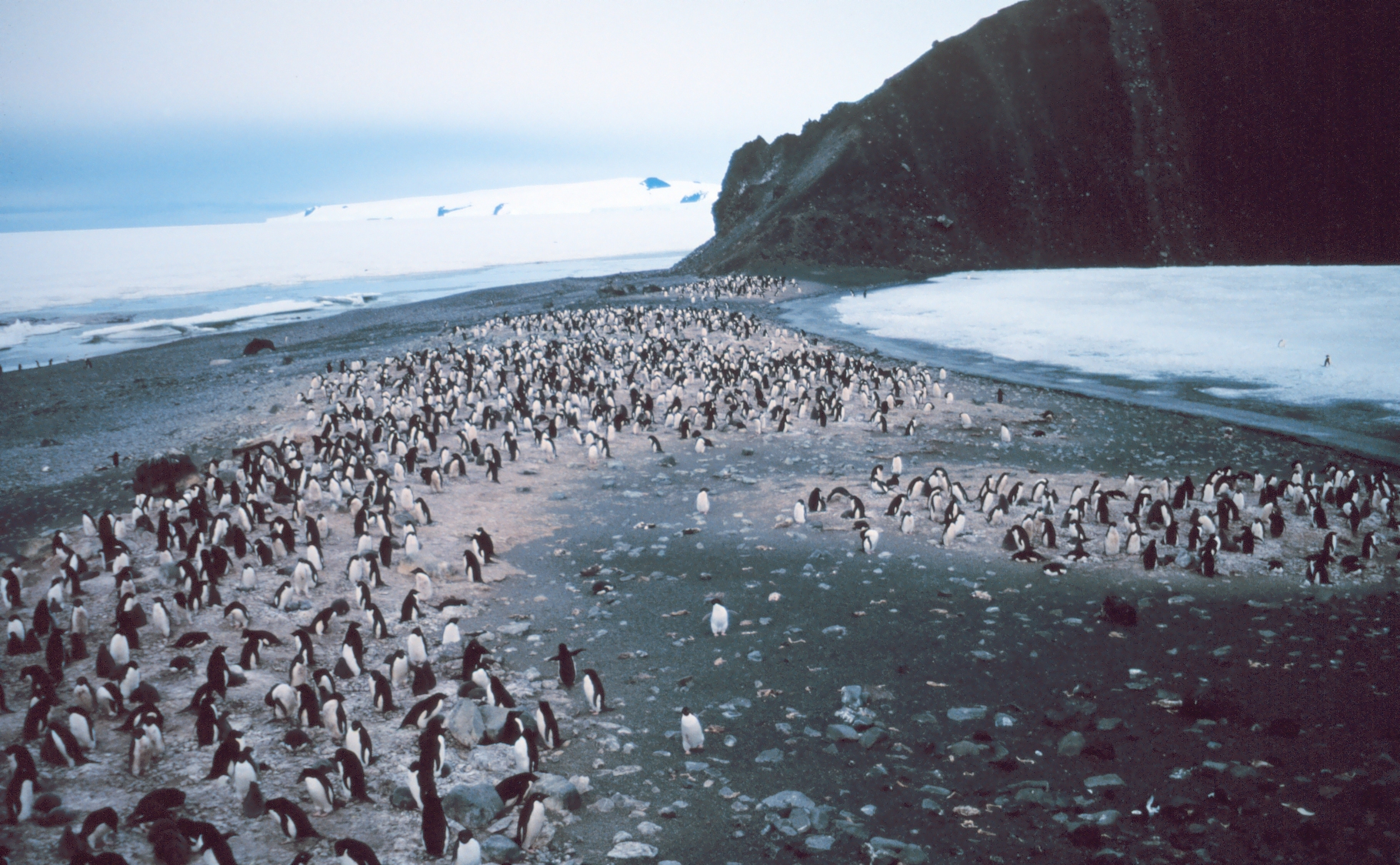
Adelie Penguin (Pygoscelis adeliae) is a black-and-white seabird that breeds around the Antarctic coast and nearby islands. A crisp white ring encircles each eye, and a long feathered tail sweeps behind its upright body. Adélies spend winter among pack ice, then return to ice-free rock for a short, intense summer breeding season. Their dependence on sea ice and krill makes colony monitoring a window into Southern Ocean change. This guide separates well-supported biology from common assumptions and covers identification, range, habitat, diet, behavior, reproduction and conservation.
Identification
Adults have a black head, back and flippers, a white belly, pink feet and a short reddish-black bill whose base is partly hidden by feathers. The narrow white eye ring is diagnostic. Their stiff tail feathers often touch the ground. Juveniles lack the complete bright eye ring and have a white throat at first; chicks wear gray-brown down. Males and females look alike; males average slightly larger but usually cannot be sexed reliably by sight.
Identification should combine body shape, markings, size, voice or movement, and location. One feature by itself can overlap with a related animal, a juvenile, or an individual in unusual light.
Photographs are most useful when they preserve scale and show several diagnostic features. Handling or repositioning a wild adelie penguin for identification can cause stress and is unnecessary.
Size and physical adaptations
Adelie Penguin typically measures About 70 cm tall and weighs Usually 3–6 kg. Mass changes substantially through feeding, breeding and the annual fast during molt.
Its useful adaptations include dense waterproof feathers trap insulating air, thick fat stores energy and limits heat loss, flipper-shaped wings drive underwater pursuit, countershading conceals birds in the sea, stiff tail supports an upright stance, tobogganing saves energy on snow. These traits work together in the animal’s normal setting rather than serving as isolated curiosities.
Published measurements may use different methods, life stages or sample locations. Comparing figures responsibly means checking what was measured rather than selecting the largest number available.
Range and distribution
Adélie Penguins breed circumpolarly on ice-free coasts and islands around Antarctica. Outside the breeding season they disperse through Antarctic coastal waters and the pack-ice zone, traveling hundreds or more than a thousand kilometers. Their distribution shifts with sea-ice extent, open-water access, currents and prey. The native range includes Antarctica.
A country-level map indicates broad distribution, not continuous occupation. Climate, elevation, water, vegetation, prey, breeding sites, barriers and survey effort all affect where records occur.
Records near the edge of the range deserve careful documentation because they may reflect natural movement, improved survey coverage, accidental transport or a genuine distribution change.
Habitat
Antarctic pack ice and coastal ocean, with ice-free rocky slopes and islands used for breeding.
At sea, Adélies forage around pack-ice edges, polynyas, coastal shelves and current features that concentrate krill and fish. On land they select exposed sloping rock where meltwater can drain away and collect pebbles into shallow nests. The colony location balances safe ground with access to open water; excessive fast ice can force costly walking trips. Protecting a population therefore requires the feeding, shelter and breeding features that make a site usable, along with connections that allow movement.
Microhabitat matters. Shade, soil, current, moisture, shelter or host plants can determine whether a small area is usable even when the surrounding landscape appears suitable.
Diet and feeding
Adelie Penguin is a marine carnivore. Important foods include antarctic krill, crystal krill, antarctic silverfish and other fish, amphipods, small crustaceans, occasional squid and jellyfish. Penguins pursue prey underwater with powerful flipper strokes, steering with feet and tail. Most feeding occurs in the upper 70 meters, although dives can reach about 175 meters. Diet differs by colony and trip: nearshore meals may contain crystal krill, fish and amphipods, while offshore birds often take Antarctic krill. Adults carry partially digested food back and regurgitate it to chicks.
Diet changes with age, season, location and food supply. A dramatic prey record does not establish what most individuals eat most of the time; repeated field observations provide a stronger picture.
Feeding opportunities also create risk. An animal focused on prey may be less alert to predators, traffic or people, while contaminated prey can transfer pollutants through the food web.
Behavior and communication
Diurnal and crepuscular during the bright Antarctic summer; at-sea activity follows prey and light conditions. Adélies swim, porpoise at the surface, walk with a waddle and slide on the belly across suitable snow. They commute long distances between nests and feeding water, gather in huge colonies and defend a small territory around each pebble nest. They are bold during disputes, using calls, upright postures, flipper blows and bill jabs.
Each adult has individually recognizable calls that help mates and chicks find one another amid a noisy colony. Courtship includes an ecstatic display with raised bill, flippers and repeated calls. Threat postures, side-to-side head movements and direct pecks settle disputes over nest space and stones. Behavior should be interpreted in context: alarm, courtship, feeding and temperature regulation can produce very different actions from the same animal.
Daily schedules are flexible responses, not rigid rules. Weather, breeding condition, disturbance, tides or food can move activity into a different part of the day.
Reproduction and development
Adults return in spring, often to the same colony, mate and nest site. A pair builds a ring of pebbles on exposed ground; stones lift the eggs above cold meltwater and are repeatedly collected, rearranged or stolen. Both parents incubate and later alternate guarding with foraging trips. Timing is compressed so chicks can fledge before winter returns. Usually 2 eggs Chicks hatch covered in down and remain guarded by one adult while the other feeds. At roughly three weeks they join crèches that provide warmth and some protection while both parents forage. They replace down with waterproof juvenile feathers and enter the sea at about 7–9 weeks, then live independently.
Young animals face different risks and may use different microhabitats or food than adults. Breeding success depends on adult condition, suitable sites and the survival of offspring through vulnerable early stages.
Counts of eggs or young describe reproductive output, not the number expected to reach adulthood. Mortality is normally greatest during eggs, larval or juvenile stages.
Predators and ecological role
Adélies are major consumers of krill and small fish and important prey for leopard seals and killer whales. Eggs and chicks feed south polar skuas and sheathbills. Dense colonies move marine nutrients onto land through guano, supporting Antarctic microbes and invertebrates. Because breeding success tracks sea ice, weather and food, scientists use them in CCAMLR ecosystem monitoring and krill-fishery management. Documented or likely predators include Leopard Seal, Killer Whale, South Polar Skua, Southern Giant Petrel.
This animal is both a consumer and a food source. Its influence comes through many repeated interactions, so ecological claims should be based on measured populations rather than assumptions drawn from appearance.
Predator and prey relationships differ among places. A species can be ecologically influential without being abundant everywhere, and its role can change across its range.
Relationship with people
Scientific teams count colonies from the ground, aircraft and satellite images, weigh commuting birds and attach temporary tracking devices to study feeding. Visitors must follow Antarctic wildlife rules, remain distant, keep food and equipment secure and never block a penguin’s route between colony and sea.
Allow penguins to choose their own path, avoid kneeling close for photographs and follow expedition or station guidance. Antarctic weather, unstable ice and cold water present serious hazards to people; wildlife should never be touched or fed. Responsible observation means keeping an appropriate distance, avoiding capture or feeding, protecting habitat and following local wildlife or invasive-species guidance.
Wildlife guidance should come from the responsible local agency because collection rules, reporting requests and appropriate responses differ between native and introduced ranges.
Conservation
The IUCN Red List classifies the Adélie Penguin as Least Concern because its total population is large and many East Antarctic colonies have increased. Trends differ sharply by region: parts of the Antarctic Peninsula have declined as sea ice and food webs change, while other areas are stable or growing. A global category does not remove the need for colony-level monitoring. The reported global trend is Increasing overall in recent global assessments, with strong regional differences.
Important pressures include climate-driven changes in sea ice, altered krill and fish availability, competition with expanding krill fisheries, extreme snow and rain at colonies, disturbance and disease introduction, marine pollution. Global status can hide local decline or recovery, so current regional monitoring and habitat management remain necessary.
The most useful conservation action follows the documented pressure. Protecting breeding sites, reducing road deaths or limiting pollutants can require different tools in different populations.
