
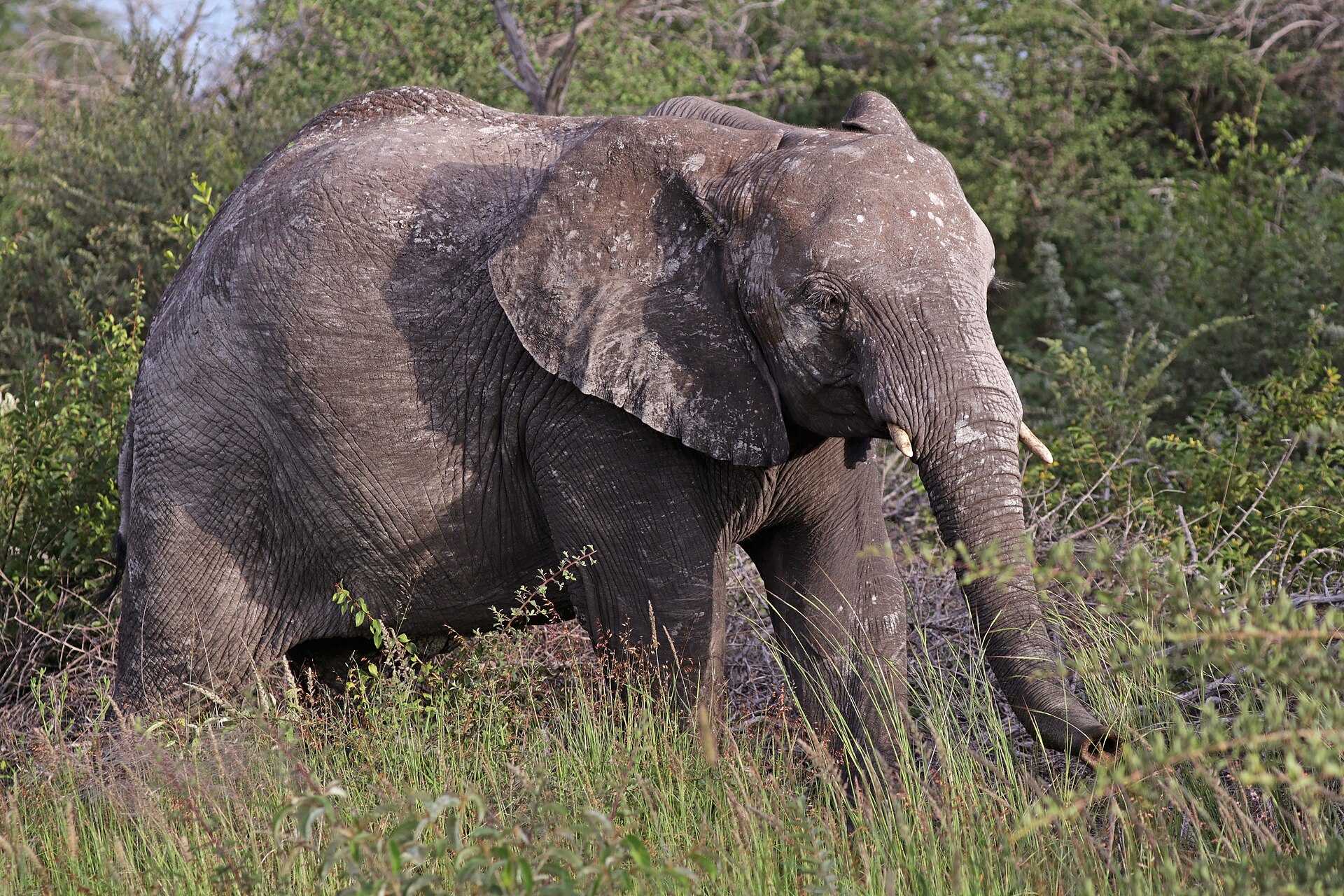
The African bush elephant (Loxodonta africana), also called the African savanna elephant, is the largest living land animal. It is one of two living African elephant species; the other is the smaller African forest elephant (Loxodonta cyclotis). Bush elephants occupy a much wider variety of open and wooded habitats than their name suggests, from grassland and woodland to wetlands and semi-desert.
These elephants are not simply large herbivores. By opening paths, dispersing seeds, digging for water and changing woody vegetation, they alter habitat used by many other species. Their ecological influence is one reason they are often described as ecosystem engineers.
How to identify an African bush elephant
African bush elephants have very large, fan-shaped ears, a long muscular trunk and a high, often gently concave back. The trunk ends in two opposing finger-like projections that help the elephant grasp grass, branches and other objects. Both males and females usually grow tusks, although tusk size varies greatly and some individuals are tuskless.
Adult males are considerably larger than adult females. Published measurements vary among populations and methods, so a single “average” can be misleading. Mature males may stand roughly 3.2–4 metres (10.5–13 feet) at the shoulder and weigh about 4,700–6,000 kilograms (10,400–13,300 pounds), while females are generally smaller. Exceptional individuals can fall outside these ranges.
The wrinkled grey skin carries sparse hair. Mud and dust often change an elephant’s apparent colour and also help protect its skin from sun and biting insects. Its broad ears contain a dense network of blood vessels; moving the ears can assist heat loss, although the ears also serve in display and communication.
Range and habitat
The species survives in fragmented populations across sub-Saharan Africa. Its present range includes parts of West, Central, East and Southern Africa, with the largest numbers concentrated in Southern and East Africa. Savannas are well known elephant habitat, but bush elephants also use woodlands, scrub, floodplains, wetlands and arid landscapes where sufficient food and water remain accessible.
Elephant movements change with rainfall, water availability, vegetation and human land use. Some populations migrate seasonally across large landscapes and national borders. Fences, farms, roads and expanding settlements can sever these traditional routes, increasing conflict and isolating herds.
Diet and daily life
African bush elephants are herbivores that both graze and browse. Their diet may include grasses, leaves, shoots, bark, roots, fruits and seeds, with the balance shifting by season and habitat. The trunk gathers food and delivers it to the mouth; tusks can strip bark or dig, and the large ridged molars grind fibrous vegetation.
An elephant passes through six sets of chewing teeth during its life. New molars emerge at the back of the jaw and move forward as older teeth wear down. Because their food is abrasive, tooth wear can eventually limit an old elephant’s ability to feed.
Elephants may spend much of each day feeding and walking between resources. They drink regularly when water is available, bathe, wallow in mud and throw dust over their bodies. The exact amount eaten or drunk changes with body size, season, forage quality and temperature, so fixed daily figures should be treated as rough examples rather than universal rules.
Social structure and communication
Related adult females and their young form the core family unit, often led by an experienced matriarch. Families can associate temporarily with other families, creating larger groups when food and water allow. Young males gradually leave their natal family; adult bulls may travel alone or join loose male associations.
African elephants communicate with touch, scent, posture, ear and trunk movements, trumpets and low-frequency rumbles. Some calls travel over long distances, helping separated animals coordinate. Their feet and trunks can also detect vibrations travelling through the ground.
Long lives and strong social bonds allow knowledge to pass between generations. Older females can help a family locate water and respond to threats. Elephants investigate bones and bodies of dead elephants, but descriptions of human-like emotions should be made carefully: the observable behaviour is well documented, while an animal’s private emotional experience cannot be measured directly.
Reproduction and development
Breeding can occur throughout the year when conditions permit. Adult bulls periodically enter musth, a physiological state associated with elevated reproductive activity and characteristic secretions and behaviour. Females advertise reproductive condition through chemical and acoustic signals.
Pregnancy lasts about 22 months, the longest known gestation among living mammals. A female normally gives birth to one calf; twins are uncommon. Newborns depend on milk and close protection, while mothers, sisters and other female relatives help guard and guide them. Calves begin sampling vegetation early but may nurse for several years. Females usually remain with their family, whereas males disperse as they mature.
Wild elephants can live for several decades, and some approach 60–70 years. Survival varies widely with drought, food, disease, injury, poaching and conflict with people.
Ecological role
As they feed and travel, bush elephants knock down or prune woody plants, create openings, move nutrients in dung and carry seeds away from parent plants. They can dig into dry riverbeds and expose water that other animals use. Trails made by elephants become routes for wildlife and sometimes people.
The effect is not identical everywhere. Elephant activity can maintain a varied savanna mosaic, but very high densities in confined landscapes can reduce large trees and transform vegetation. Conservation managers therefore consider water provision, landscape size, migration routes and the needs of local communities rather than treating elephant numbers as the only measure of ecosystem health.
Conservation status and threats
The IUCN lists the African savanna elephant as Endangered. Its 2020 assessment, published in 2021, separated the savanna elephant from the African forest elephant and concluded that the savanna species had undergone a substantial long-term reduction. A large total population does not remove extinction risk when decline, fragmentation and pressure continue across much of the range.
Ivory poaching remains a major threat. Habitat loss and fragmentation, drought, and conflict over crops and water also affect elephants and people. Retaliatory killing can follow crop damage or dangerous encounters. Effective protection therefore includes anti-poaching work, connected habitat, safe movement corridors, land-use planning and locally appropriate measures that reduce conflict.
CITES regulates international trade in African elephants under a split listing. Most populations are in Appendix I; the populations of Botswana, Namibia, South Africa and Zimbabwe are in Appendix II under specific conditions. This legal detail is more accurate than describing every population as subject to one identical trade rule.
African bush elephant vs. African forest elephant
The two African elephants are distinct species. Bush elephants are generally larger, with broad ears and tusks that tend to curve outward. Forest elephants are smaller, have rounder ears and straighter, downward-pointing tusks, and are adapted to dense forests of West and Central Africa. Their ranges can approach or overlap in some areas, so habitat alone is not a perfect identification method.
Living safely near elephants
African bush elephants are powerful wild animals and can be fatal when threatened, surprised or defending calves. Visitors should remain in vehicles where required, keep a generous distance, avoid blocking an elephant’s route and follow local guides and wildlife authorities. Feeding or approaching elephants habituates them to people and can make future encounters more dangerous.
Long-term coexistence depends on protecting space for elephants while reducing costs to people who live beside them. Well-designed corridors, early-warning systems, crop-protection methods and benefits from wildlife tourism can all contribute, but solutions must be adapted to each landscape and community.