
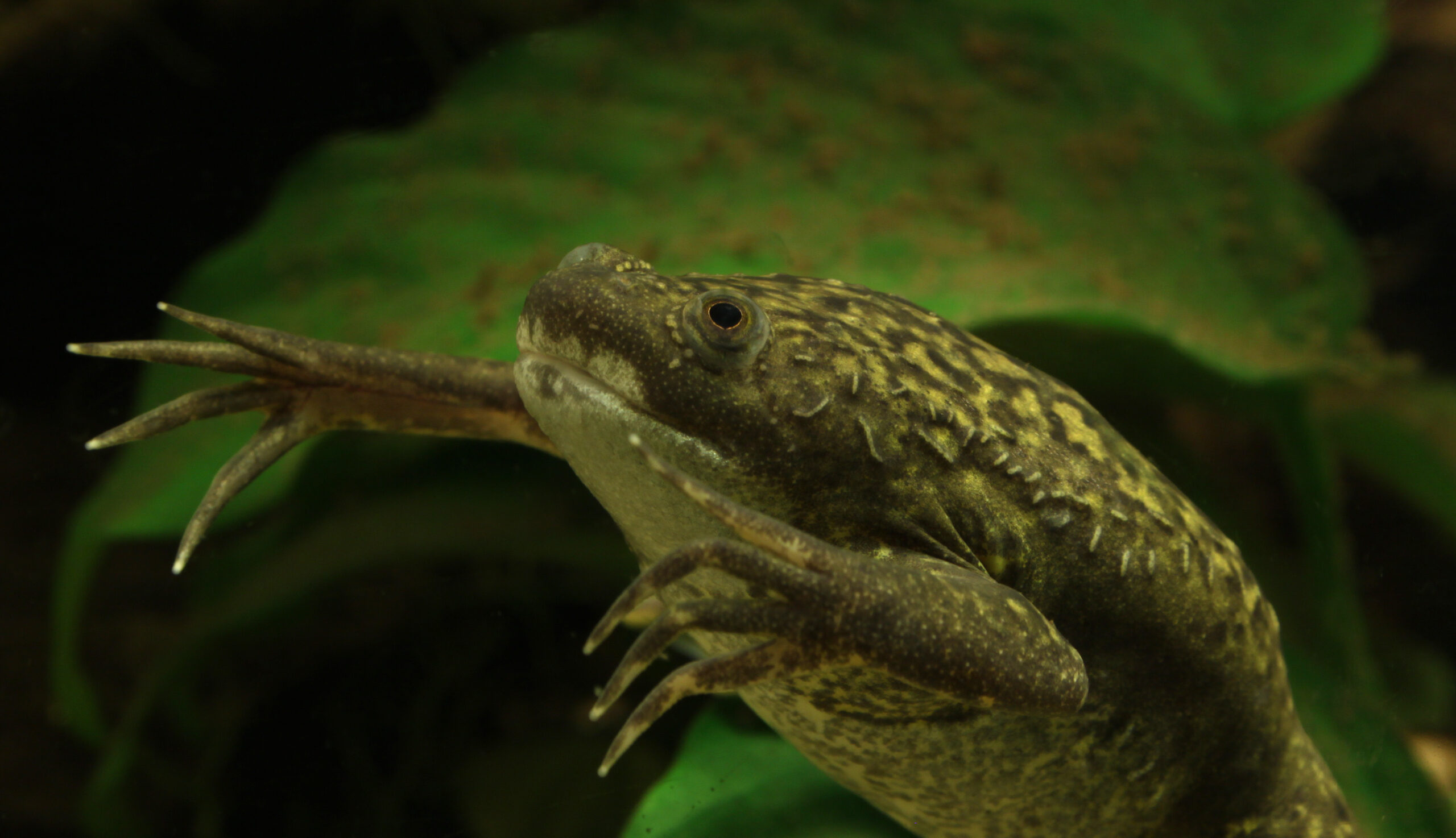
African Clawed Frog (Xenopus laevis) is a widespread southern African pipid that now also occurs in introduced populations on several continents. This guide separates well-supported biology from common assumptions and covers identification, range, habitat, diet, behavior, reproduction and conservation.
Identification
A broad, flattened frog with small upward-facing eyes, no visible eardrum, smooth mottled olive-to-brown skin, a pale belly, unwebbed slender fingers and fully webbed hind feet. The inner three toes of each hind foot end in short dark claws, and stitch-like lateral-line organs are visible along the body. Adult females are substantially larger and have a conspicuous cloacal extension; males are smaller and develop dark nuptial pads on the forearms and fingers during breeding.
Identification should combine body shape, markings, size, voice or movement, and location. One feature by itself can overlap with a related animal, a juvenile, or an individual in unusual light.
Photographs are most useful when they preserve scale and show several diagnostic features. Handling or repositioning a wild african clawed frog for identification can cause stress and is unnecessary.
Size and physical adaptations
African Clawed Frog typically measures about 5–14 cm snout-to-vent length and weighs adult females commonly about 20–150 g; males are usually lighter. Adult size varies strongly with sex, age, population and condition; females usually reach the upper end of the range.
Its useful adaptations include powerful fully webbed hind feet drive swimming in every direction, three clawed hind toes tear larger food items, a lateral-line system detects water movement, upward-facing eyes and nostrils allow surface breathing with little exposure, sensitive fingers and suction feeding compensate for the absence of a tongue. These traits work together in the animal’s normal setting rather than serving as isolated curiosities.
Published measurements may use different methods, life stages or sample locations. Comparing figures responsibly means checking what was measured rather than selecting the largest number available.
Range and distribution
Its native range spans much of southern Africa and parts of central Africa. Released laboratory and aquarium animals established populations in western North America, Chile, Mexico, western Europe, Japan and China. The native range includes Angola, Botswana, Democratic Republic of the Congo, Eswatini, Lesotho, Malawi, Mozambique, Namibia, South Africa, Zambia, Zimbabwe.
A country-level map indicates broad distribution, not continuous occupation. Climate, elevation, water, vegetation, prey, breeding sites, barriers and survey effort all affect where records occur.
Records near the edge of the range deserve careful documentation because they may reflect natural movement, improved survey coverage, accidental transport or a genuine distribution change.
Habitat
It occupies permanent and seasonal ponds, reservoirs, streams, irrigation channels and other fresh waters, including disturbed or nutrient-rich sites.
Adults spend almost their whole lives underwater, surface to breathe, hide in bottom mud or vegetation and may burrow into damp sediment or move overland when water disappears. Protecting a population therefore requires the feeding, shelter and breeding features that make a site usable, along with connections that allow movement.
Microhabitat matters. Shade, soil, current, moisture, shelter or host plants can determine whether a small area is usable even when the surrounding landscape appears suitable.
Diet and feeding
African Clawed Frog is a opportunistic aquatic carnivore and scavenger. Important foods include aquatic insects, worms, crustaceans, small fish, amphibian eggs and larvae, carrion. Because it has no tongue, it uses rapid suction and its forefeet to push food into the mouth; the hind claws can tear larger items. Tadpoles filter plankton and suspended particles rather than hunting like adults.
Diet changes with age, season, location and food supply. A dramatic prey record does not establish what most individuals eat most of the time; repeated field observations provide a stronger picture.
Feeding opportunities also create risk. An animal focused on prey may be less alert to predators, traffic or people, while contaminated prey can transfer pollutants through the food web.
Behavior and communication
Aquatic by day and night, with activity shaped by temperature, rainfall, food and disturbance. Usually solitary, it rests on the bottom, swims powerfully, surfaces for air and follows vibrations or odor toward food. Drought can trigger burrowing or nocturnal overland dispersal to another water body.
Males produce underwater advertisement calls, while females can answer with receptive or rejection calls; touch, water movement and chemical cues also guide feeding and courtship. Behavior should be interpreted in context: alarm, courtship, feeding and temperature regulation can produce very different actions from the same animal.
Daily schedules are flexible responses, not rigid rules. Weather, breeding condition, disturbance, tides or food can move activity into a different part of the day.
Reproduction and development
Rainfall, rising water and nutrient pulses can stimulate underwater amplexus. A male clasps the female around the waist while she releases eggs that are fertilized externally. Hundreds to several thousand small eggs may be released in a breeding event. Transparent embryos become free-swimming, filter-feeding tadpoles; metamorphosis produces a fully aquatic froglet as the tail is absorbed.
Young animals face different risks and may use different microhabitats or food than adults. Breeding success depends on adult condition, suitable sites and the survival of offspring through vulnerable early stages.
Counts of eggs or young describe reproductive output, not the number expected to reach adulthood. Mortality is normally greatest during eggs, larval or juvenile stages.
Predators and ecological role
A flexible predator, scavenger and tadpole filter feeder. In its native range it belongs to pond food webs; where introduced it can consume native animals, compete with amphibians and carry pathogens. Documented or likely predators include Water Birds, Large Fish, Aquatic Snakes, Humans.
This animal is both a consumer and a food source. Its influence comes through many repeated interactions, so ecological claims should be based on measured populations rather than assumptions drawn from appearance.
Predator and prey relationships differ among places. A species can be ecologically influential without being abundant everywhere, and its role can change across its range.
Relationship with people
The species transformed pregnancy testing and remains a major model in developmental, cell and molecular biology. Releases from laboratories and aquaria helped create invasive populations, so unwanted animals must never be released.
Handle only when necessary and with wet, clean, powder-free gloves under professional guidance. Wash hands after aquarium work, prevent contact with kitchen equipment, and follow local rules because possession is restricted in some jurisdictions. Responsible observation means keeping an appropriate distance, avoiding capture or feeding, protecting habitat and following local wildlife or invasive-species guidance.
Wildlife guidance should come from the responsible local agency because collection rules, reporting requests and appropriate responses differ between native and introduced ranges.
Conservation
The IUCN Red List assesses Xenopus laevis as Least Concern because it has a very wide native distribution, tolerates many habitats and is not undergoing a global decline severe enough for a threatened category. The reported global trend is Increasing globally, including through introduced populations.
Important pressures include wetland alteration in parts of the native range, pollution and pesticide exposure, disease and pathogen exchange, control programs in invaded regions. Global status can hide local decline or recovery, so current regional monitoring and habitat management remain necessary.
The most useful conservation action follows the documented pressure. Protecting breeding sites, reducing road deaths or limiting pollutants can require different tools in different populations.
