
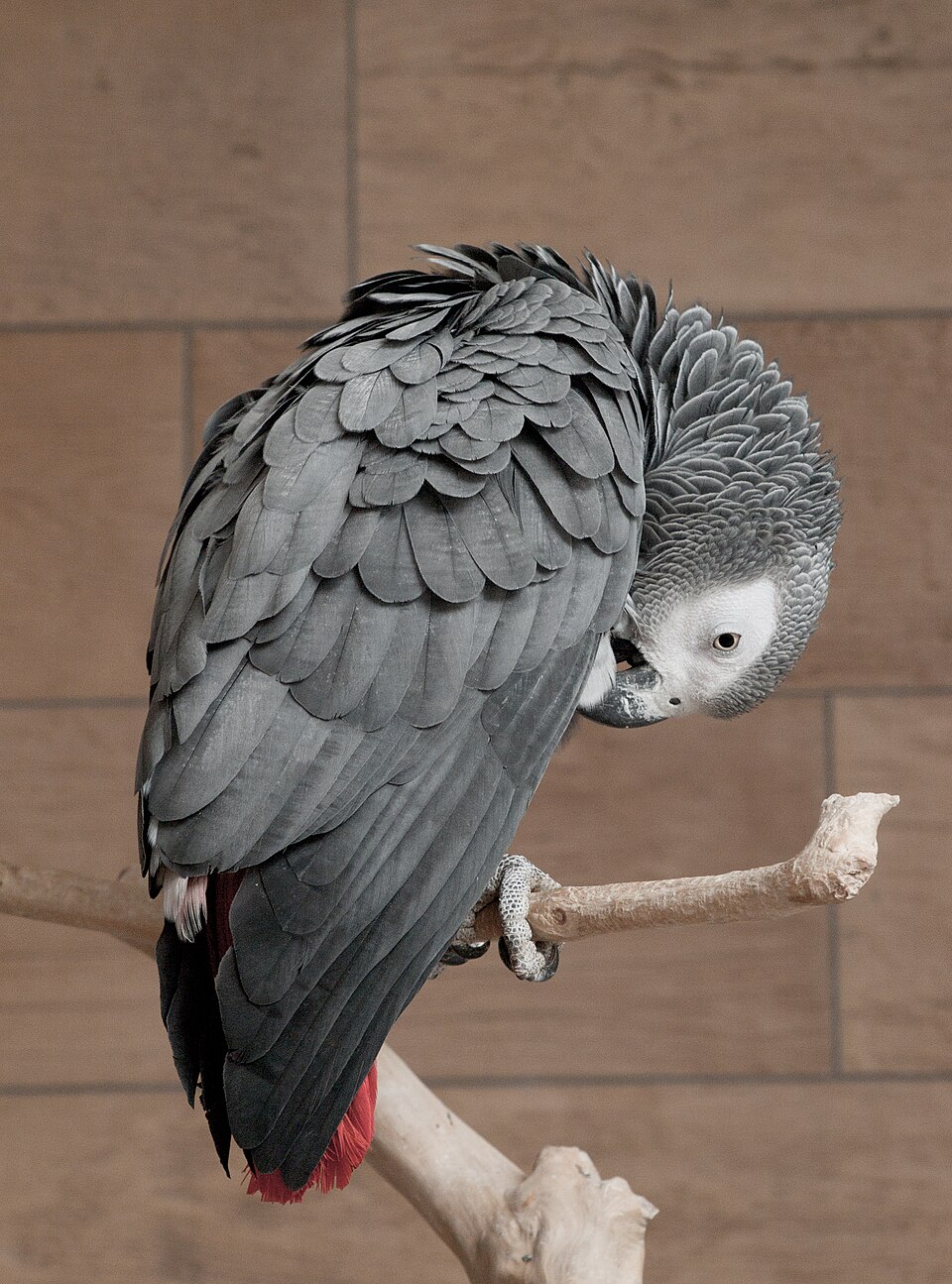
The African grey parrot (Psittacus erithacus), also called the grey parrot or Congo grey, is a medium-sized forest parrot native to equatorial Africa. Its restrained grey plumage, bright red tail and remarkable capacity for vocal learning make it familiar in aviculture, but the wild bird is an endangered species whose survival depends on intact forest, mature nesting trees and protection from capture.
This profile covers Psittacus erithacus as a species. The darker Timneh parrot, once treated as a subspecies, is now generally recognized as the separate species Psittacus timneh. Information about one should not automatically be applied to the other.
Identification and appearance
African grey parrots have a compact body, broad rounded wings, a short scarlet tail and a strong black hooked bill. Pale edges on the grey body feathers create a finely scalloped effect. Bare whitish skin surrounds the eyes; adults usually develop a pale yellow iris, while young birds have darker eyes. Their feet are zygodactyl, with two toes directed forward and two backward, which helps them grip branches and manipulate food.
Adults are commonly about 33 centimetres long and weigh roughly 400–500 grams, although sex, age, locality and condition produce variation. Males and females overlap strongly in colour and size, so visual sexing is unreliable. DNA testing or veterinary methods are used when an individual’s sex must be established.
Taxonomy and related parrots
The species belongs to order Psittaciformes, family Psittacidae and genus Psittacus. Linnaeus described it in 1758. Modern treatments separate the Timneh parrot as Psittacus timneh, distinguished by its darker body, maroon tail and partly horn-coloured upper bill. Both species are African forest parrots, but they have different geographic distributions and conservation histories.
Other African parrots in the same family include Senegal, Meyer’s and red-bellied parrots in genus Poicephalus. Similar intelligence or feeding behaviour does not make those birds African greys; identification should use plumage, bill, voice, size and geographic origin together.
Range and habitat
The native range extends from southeastern Côte d’Ivoire through the moist forests of West and Central Africa, across the Congo Basin and east toward the Albertine Rift, with populations on Bioko and São Tomé and Príncipe. The IUCN assessment records extant resident populations in Angola, Burundi, Cameroon, the Central African Republic, both Congo states, Côte d’Ivoire, Equatorial Guinea, Gabon, Ghana, Kenya, Nigeria, Rwanda, São Tomé and Príncipe, Tanzania and Uganda. Presence within a country is patchy and does not mean every forest is occupied.
African greys use moist lowland forest, swamp forest, mangroves, gallery forest, wooded savanna, forest edge and some cultivated landscapes where large trees remain. They roost communally, often in tall trees near water, and travel to feeding areas during the day. Mature trees are especially important because breeding pairs rely on existing cavities rather than excavating their own nest holes.
Diet and ecological role
Wild African greys eat fruits, seeds, nuts, flowers, buds and other plant material. Oil-palm fruit is frequently reported, but diet varies across seasons and regions. Birds use the bill to open tough fruits and the feet to hold food while biting. Occasional invertebrates may be taken, so a simple label such as “seed eater” understates their feeding ecology.
By moving among fruiting trees, parrots transport seeds and plant material through the forest. They also consume some seeds directly and provide prey for raptors and other predators. The balance between seed dispersal and seed predation depends on the plant and feeding context, so the species’ ecological role cannot be reduced to one universal effect.
Social behavior and communication
African greys are highly social. Large groups may gather at traditional roosts, while smaller parties travel and feed during daylight. Contact calls help individuals maintain flock cohesion in dense vegetation, and louder alarm calls warn of danger. Pairs use close-range calls, mutual preening and food sharing to maintain their bond.
Their ability to copy sounds is part of a broader capacity for vocal learning. Captive birds can reproduce household noises and human speech, but repetition alone does not prove that a bird understands every copied word. Careful experiments with the parrot Alex demonstrated discrimination of colours, shapes, materials, quantities and relational concepts under controlled conditions. Those results show substantial cognitive flexibility without making African greys equivalent to human children in every domain.
Breeding and development
Pairs nest in natural tree cavities. Breeding timing varies geographically and is often associated with local dry seasons. A clutch commonly contains three to five white eggs. The female performs most incubation for about a month while the male supplies food, and both parents feed and protect the young after hatching.
Chicks are altricial and remain in the cavity while feathers develop. Fledging is commonly reported at around twelve weeks, but young birds continue learning from parents and flock members. Sexual maturity is reached only after several years. Slow maturation, dependence on scarce nest cavities and the removal of adults for trade all limit how quickly depleted populations can recover.
Conservation status and trade
The IUCN Red List classifies the grey parrot as Endangered and describes a decreasing population. Major pressures include capture for the live-bird trade and the loss or degradation of forest, especially large cavity-bearing trees. Local disappearance can occur long before a species vanishes across its entire mapped range.
CITES transferred the species to Appendix I, sharply restricting international commercial trade in wild-sourced birds. Legal captive breeding does not erase the need for documentation: buyers should verify origin, permanent identification and all national and international paperwork. Laundering wild birds through false captive-bred claims remains a conservation and welfare concern.
Relationships with people
African greys have contributed greatly to research on vocal learning and animal cognition. They also hold economic and cultural significance in range states and in the international companion-bird community. Responsible appreciation must account for the species’ wild conservation status and the welfare demands of a bird that can live for decades.
Captive African greys need substantial flight space, social contact, foraging opportunities, safe objects to destroy, predictable sleep and specialist avian veterinary care. A seed-only diet is nutritionally inadequate. Smoke, aerosols and fumes from overheated non-stick coatings can be dangerous to birds. Stress, isolation and medical problems can contribute to feather-damaging behaviour, which requires veterinary and behavioural assessment rather than punishment.
Safety and responsible observation
A frightened parrot can inflict a painful bite with its powerful bill. Handling should be voluntary and reward-based, and children need close supervision. Birds can also carry pathogens transmissible to people, including the bacterium associated with psittacosis, so hygiene and veterinary screening matter. Anyone bitten deeply or exposed to a sick bird should seek appropriate medical advice.
In the wild, observers should remain far enough away that birds continue feeding, roosting or nesting normally. Nest locations should not be publicized when disclosure could aid trapping. Never purchase a bird offered without credible legal-origin records, and never release a captive parrot into the wild.