
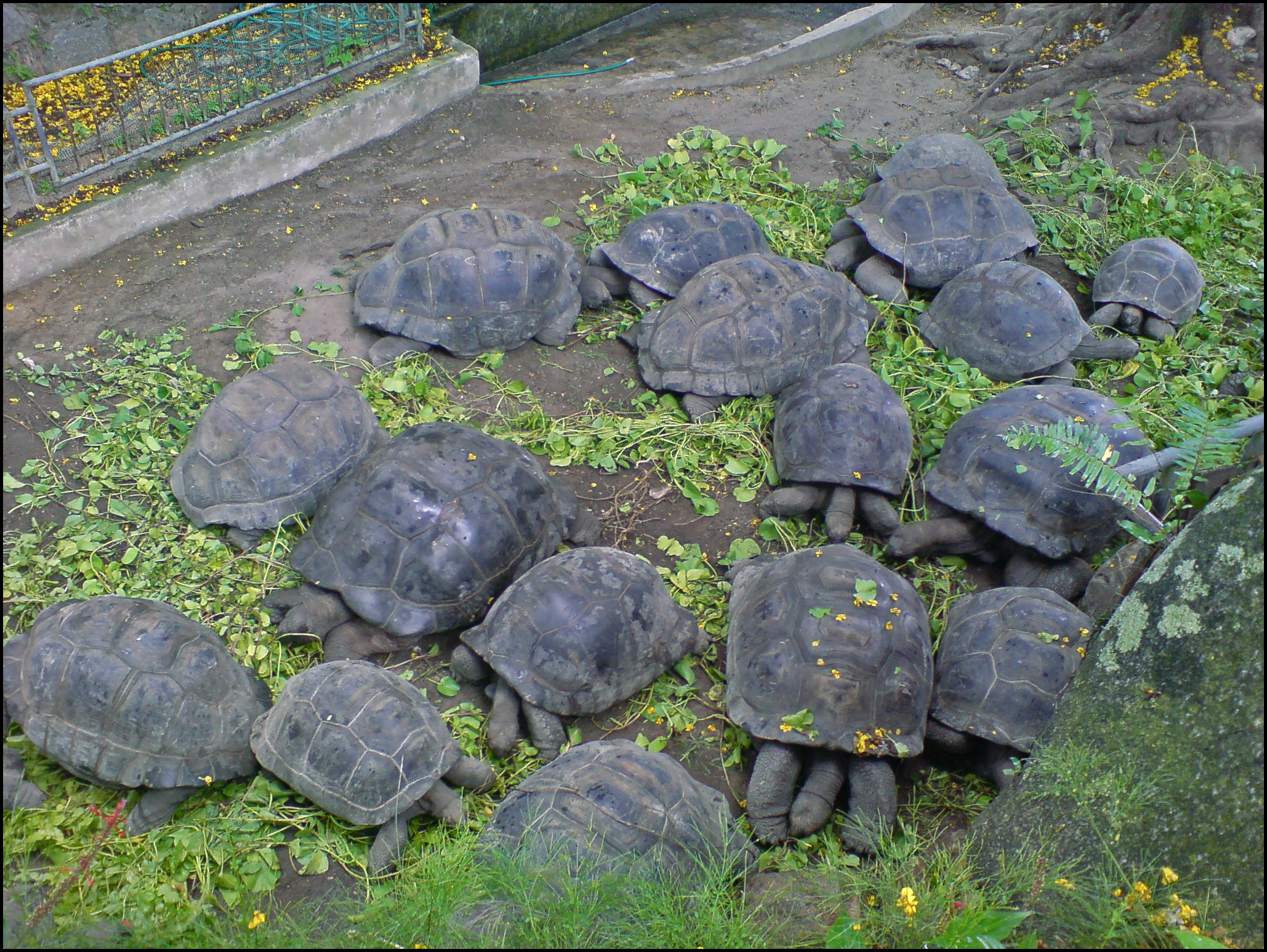
Aldabra Giant Tortoise (Aldabrachelys gigantea) is one of the world’s largest land tortoises and the dominant large herbivore of Aldabra Atoll in Seychelles. Its wild stronghold supports far more giant tortoises than any other place on Earth. Adults graze, browse, disperse seeds and physically reshape vegetation, filling an ecological role often compared with that of elephants. Individuals can survive dry periods by conserving water and energy, but eggs and young remain vulnerable to heat, flooding and introduced predators. This guide separates well-supported biology from common assumptions and covers identification, range, habitat, diet, behavior, reproduction and conservation.
Identification
Adults have a massive dark gray to black domed carapace, a relatively small pointed head, long neck and thick column-like legs covered in heavy scales. The front of the carapace usually bears a small nuchal plate above the neck. Shell shape varies with habitat and feeding height: some animals have a high opening that allows the neck to reach browse, while others are more strongly domed. The shell is living bone covered by keratin and can feel touch. Adult males are substantially larger than females, with longer thicker tails and a concave plastron that assists mating. Juveniles are difficult to sex visually, and body size alone is unreliable before maturity.
Identification should combine body shape, markings, size, voice or movement, and location. One feature by itself can overlap with a related animal, a juvenile, or an individual in unusual light.
Photographs are most useful when they preserve scale and show several diagnostic features. Handling or repositioning a wild aldabra giant tortoise for identification can cause stress and is unnecessary.
Size and physical adaptations
Aldabra Giant Tortoise typically measures males may reach about 1.22 m carapace length; females about 0.91 m and weighs large males may reach about 250 kg; females may reach about 159 kg. Exceptional animals can exceed these figures, but typical size varies with sex, age, island, rainfall and food supply.
Its useful adaptations include huge body stores water and energy, long neck reaches shrubs and low branches, columnar legs support great mass, domed shell protects the body, broad beak crops grasses and browse, slow metabolism supports survival through dry periods, nostril position helps drink from shallow pools. These traits work together in the animal’s normal setting rather than serving as isolated curiosities.
Published measurements may use different methods, life stages or sample locations. Comparing figures responsibly means checking what was measured rather than selecting the largest number available.
Range and distribution
The only natural surviving population is centered on Aldabra Atoll in the outer Seychelles. Managed or introduced populations occur on several granitic Seychelles islands and on restoration islands in Mauritius, but those sites must not be mapped as part of the original native range. The native range includes Seychelles.
A country-level map indicates broad distribution, not continuous occupation. Climate, elevation, water, vegetation, prey, breeding sites, barriers and survey effort all affect where records occur.
Records near the edge of the range deserve careful documentation because they may reflect natural movement, improved survey coverage, accidental transport or a genuine distribution change.
Habitat
Tortoise turf grassland, open and dense scrub, coastal dunes, mangrove margins, limestone surfaces and shaded pools across the dry coral islands of Aldabra Atoll.
Tortoises move between feeding grounds, shade and seasonal water. Grasslands are strongly preferred where available, but scrub becomes important for browse and shelter. During heat they rest beneath shrubs, in caves, pools or mud wallows. Home ranges vary greatly among islands and individuals, reflecting local vegetation, freshwater and crowding. Protecting a population therefore requires the feeding, shelter and breeding features that make a site usable, along with connections that allow movement.
Microhabitat matters. Shade, soil, current, moisture, shelter or host plants can determine whether a small area is usable even when the surrounding landscape appears suitable.
Diet and feeding
Aldabra Giant Tortoise is a primarily herbivorous grazer and browser. Important foods include grasses, herbs, leaves, woody browse, fruit, flowers, cactus on managed islands, occasional carrion. Most feeding involves grasses, low herbs and woody plants. The long neck reaches foliage, and heavy adults sometimes push over shrubs to obtain leaves. Seeds survive passage through the gut and may germinate after dispersal. Rare scavenging or feces consumption is opportunistic and does not make the species primarily omnivorous.
Diet changes with age, season, location and food supply. A dramatic prey record does not establish what most individuals eat most of the time; repeated field observations provide a stronger picture.
Feeding opportunities also create risk. An animal focused on prey may be less alert to predators, traffic or people, while contaminated prey can transfer pollutants through the food web.
Behavior and communication
Diurnal, with most feeding and travel during cooler morning and late-afternoon periods. Individuals often aggregate at productive grassland, shade or water, although they do not form tightly coordinated social groups. They follow regular paths, browse standing plants, wallow in mud and rest for long periods during heat. Males may push, ram or overturn rivals during breeding competition. Despite slow movement, a tortoise can cover meaningful distances between resources.
Tortoises use smell and close visual cues to locate food and other animals. Courtship includes following, nudging and shell contact. Adult males produce deep vocal sounds during mating, while shell ramming and posture convey competition. Ground vibration and touch are likely more relevant at close range than long-distance calls. Behavior should be interpreted in context: alarm, courtship, feeding and temperature regulation can produce very different actions from the same animal.
Daily schedules are flexible responses, not rigid rules. Weather, breeding condition, disturbance, tides or food can move activity into a different part of the day.
Reproduction and development
Breeding activity peaks from February into May. A male follows and nudges a female before mounting. After internal fertilization, the female digs a flask-shaped nest in soil and covers the eggs. Nesting frequency and clutch size respond to density and environmental conditions. Usually about 9–25 hard-shelled eggs, with fewer eggs common in crowded populations Hatchlings dig to the surface and live without parental care. Their small size exposes them to crabs, birds, rats, heat and dehydration. Growth continues for decades, and the sex of embryos is influenced by incubation temperature as in many tortoises.
Young animals face different risks and may use different microhabitats or food than adults. Breeding success depends on adult condition, suitable sites and the survival of offspring through vulnerable early stages.
Counts of eggs or young describe reproductive output, not the number expected to reach adulthood. Mortality is normally greatest during eggs, larval or juvenile stages.
Predators and ecological role
Aldabra Giant Tortoises are ecosystem engineers. Their grazing creates short tortoise turf, browsing changes scrub structure, trails open vegetation and dung transports nutrients and seeds. They occupy a role similar to a large mammalian herbivore, affecting habitat used by insects, land birds and other reptiles. Restoring tortoises to suitable islands can therefore restore lost ecological processes when carefully managed. Documented or likely predators include Coconut Crab, Black Rat, Aldabra Rail, Humans, Domestic Dog.
This animal is both a consumer and a food source. Its influence comes through many repeated interactions, so ecological claims should be based on measured populations rather than assumptions drawn from appearance.
Predator and prey relationships differ among places. A species can be ecologically influential without being abundant everywhere, and its role can change across its range.
Relationship with people
Sailors once killed Indian Ocean giant tortoises for meat and carried live animals aboard ships, eliminating nearly every regional species. Protection of Aldabra stopped that collapse, and the atoll is now a UNESCO World Heritage Site managed by the Seychelles Islands Foundation. Visitors must follow strict biosecurity and wildlife rules. Captive trade is regulated under CITES Appendix II, and legal origin, permits and lifetime welfare capacity must be documented.
Aldabra Giant Tortoises are not venomous, but their mass and powerful beak can injure. Never place fingers near the mouth, sit or stand on the shell, allow children to climb on one, or stand where a moving animal can pin a foot. Wash hands after contact and follow keeper barriers. Responsible observation means keeping an appropriate distance, avoiding capture or feeding, protecting habitat and following local wildlife or invasive-species guidance.
Wildlife guidance should come from the responsible local agency because collection rules, reporting requests and appropriate responses differ between native and introduced ranges.
Conservation
The IUCN Red List assessment classifies the Aldabra Giant Tortoise as Vulnerable because its native wild population is concentrated on a single low-lying atoll. Protection has allowed a large recovery, but geographic concentration leaves the species exposed to climate change, extreme weather, disease and invasive species. The reported global trend is Stable to recovered at Aldabra under protection, while long-term climate risk remains.
Important pressures include sea-level rise, extreme heat and drought, storm surge and flooding, introduced predators, disease introduction, illegal trade, habitat change on managed islands, low hatchling survival. Global status can hide local decline or recovery, so current regional monitoring and habitat management remain necessary.
The most useful conservation action follows the documented pressure. Protecting breeding sites, reducing road deaths or limiting pollutants can require different tools in different populations.