
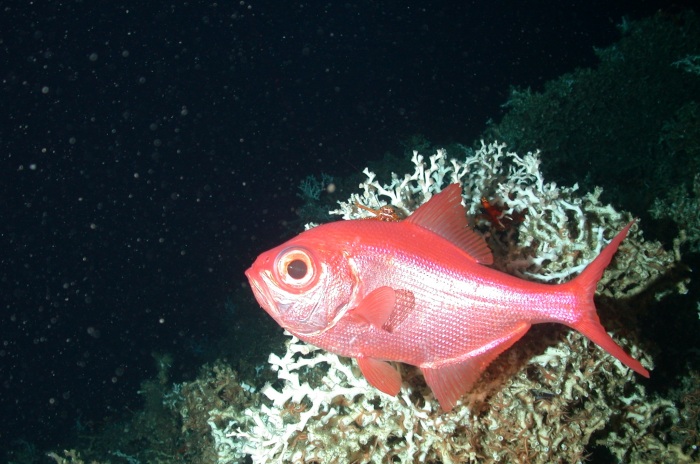
Alfonsino (Beryx decadactylus) is a deep-bodied marine fish found in temperate and tropical oceans around the world. It lives far below ordinary daylight, often near rocky continental slopes, underwater ridges and seamounts. Bright red fins and scales, a silvery underside and exceptionally large eyes distinguish it from many other deepwater fishes. Alfonsinos rise from the bottom to feed and form schools that can be targeted by deepwater fisheries. This guide separates well-supported biology from common assumptions and covers identification, range, habitat, diet, behavior, reproduction and conservation.
Identification
The body is very deep, oval and strongly compressed from side to side. Its head is large, the mouth opens obliquely and the lower jaw projects slightly. The eye is strikingly large, an adaptation for dim water. The back, iris and fins are brilliant red to orange-red; the flanks are scarlet over silver and the belly is paler. A long dorsal fin and a longer-based anal fin lead toward a deeply forked tail. Males and females are not readily distinguished by external color or body shape; mature females may grow larger in some samples.
Identification should combine body shape, markings, size, voice or movement, and location. One feature by itself can overlap with a related animal, a juvenile, or an individual in unusual light.
Photographs are most useful when they preserve scale and show several diagnostic features. Handling or repositioning a wild alfonsino for identification can cause stress and is unnecessary.
Size and physical adaptations
Alfonsino typically measures Commonly about 35–50 cm; maximum reported near 100 cm and weighs Large adults can exceed 10 kg. Maximum sizes are exceptional; fish landed by regional fisheries are usually much smaller.
Its useful adaptations include very large eyes gather scarce deepwater light, red coloration appears dark at depth, compressed body maneuvers near steep terrain, swim bladder controls buoyancy, large mouth captures mobile prey, schooling improves feeding and predator detection. These traits work together in the animal’s normal setting rather than serving as isolated curiosities.
Published measurements may use different methods, life stages or sample locations. Comparing figures responsibly means checking what was measured rather than selecting the largest number available.
Range and distribution
Alfonsinos occur circumglobally in the Atlantic, Indian and Pacific oceans, including waters around oceanic islands. Records cluster along continental and island slopes, submarine banks, ridges and seamounts rather than across featureless abyssal plains. They are reported from both hemispheres, with major study areas around the North Atlantic islands, Mediterranean margins, southern Africa, Japan, Australia and New Zealand. The native range includes Argentina, Australia, Brazil, Canada, France, India, Ireland, Japan, Mexico, Morocco, New Zealand, Portugal, South Africa, Spain, United Kingdom, United States.
A country-level map indicates broad distribution, not continuous occupation. Climate, elevation, water, vegetation, prey, breeding sites, barriers and survey effort all affect where records occur.
Records near the edge of the range deserve careful documentation because they may reflect natural movement, improved survey coverage, accidental transport or a genuine distribution change.
Habitat
Deep continental and island slopes, banks and seamounts, usually over or near hard bottom.
Adults are most often recorded from roughly 200 to 1,000 meters, though local catches can extend outside that band. During daylight they may stay close to steep bottom features and move upward in the water column at night as prey migrates. Juveniles can occupy shallower water than adults. Seamount currents concentrate zooplankton and small fishes, making these isolated elevations valuable feeding habitat but also predictable fishing grounds. Protecting a population therefore requires the feeding, shelter and breeding features that make a site usable, along with connections that allow movement.
Microhabitat matters. Shade, soil, current, moisture, shelter or host plants can determine whether a small area is usable even when the surrounding landscape appears suitable.
Diet and feeding
Alfonsino is a deepwater carnivore. Important foods include small fishes, shrimps, prawns, euphausiid krill, amphipods, squid and other cephalopods. Alfonsinos use large light-sensitive eyes to locate silhouettes and flashes from prey in dim water. They take midwater crustaceans, squid and small fish with a quick opening of the large mouth. Feeding intensity and prey composition differ by depth, season and region. Vertical movements of krill and lanternfishes can draw schools away from the bottom after dusk and back toward shelter as daylight increases.
Diet changes with age, season, location and food supply. A dramatic prey record does not establish what most individuals eat most of the time; repeated field observations provide a stronger picture.
Feeding opportunities also create risk. An animal focused on prey may be less alert to predators, traffic or people, while contaminated prey can transfer pollutants through the food web.
Behavior and communication
Active in deep water by day and night, with vertical movements often linked to migrating prey. Individuals commonly gather in schools near prominent bottom features. Schools may separate by size as juveniles and adults use different depths. The fish maintain position in currents around ridges, then make short excursions into the water column to feed. Their aggregation around seamounts creates localized populations that can be depleted faster than a broad map of the species would suggest.
No specialized social signal has been demonstrated. Like other fishes, Alfonsinos can detect movement and vibration through the lateral-line system, chemical cues through smell and nearby animals through vision. School alignment probably depends on these combined senses rather than a single call or display. Behavior should be interpreted in context: alarm, courtship, feeding and temperature regulation can produce very different actions from the same animal.
Daily schedules are flexible responses, not rigid rules. Weather, breeding condition, disturbance, tides or food can move activity into a different part of the day.
Reproduction and development
Spawning occurs in open water, and timing differs among ocean regions. Mature females release many small buoyant eggs while males release sperm into the water. Fertilized eggs and early larvae drift with currents near the surface or in upper layers, far above the usual adult habitat. As juveniles grow, they move progressively deeper and develop the high body, red pigmentation and large eyes of adults. Many thousands of pelagic eggs; exact output rises with female size Larvae begin as transparent plankton and feed on small zooplankton. Fin rays and body depth become more distinctive during growth. Juveniles recruit to slope and bank habitats, then mature slowly compared with many shallow-water fishes. Growth rings in hard structures are used to estimate age, but validation can be difficult in long-lived deepwater species.
Young animals face different risks and may use different microhabitats or food than adults. Breeding success depends on adult condition, suitable sites and the survival of offspring through vulnerable early stages.
Counts of eggs or young describe reproductive output, not the number expected to reach adulthood. Mortality is normally greatest during eggs, larval or juvenile stages.
Predators and ecological role
Alfonsinos transfer energy from migrating crustaceans and small fishes to larger deepwater predators. By feeding both near the bottom and in midwater, they link seamount food webs with the ocean’s daily vertical migration. Sharks, large predatory fishes and marine mammals may take them. Carcasses and fishery discards also return nutrients to scavengers on the slope. Documented or likely predators include Large Deepwater Sharks, Wreckfish, Toothed Whales.
This animal is both a consumer and a food source. Its influence comes through many repeated interactions, so ecological claims should be based on measured populations rather than assumptions drawn from appearance.
Predator and prey relationships differ among places. A species can be ecologically influential without being abundant everywhere, and its role can change across its range.
Relationship with people
Alfonsino flesh is sold fresh, frozen and prepared in several coastal cuisines. Commercial vessels catch it with bottom trawls, midwater trawls, longlines and handlines, often around seamounts. Deepwater stocks require cautious management because schools are easy to locate, adults can live for decades and recruitment can vary. Catch records should separate Beryx decadactylus from Beryx splendens whenever possible so managers can follow each species accurately.
Seafood should come from a legally managed fishery and be kept cold and cooked safely. People should check current local advice on mercury and fishery sustainability because those recommendations depend on region, size and harvest method. Responsible observation means keeping an appropriate distance, avoiding capture or feeding, protecting habitat and following local wildlife or invasive-species guidance.
Wildlife guidance should come from the responsible local agency because collection rules, reporting requests and appropriate responses differ between native and introduced ranges.
Conservation
The IUCN Red List assesses the Alfonsino as Least Concern at the global species level. That category reflects its enormous geographic range, but it does not guarantee that every seamount aggregation or regional stock is healthy. Local depletion is possible where fishing repeatedly targets slow-growing schools, so catch limits, habitat protection and stock-specific monitoring remain important. The reported global trend is Unknown globally; regional stocks and fishing pressure differ.
Important pressures include targeted deepwater fishing, bycatch in slope fisheries, seamount habitat damage from bottom trawling, slow recovery of localized schools, species mixing in catch statistics, climate-driven changes in ocean productivity. Global status can hide local decline or recovery, so current regional monitoring and habitat management remain necessary.
The most useful conservation action follows the documented pressure. Protecting breeding sites, reducing road deaths or limiting pollutants can require different tools in different populations.
