
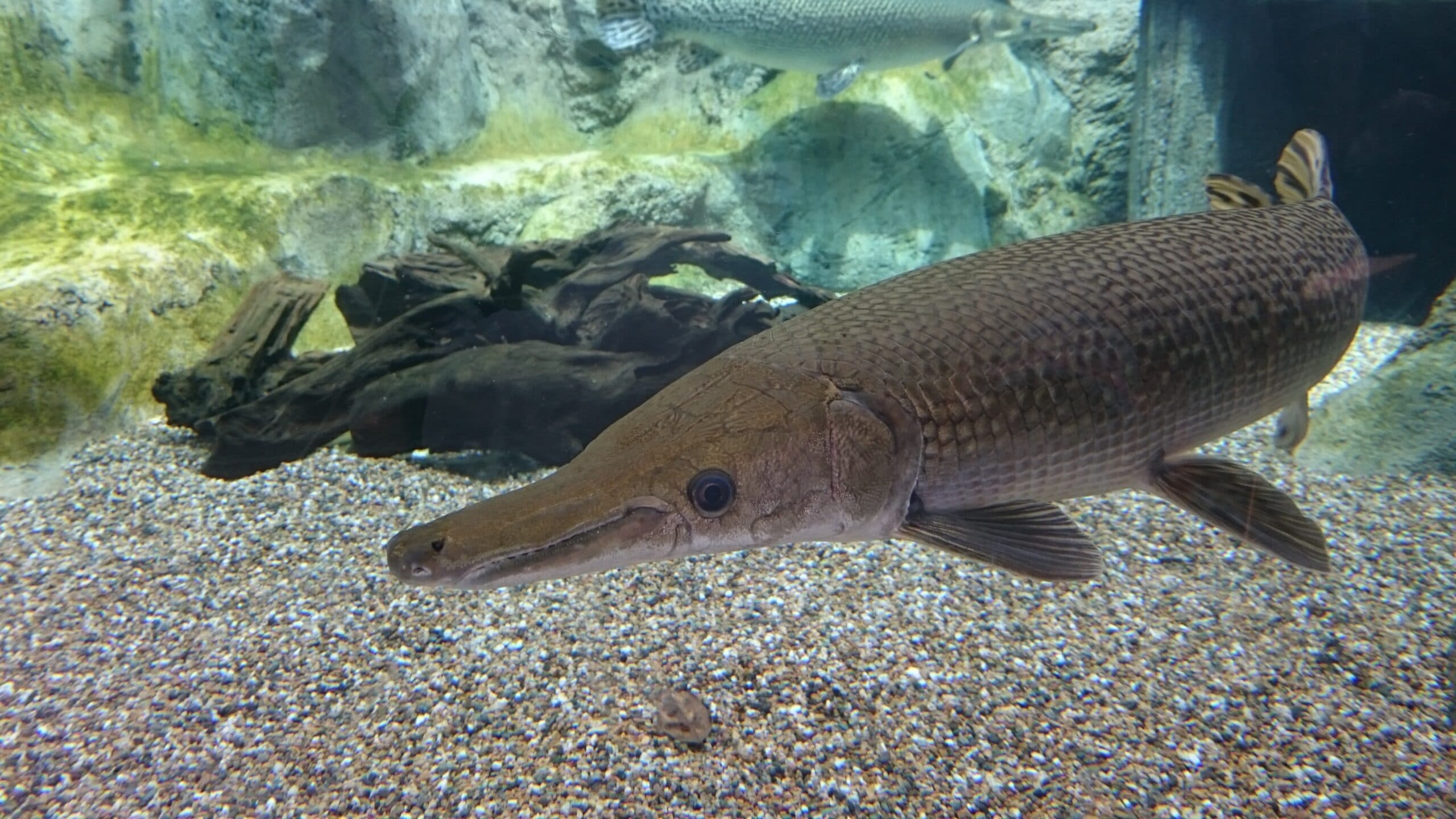
Alligator Gar (Atractosteus spatula) is one of North America’s largest freshwater fishes. It inhabits major rivers, floodplain lakes, bayous and Gulf Coast estuaries from the central United States into eastern Mexico. Although it looks formidable, it is an opportunistic fish predator rather than a threat to swimmers. Its late maturity and dependence on periodic spring floods make populations slow to replace large adults. This guide separates well-supported biology from common assumptions and covers identification, range, habitat, diet, behavior, reproduction and conservation.
Identification
The body is long and cylindrical with dorsal and anal fins set far back near the tail. A broad, relatively short snout carries two rows of large teeth in the upper jaw, distinguishing adults from narrower-snouted gar species. Hard diamond-shaped ganoid scales form a flexible armor. The back is olive or brown, sides lighter, belly pale, and fins often spotted, especially in young fish. Females grow larger and live longer than males, but the sexes have no reliable simple color difference for field identification.
Identification should combine body shape, markings, size, voice or movement, and location. One feature by itself can overlap with a related animal, a juvenile, or an individual in unusual light.
Photographs are most useful when they preserve scale and show several diagnostic features. Handling or repositioning a wild alligator gar for identification can cause stress and is unnecessary.
Size and physical adaptations
Alligator Gar typically measures commonly about 2 m; exceptional fish approach 3 m and weighs exceptional fish can exceed 135 kg; historical reports reach about 159 kg. Extreme records are rare and sometimes poorly documented. Most fish encountered are much smaller than the historical maximum.
Its useful adaptations include vascular swim bladder functions as an air-breathing organ, ganoid scales provide hard flexible armor, broad jaws seize large slippery prey, rear-set fins drive sudden ambush lunges, air gulping permits survival in warm oxygen-poor water, sensitive lateral line detects water movement, long lifespan buffers irregular spawning years. These traits work together in the animal’s normal setting rather than serving as isolated curiosities.
Published measurements may use different methods, life stages or sample locations. Comparing figures responsibly means checking what was measured rather than selecting the largest number available.
Range and distribution
Lower and middle Mississippi River drainage, Gulf Coast rivers and coastal plain waters from western Florida through Texas and south to Veracruz, Mexico. It formerly reached farther north in the Mississippi and Ohio systems and has disappeared from some historical waters. Unverified releases outside the native range should not be treated as natural distribution. The native range includes Mexico, United States.
A country-level map indicates broad distribution, not continuous occupation. Climate, elevation, water, vegetation, prey, breeding sites, barriers and survey effort all affect where records occur.
Records near the edge of the range deserve careful documentation because they may reflect natural movement, improved survey coverage, accidental transport or a genuine distribution change.
Habitat
Large slow rivers, deep pools, oxbows, bayous, reservoirs, swamps, flooded bottomlands and fresh to brackish estuaries.
Adults use main river channels, backwaters and estuarine reaches, moving with season, temperature, flow and prey. Warm quiet water suits air breathing and ambush feeding. Reproduction requires a different habitat: spring floods must spread shallow water over grassy floodplains so adhesive eggs can attach to submerged vegetation. Levees and regulated flows can preserve adult habitat while removing the nursery conditions needed for recruitment. Protecting a population therefore requires the feeding, shelter and breeding features that make a site usable, along with connections that allow movement.
Microhabitat matters. Shade, soil, current, moisture, shelter or host plants can determine whether a small area is usable even when the surrounding landscape appears suitable.
Diet and feeding
Alligator Gar is a large opportunistic piscivore and scavenger. Important foods include gizzard shad, buffalo fish, carp, freshwater drum, mullet, crustaceans, waterbirds on rare occasions, carrion. The gar drifts or holds nearly motionless, then sweeps its head sideways and grips prey with numerous teeth. Adults eat abundant fishes, including invasive species where available, and may scavenge. Texas diet studies show rough fishes dominate while popular sport fishes are minor items. A spectacular record of a bird or mammal does not represent the everyday diet.
Diet changes with age, season, location and food supply. A dramatic prey record does not establish what most individuals eat most of the time; repeated field observations provide a stronger picture.
Feeding opportunities also create risk. An animal focused on prey may be less alert to predators, traffic or people, while contaminated prey can transfer pollutants through the food web.
Behavior and communication
Active by day and night, with feeding and movement influenced by temperature, flow and prey. Alligator Gar often rest near the surface or in deep pools and rise periodically to gulp air. They may gather at rich feeding sites or spawning floods without forming permanent schools. Their slow cruising can switch to a fast short strike. Large fish migrate within river networks but do not make long ocean migrations. Handling stress is dangerous because the fish is heavy, powerful and dependent on water support.
There is little evidence for complex social communication. The lateral line detects pressure waves from prey and nearby fish, while smell and vision guide feeding and spawning. During floodplain spawning, several males may attend one female and body contact helps synchronize release of eggs and sperm. Air-gulping and splashing are respiratory or locomotor actions rather than calls. Behavior should be interpreted in context: alarm, courtship, feeding and temperature regulation can produce very different actions from the same animal.
Daily schedules are flexible responses, not rigid rules. Weather, breeding condition, disturbance, tides or food can move activity into a different part of the day.
Reproduction and development
Spawning occurs in late spring when warm rising water floods terrestrial vegetation. A large female enters shallow overflow habitat accompanied by several males. Eggs and milt are broadcast over submerged grasses, and the sticky eggs attach to stems. Flood timing matters: in drought years or where rivers cannot reach their floodplains, little successful reproduction may occur. Tens of thousands of eggs; large females may produce well over 100,000 Larvae possess an adhesive organ on the snout and remain attached to vegetation while the yolk sac is absorbed for roughly five to ten days. Free-swimming juveniles begin with plankton and invertebrates, then shift toward fish. Flooded nurseries offer warm productive water and cover from predators. Growth is faster in early years but adults mature late.
Young animals face different risks and may use different microhabitats or food than adults. Breeding success depends on adult condition, suitable sites and the survival of offspring through vulnerable early stages.
Counts of eggs or young describe reproductive output, not the number expected to reach adulthood. Mortality is normally greatest during eggs, larval or juvenile stages.
Predators and ecological role
Alligator Gar are long-lived upper-level predators that consume abundant fishes and carrion. They link river channels, floodplains and estuaries, and their survival indicates large connected aquatic habitat. Because adults can persist for decades, a population may appear present even when dams, levees or drought have prevented young fish from joining it. Conservation therefore measures age structure and recruitment rather than adult sightings alone. Documented or likely predators include American Alligator, Large Catfish, Wading Birds, Other Alligator Gar, Human.
This animal is both a consumer and a food source. Its influence comes through many repeated interactions, so ecological claims should be based on measured populations rather than assumptions drawn from appearance.
Predator and prey relationships differ among places. A species can be ecologically influential without being abundant everywhere, and its role can change across its range.
Relationship with people
Gar were long labeled destructive competitors and killed through eradication campaigns, a view unsupported by modern diet studies. They now support regulated sport fisheries, guiding businesses, cultural traditions and conservation research. Rules vary by state and country because old females are disproportionately valuable for reproduction. Eggs are toxic to people and must never be eaten.
Alligator Gar do not hunt people, but a captured fish can thrash and cause severe cuts with teeth or scales. Use legal tackle, wet support and trained help, keep hands away from the mouth and minimize air exposure if releasing. Never eat the eggs because they contain a potent toxin. Check consumption advisories for meat from polluted waters. Responsible observation means keeping an appropriate distance, avoiding capture or feeding, protecting habitat and following local wildlife or invasive-species guidance.
Wildlife guidance should come from the responsible local agency because collection rules, reporting requests and appropriate responses differ between native and introduced ranges.
Conservation
The Alligator Gar has not been given a current global IUCN Red List category. It remains secure in some southern strongholds but has declined or disappeared from much of its northern historical range. Management is regional and must protect old females, river connectivity and floodplain spawning. The reported global trend is Declining historically, with local recovery where harvest and habitat are managed.
Important pressures include levees that disconnect floodplains, dams and altered spring flows, overharvest of large females, channelization and wetland loss, pollution, drought and climate change, misidentification and deliberate killing. Global status can hide local decline or recovery, so current regional monitoring and habitat management remain necessary.
The most useful conservation action follows the documented pressure. Protecting breeding sites, reducing road deaths or limiting pollutants can require different tools in different populations.