
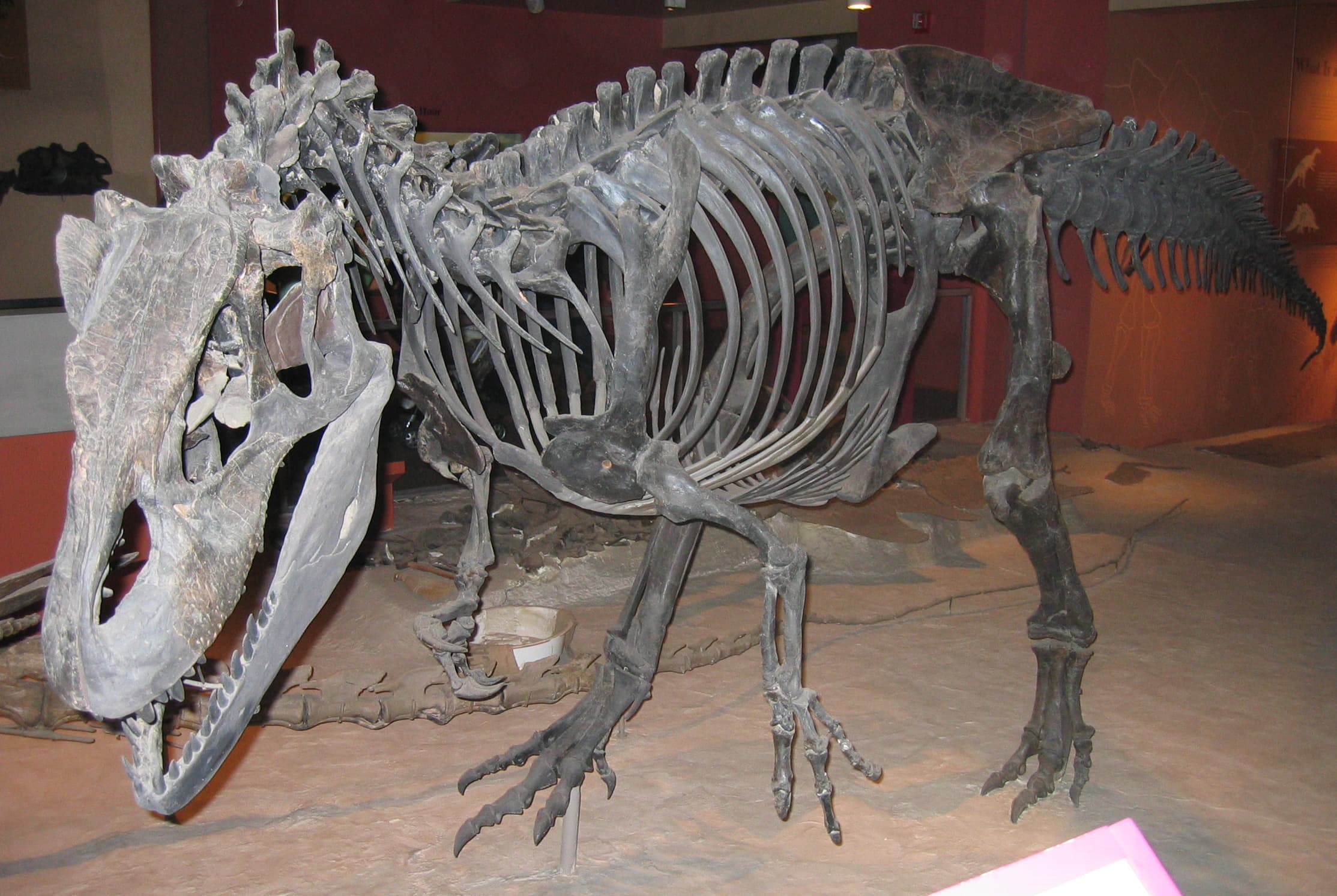
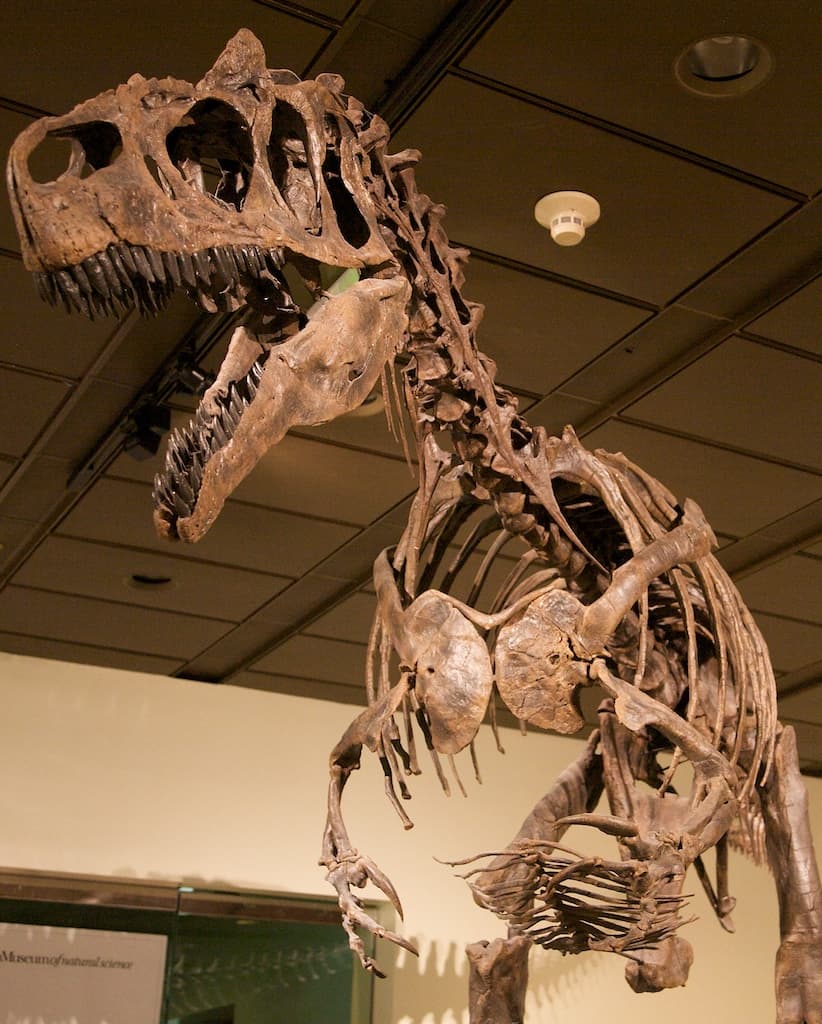
What was Allosaurus?
This profile focuses on Allosaurus fragilis, the best-known species of a large predatory dinosaur from western North America. It lived during the Late Jurassic, long before Tyrannosaurus rex. The Natural History Museum classifies it within Theropoda and Allosauridae, while the Smithsonian’s nearly complete USNM V 4734 skeleton now serves as the name-bearing reference specimen for the species. That scope matters because researchers have assigned several species to Allosaurus, and some names remain debated or have been revised.
The name means “different lizard,” referring to vertebrae that appeared unusual when Othniel Charles Marsh named the animal in 1877. Fossils show a two-legged carnivore with a large skull, balancing tail, powerful hind limbs and three-fingered hands. Reconstructions of skin color, courtship and exact social behavior remain hypotheses because bones do not preserve those details directly.
Size and skeletal anatomy
The Natural History Museum gives a representative length near 9.7 metres and mass near 2,700 kilograms, while National Park Service material describes adults around 8.5 metres. Estimates differ because specimens vary in age and completeness, and body-mass models make different assumptions. A cautious profile therefore presents an approximate range rather than treating one reconstruction as an exact maximum.
The skull was large but built with openings that reduced weight. Low crests or horn-like structures rose above the eyes. The jaws carried recurved, serrated teeth, and the forelimbs ended in three clawed fingers. Strong hind limbs supported bipedal movement, while the long tail counterbalanced the front of the body. Juveniles had proportionally longer lower limbs, which may indicate changes in locomotion and prey choice as they grew.
When and where it lived
Allosaurus fragilis is strongly associated with the Morrison Formation of the western United States. The National Park Service dates this famous rock sequence to the Late Jurassic and describes landscapes of river channels, floodplains, lakes and seasonally dry ground. Fossils occur across several western states, especially Colorado, Utah and Wyoming. The species is extinct, so modern country maps show fossil provenance rather than a living native range.
The Morrison ecosystem lacked flowering plants and grasses. Conifers, cycads, ginkgoes, ferns and horsetails formed the vegetation. Large sauropods, stegosaurs and smaller plant-eating dinosaurs shared the region with theropods, crocodile relatives, turtles, fishes and small mammals. River sediments sometimes buried bones rapidly enough for fossilization, producing rich quarry deposits that now reveal community composition.
Diet and feeding evidence
Allosaurus was a carnivore, but fossils cannot provide a simple menu. Serrated teeth and clawed forelimbs were suited to cutting and gripping, and bite traces link allosaurids with large herbivore carcasses. The Natural History Museum notes evidence involving stegosaurs and sauropods. Some marks may represent active predation, others scavenging, and a single fossil does not prove that every individual hunted the same prey.
Very large sauropods would have been dangerous targets. Allosaurus may have attacked smaller animals, juveniles, weakened individuals or vulnerable body regions, and it could also have fed from carcasses. Claims that it used one dramatic killing method go beyond the evidence. Tooth replacement, healed injuries and feeding traces offer firmer clues than cinematic reconstructions.
Movement, senses and daily behavior
Allosaurus moved on two hind limbs with its torso held roughly horizontal and its tail extended behind. It could not run with an upright, dragging-tail posture. Musculoskeletal studies can estimate ranges of motion, but exact top speed remains uncertain because soft tissues and behavior are not preserved. The animal likely relied on vision, smell and coordinated head and neck movement when locating food and navigating its environment.
Whether Allosaurus hunted cooperatively is unresolved. Several individuals occur together at some fossil sites, but floods, drought, carcasses or other processes can concentrate unrelated animals. Bite marks attributed to other allosaurs may even reflect conflict or scavenging. Grouped bones are evidence of association at death, not automatic proof of stable packs, coordinated hunting or a mammal-like social hierarchy.
Growth, reproduction and injuries
Like other non-avian dinosaurs, Allosaurus hatched from eggs, but no complete life history is preserved. Bone microstructure records growth and age, showing that body proportions changed as animals matured. Juveniles were more lightly built, while adults developed deeper skulls and heavier bodies. Exact clutch size, incubation period and age at sexual maturity are unknown for A. fragilis, so precise figures should not be invented from other dinosaurs.
Several skeletons preserve healed injuries and disease. The famous “Big Al” specimens contain numerous pathologies, demonstrating that individuals survived broken bones and infections for meaningful periods. Such fossils help researchers study movement, stress and recovery, but they do not reveal personality. A damaged bone documents an event in one animal’s life, not a universal behavior for the species.
Discovery and changing taxonomy
Marsh named Allosaurus fragilis during the nineteenth-century “Bone Wars,” initially using fragmentary material. In 2024, the Smithsonian reported that the International Commission on Zoological Nomenclature designated the much more complete USNM V 4734 skeleton as the species’ neotype. A neotype provides a stable physical reference when an original type is inadequate for distinguishing the taxon.
Taxonomy continues to change as researchers compare old collections and newly prepared fossils. The Natural History Museum notes recent reassessment of material once called Saurophaganax, with some bones referred to a different Allosaurus species and others questioned. A responsible profile separates the genus from A. fragilis and treats disputed assignments as active research rather than settled fact.
Extinction, fossils and protection
Allosaurus disappeared millions of years before the asteroid impact that ended the Cretaceous. Its extinction belongs to broader ecological changes near the end of the Jurassic and cannot be reduced to one documented event. Because the species is extinct, an IUCN-style code is only a display convention here; it is not a modern Red List assessment.
Fossils are nonrenewable scientific resources. On United States federal land, vertebrate fossils are protected and collecting requires permits and professional curation. Visitors should photograph discoveries, record location without disturbing the specimen, and notify land managers. Museum mounts may combine original fossil, casts and reconstructed parts, so captions should identify the specimen and avoid presenting every visible bone as original.