
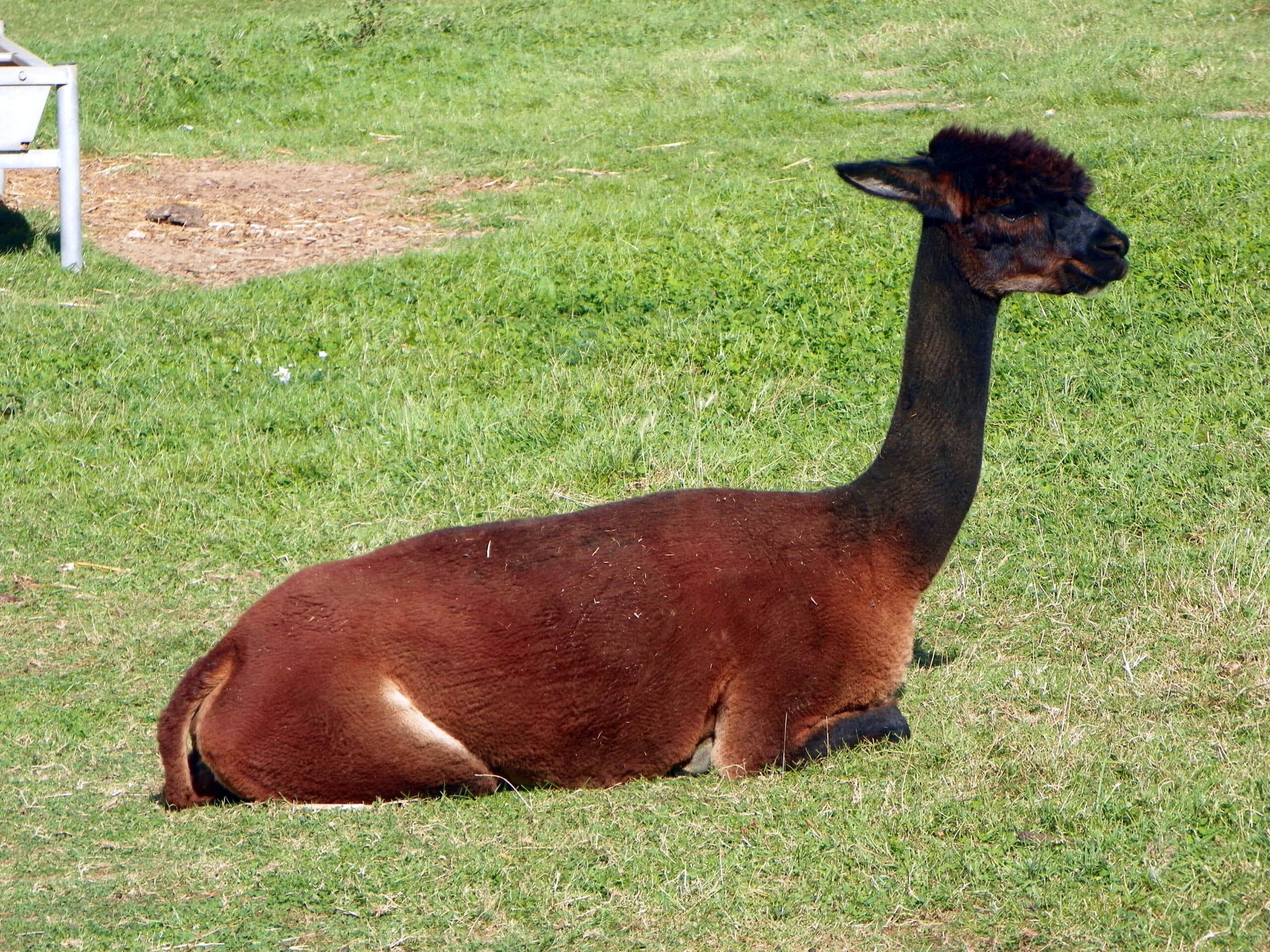
Alpaca (Vicugna pacos) is a fully domesticated South American camelid raised mainly for its soft fleece. It has no natural wild population. Andean communities developed alpacas from vicuña-related ancestors thousands of years ago, creating an animal central to highland textiles, food systems and culture. This guide separates well-supported biology from common assumptions and covers identification, range, habitat, diet, behavior, reproduction and conservation.
Identification
Alpacas have a compact slender body, long neck, small wedge-shaped head, large pointed ears and a dense fleece in white, cream, fawn, brown, gray or black. Their padded two-toed feet lack hard hooves and tread lightly on pasture. Huacaya fleece grows outward in a crimpy, springy coat, while Suri fiber forms long lustrous locks that hang close to the body. Alpacas are smaller and shorter-eared than most llamas and were bred chiefly for fiber rather than heavy packing. Males and females overlap in height, weight and fleece color. Mature males develop larger lower canines and upper fighting teeth, and are often more heavily muscled through the neck and chest, but sex is not reliably determined from size alone.
Identification should combine body shape, markings, size, voice or movement, and location. One feature by itself can overlap with a related animal, a juvenile, or an individual in unusual light.
Photographs are most useful when they preserve scale and show several diagnostic features. Handling or repositioning a wild alpaca for identification can cause stress and is unnecessary.
Size and physical adaptations
Alpaca typically measures about 1.2–2.2 m head and body and weighs about 45–90 kg. Most adults stand roughly 0.8–1.1 m at the shoulder. Measurements vary with type, sex, nutrition and breeding line.
Its useful adaptations include dense fine fleece insulates against cold andean nights, padded two-toed feet reduce damage to fragile soils, efficient digestion extracts nutrients from coarse forage, high-affinity blood physiology supports life at altitude, long eyelashes help protect eyes from dust and glare, communal dung piles concentrate waste away from grazing areas, a split upper lip selects plants precisely. These traits work together in the animal’s normal setting rather than serving as isolated curiosities.
Published measurements may use different methods, life stages or sample locations. Comparing figures responsibly means checking what was measured rather than selecting the largest number available.
Range and distribution
The historic core of alpaca husbandry lies on the high Andean Altiplano of Peru, Bolivia, northern Chile and northwestern Argentina. Most of the global herd remains in Peru and Bolivia. Because alpacas are domestic livestock, people now keep them in North America, Europe, Australia, New Zealand and other temperate regions; these overseas herds are introduced agricultural populations rather than a natural geographic range. The native range includes Peru, Bolivia, Chile, Argentina.
A country-level map indicates broad distribution, not continuous occupation. Climate, elevation, water, vegetation, prey, breeding sites, barriers and survey effort all affect where records occur.
Records near the edge of the range deserve careful documentation because they may reflect natural movement, improved survey coverage, accidental transport or a genuine distribution change.
Habitat
Managed high-altitude puna grasslands, peat wetlands and pastures, plus farms in temperate regions worldwide.
Traditional herds graze open Andean rangelands often 3,600–5,000 meters above sea level, where daily temperature swings, frost, wind and seasonal drought challenge livestock. Herders move animals among natural grasses, sedges and wet meadows according to water and forage. Overseas farms use fenced pasture, shelter, supplemental hay and veterinary care. Alpacas need dry resting areas and protection from heat because their heavy fleece can trap warmth. Protecting a population therefore requires the feeding, shelter and breeding features that make a site usable, along with connections that allow movement.
Microhabitat matters. Shade, soil, current, moisture, shelter or host plants can determine whether a small area is usable even when the surrounding landscape appears suitable.
Diet and feeding
Alpaca is a herbivore. Important foods include native andean grasses, sedges, forbs, pasture grasses, hay, mineral supplements. Alpacas crop plants with a split upper lip and lower incisors that bite against a dental pad. Their padded feet and selective grazing can be gentler on pasture than hard-hoofed livestock when stocking is appropriate. As foregut fermenters with three stomach compartments, they rely on microbes to break down fibrous plants and rechew cud. Good management balances forage quality, minerals, clean water and stocking density rather than relying on grain-heavy diets.
Diet changes with age, season, location and food supply. A dramatic prey record does not establish what most individuals eat most of the time; repeated field observations provide a stronger picture.
Feeding opportunities also create risk. An animal focused on prey may be less alert to predators, traffic or people, while contaminated prey can transfer pollutants through the food web.
Behavior and communication
Diurnal, with repeated grazing and resting periods and cud chewing during quiet intervals. Alpacas are social livestock that become stressed when kept alone. Herds use posture, ear position, tail carriage, humming and proximity to maintain relationships. They establish a hierarchy but often avoid serious conflict when space and food are sufficient. Communal dung piles make cleaning and parasite monitoring easier. A threatened alpaca may spit partially digested material, kick or charge, although most warning disputes occur between herd mates.
Soft humming is the best-known alpaca sound and can indicate contact, curiosity, discomfort or maternal communication depending on context. Alarm calls are sharper and louder. Ear angle, neck posture, tail position and approach distance convey mood. Spitting is a forceful social warning, while mothers and crias recognize one another through voice, smell and close contact. Behavior should be interpreted in context: alarm, courtship, feeding and temperature regulation can produce very different actions from the same animal.
Daily schedules are flexible responses, not rigid rules. Weather, breeding condition, disturbance, tides or food can move activity into a different part of the day.
Reproduction and development
Alpacas are induced ovulators, meaning mating stimulates release of an egg rather than ovulation following a fixed cycle. Breeders plan matings around body condition, genetics, weather and pasture. After an average gestation near 335 days, a female generally delivers one cria, often during daylight. Twins are rare. The mother stands to give birth and begins nursing and bonding quickly. Usually one cria; twins are rare A healthy cria attempts to stand and nurse soon after birth. Early colostrum is essential because antibodies do not cross the placenta in useful amounts. Crias grow rapidly on milk and begin nibbling forage within weeks. Weaning commonly occurs around six months, adjusted for weight, health and herd conditions. Young alpacas learn grazing routes and social signals from the herd.
Young animals face different risks and may use different microhabitats or food than adults. Breeding success depends on adult condition, suitable sites and the survival of offspring through vulnerable early stages.
Counts of eggs or young describe reproductive output, not the number expected to reach adulthood. Mortality is normally greatest during eggs, larval or juvenile stages.
Predators and ecological role
Alpacas are domestic herbivores rather than a wild ecological population. On well-managed Andean rangelands they convert high-fiber plants into fleece, meat and manure while padded feet reduce soil cutting. Excessive stocking can still overgraze fragile puna vegetation and increase erosion. Herd manure recycles nutrients, and communal dung piles concentrate both fertility and parasite stages. Predation and disease link herds with surrounding wildlife and domestic animals. Documented or likely predators include Puma, Culpeo, Domestic Dog, Humans.
This animal is both a consumer and a food source. Its influence comes through many repeated interactions, so ecological claims should be based on measured populations rather than assumptions drawn from appearance.
Predator and prey relationships differ among places. A species can be ecologically influential without being abundant everywhere, and its role can change across its range.
Relationship with people
For thousands of years, Andean peoples have used alpaca fiber for warm textiles, manure for fuel and fertilizer, and meat for food. Fleece remains a major rural income source, with quality influenced by genetics, nutrition, cleanliness and humane shearing. Alpacas are also kept for small-farm fiber, shows and livestock companionship worldwide. They are not normally pack animals, a role more associated with llamas.
Approach calmly from the side, avoid trapping an alpaca against a fence and supervise children. Males with fighting teeth require skilled handling, and any alpaca can kick or spit when frightened. Owners need veterinary guidance for shearing, nails, teeth, parasites, vaccination and heat stress. Hand-reared males can develop dangerous behavior if they treat people as rival alpacas. Responsible observation means keeping an appropriate distance, avoiding capture or feeding, protecting habitat and following local wildlife or invasive-species guidance.
Wildlife guidance should come from the responsible local agency because collection rules, reporting requests and appropriate responses differ between native and introduced ranges.
Conservation
The IUCN Red List does not assess the alpaca as a wild species because it is domesticated and has no natural wild population. Conservation concerns instead focus on traditional breeds, genetic diversity, welfare and sustainable Andean rangelands. The reported global trend is Global domestic numbers are managed and regionally variable.
Important pressures include loss of locally adapted genetic diversity, overgrazing and rangeland degradation, drought, frost and climate change, parasites and infectious disease, poor shearing or heat management, market pressure on smallholder livelihoods. Global status can hide local decline or recovery, so current regional monitoring and habitat management remain necessary.
The most useful conservation action follows the documented pressure. Protecting breeding sites, reducing road deaths or limiting pollutants can require different tools in different populations.