
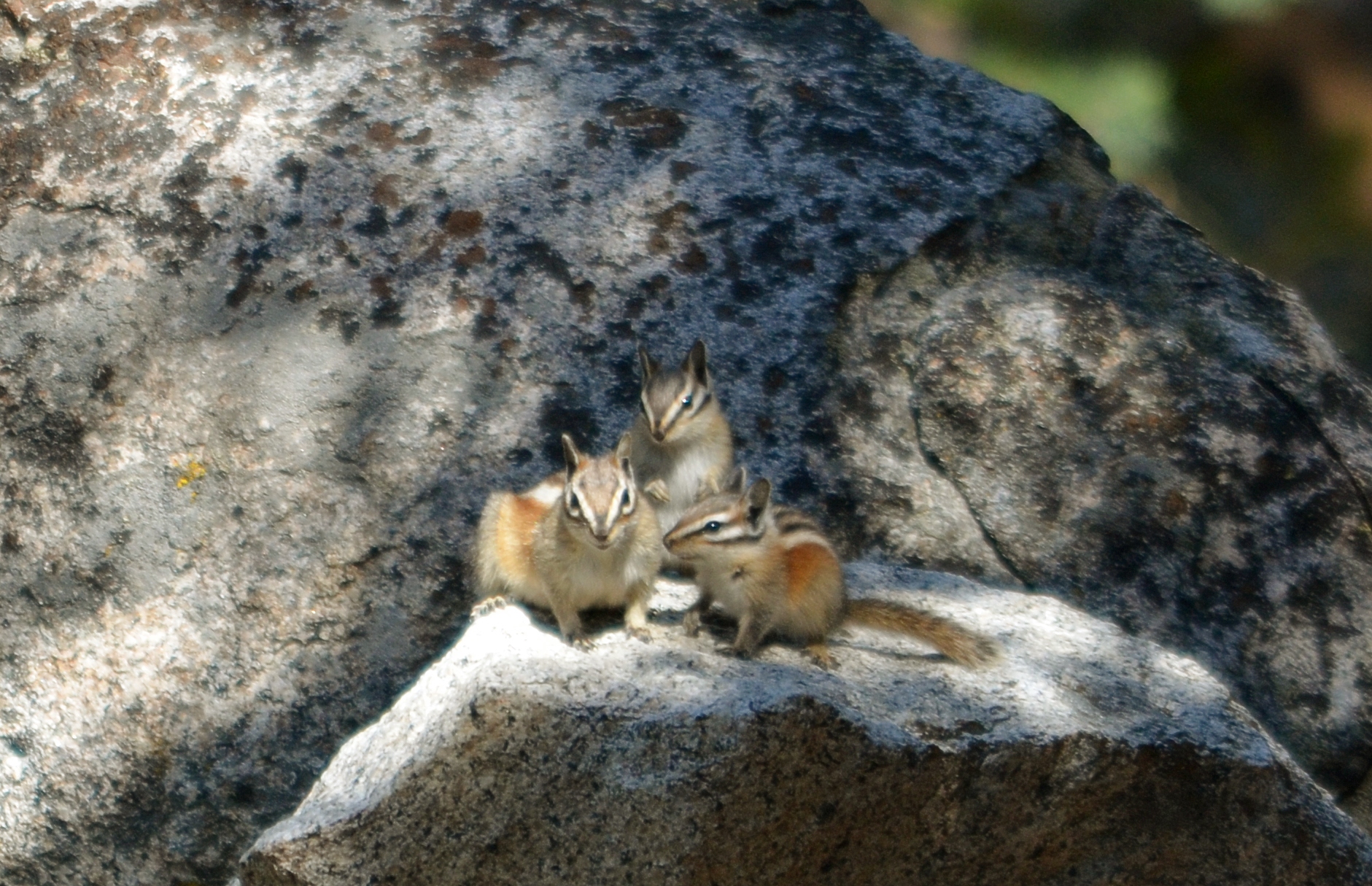
Alpine Chipmunk (Neotamias alpinus) is a high-elevation squirrel found nowhere outside the central and southern Sierra Nevada of California. It survives short alpine summers by harvesting seeds, sheltering in rock crevices and hibernating through much of the year. This guide separates well-supported biology from common assumptions and covers identification, range, habitat, diet, behavior, reproduction and conservation.
Identification
This is one of the smallest and palest western chipmunks. The upperparts are yellowish gray with four pale dorsal stripes separated by muted reddish or brown stripes; the middle dark stripe can approach black. Three pale cheek stripes mark the face, the belly is warm orange, and the tail is gray-white to yellow above with orange below. Males and females are similar in color and general appearance. Females may average slightly larger, but external measurements overlap too much for sex to be judged reliably at a distance.
Identification should combine body shape, markings, size, voice or movement, and location. One feature by itself can overlap with a related animal, a juvenile, or an individual in unusual light.
Photographs are most useful when they preserve scale and show several diagnostic features. Handling or repositioning a wild alpine chipmunk for identification can cause stress and is unnecessary.
Size and physical adaptations
Alpine Chipmunk typically measures 16.6–20.3 cm total length and weighs 28–50 g. The tail accounts for about 6.3–8.5 cm of total length; age, season and body condition affect mass.
Its useful adaptations include pale coat blends with granite talus, deep rock crevices buffer heat and wind, concentrated urine reduces water loss, cheek pouches carry seeds to caches, hibernation bridges the long alpine winter. These traits work together in the animal’s normal setting rather than serving as isolated curiosities.
Published measurements may use different methods, life stages or sample locations. Comparing figures responsibly means checking what was measured rather than selecting the largest number available.
Range and distribution
Endemic to the high Sierra Nevada of eastern and central California, from the Yosemite and Tuolumne region south through high country toward Tulare and Inyo counties. Its global distribution lies within one mountain chain. The native range includes United States.
A country-level map indicates broad distribution, not continuous occupation. Climate, elevation, water, vegetation, prey, breeding sites, barriers and survey effort all affect where records occur.
Records near the edge of the range deserve careful documentation because they may reflect natural movement, improved survey coverage, accidental transport or a genuine distribution change.
Habitat
Alpine and subalpine talus slopes, granite boulder fields, rocky ledges and sparse lodgepole pine near timberline.
Animals forage across open rock and low vegetation but stay close to cracks and boulders that provide escape cover, nest sites and a cool refuge during unusually warm weather. They use burrows and rock chambers for food storage and winter hibernation. Protecting a population therefore requires the feeding, shelter and breeding features that make a site usable, along with connections that allow movement.
Microhabitat matters. Shade, soil, current, moisture, shelter or host plants can determine whether a small area is usable even when the surrounding landscape appears suitable.
Diet and feeding
Alpine Chipmunk is a primarily granivorous herbivore with occasional animal food. Important foods include sedge seeds, grass seeds, forb seeds, pine seeds, currants, huckleberries, fungi, occasional bird eggs. Chipmunks gather small seeds and fruit across talus and alpine vegetation, packing food into cheek pouches before carrying it to concealed caches. Stored food supports brief arousals during winter torpor. Moist foods and efficient kidneys reduce dependence on open water.
Diet changes with age, season, location and food supply. A dramatic prey record does not establish what most individuals eat most of the time; repeated field observations provide a stronger picture.
Feeding opportunities also create risk. An animal focused on prey may be less alert to predators, traffic or people, while contaminated prey can transfer pollutants through the food web.
Behavior and communication
Diurnal during the short snow-free season; hibernates from autumn into late spring. Alpine chipmunks forage mostly on the ground, sprint over rocks and retreat into narrow crevices when alarmed. They defend food when it is scarce, store seeds and accumulate body fat before winter. Hibernation includes repeated bouts of torpor interrupted by arousals.
A thin repeated call advertises presence, while a sharper whipper accompanies alarm and flight to cover. Vision, scent and whisker touch help individuals navigate rocks and recognize neighbors. Behavior should be interpreted in context: alarm, courtship, feeding and temperature regulation can produce very different actions from the same animal.
Daily schedules are flexible responses, not rigid rules. Weather, breeding condition, disturbance, tides or food can move activity into a different part of the day.
Reproduction and development
Mating occurs soon after emergence from hibernation. Females prepare a sheltered nest in a burrow or rock cavity and produce one litter during the short mountain summer. Usually 3–6 young Young are born hairless, blind and dependent. They grow rapidly in the nest, emerge during summer and must learn to forage and cache food before the early alpine winter.
Young animals face different risks and may use different microhabitats or food than adults. Breeding success depends on adult condition, suitable sites and the survival of offspring through vulnerable early stages.
Counts of eggs or young describe reproductive output, not the number expected to reach adulthood. Mortality is normally greatest during eggs, larval or juvenile stages.
Predators and ecological role
Seed harvesting and forgotten caches can influence alpine plant recruitment, while fungal feeding may disperse spores. The chipmunks are prey for raptors, snakes and small carnivores, transferring energy from sparse high-elevation vegetation into the mountain food web. Documented or likely predators include Red-tailed Hawk, Golden Eagle, Long-tailed Weasel, Gopher Snake.
This animal is both a consumer and a food source. Its influence comes through many repeated interactions, so ecological claims should be based on measured populations rather than assumptions drawn from appearance.
Predator and prey relationships differ among places. A species can be ecologically influential without being abundant everywhere, and its role can change across its range.
Relationship with people
The species has little direct conflict with people because most of its range is remote high country. Hikers may encounter it near Sierra Nevada trails, but feeding changes foraging behavior and attracts animals to unsafe places.
Observe quietly, keep food sealed and never feed or handle wild chipmunks. Feeding encourages biting, concentrates animals and can spread disease. Protect fragile alpine vegetation by staying on durable trail surfaces. Responsible observation means keeping an appropriate distance, avoiding capture or feeding, protecting habitat and following local wildlife or invasive-species guidance.
Wildlife guidance should come from the responsible local agency because collection rules, reporting requests and appropriate responses differ between native and introduced ranges.
Conservation
The IUCN Red List and Mammal Diversity Database list Neotamias alpinus as Least Concern. Its small endemic range and high-elevation specialization still make climate-driven habitat change a conservation concern. The reported global trend is Unknown.
Important pressures include climate-driven loss of cool alpine conditions, shrub and tree expansion upslope, severe drought, wildfire effects near timberline, recreation pressure at localized sites. Global status can hide local decline or recovery, so current regional monitoring and habitat management remain necessary.
The most useful conservation action follows the documented pressure. Protecting breeding sites, reducing road deaths or limiting pollutants can require different tools in different populations.
