
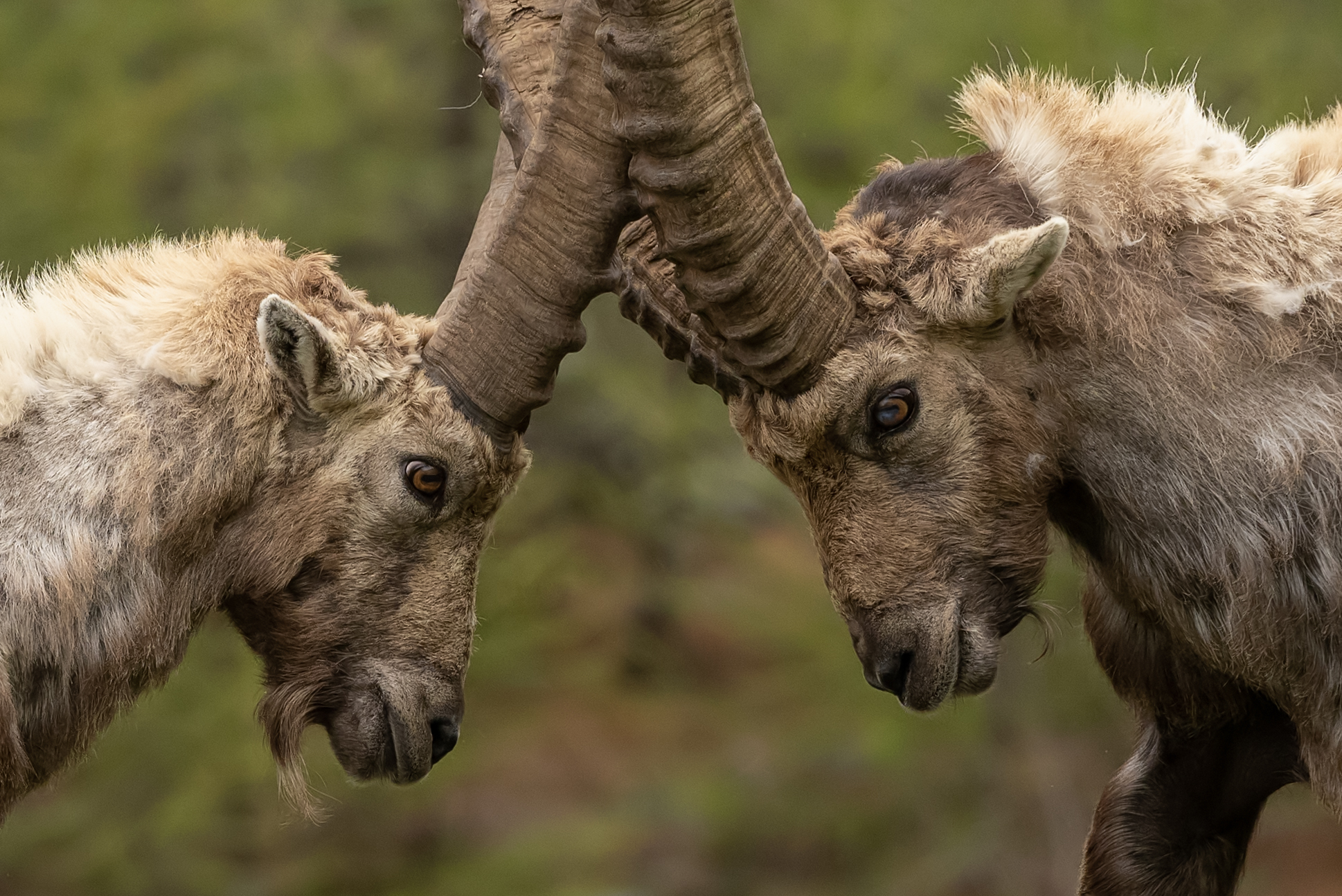
Alpine Ibex (Capra ibex) is a large wild goat found only in the European Alps. Massive backward-curving horns distinguish adult males, while flexible hooves and a low center of gravity let both sexes move confidently across cliffs, scree and steep alpine grassland. This guide separates well-supported biology from common assumptions and covers identification, range, habitat, diet, behavior, reproduction and conservation.
Identification
The body is compact and muscular with sturdy legs, cloven hooves and a short tail. Summer coats are gray-brown to tawny; winter fur becomes longer and darker. Adult males carry thick, heavily ridged horns that curve backward in a broad arc and can approach one meter. Females have much slimmer, shorter horns. Males also develop a beard and a heavier neck and shoulders, especially during the winter rut. Sexual dimorphism is pronounced. Adult males are often about twice the mass of females and bear far longer, thicker horns. Females are lighter, slimmer and more agile when accompanied by young.
Identification should combine body shape, markings, size, voice or movement, and location. One feature by itself can overlap with a related animal, a juvenile, or an individual in unusual light.
Photographs are most useful when they preserve scale and show several diagnostic features. Handling or repositioning a wild alpine ibex for identification can cause stress and is unnecessary.
Size and physical adaptations
Alpine Ibex typically measures about 115–170 cm head and body and weighs females commonly 30–50 kg; males commonly 65–100 kg. Size varies with age, sex, season and population. Exceptional old males may exceed common weight ranges.
Its useful adaptations include rubbery central hoof pads grip rock, hard hoof rims bite into narrow ledges, a low center of gravity aids balance, dense winter fur limits heat loss, large lungs and efficient movement support high altitude, seasonal vertical migration tracks forage and snow, horn ridges absorb force during male contests. These traits work together in the animal’s normal setting rather than serving as isolated curiosities.
Published measurements may use different methods, life stages or sample locations. Comparing figures responsibly means checking what was measured rather than selecting the largest number available.
Range and distribution
Confined to the European Alps from southeastern France across Switzerland and northern Italy to Austria, southern Germany and Slovenia. By the nineteenth century, hunting had reduced the species to one surviving population around Gran Paradiso in Italy. Protection, captive transfers and reintroductions rebuilt populations across much of the former alpine range. The native range includes France, Italy, Switzerland, Austria, Germany, Slovenia.
A country-level map indicates broad distribution, not continuous occupation. Climate, elevation, water, vegetation, prey, breeding sites, barriers and survey effort all affect where records occur.
Records near the edge of the range deserve careful documentation because they may reflect natural movement, improved survey coverage, accidental transport or a genuine distribution change.
Habitat
Rocky alpine and subalpine slopes, cliffs, scree, open grasslands and forest edges, generally from about 1,600 to above 3,000 meters in summer.
Ibex shift elevation with weather and food. In summer they climb into high meadows and rocky terrain where fresh herbs grow; in winter they descend to steep, sun-exposed slopes where wind and sunlight uncover grass. Cliffs provide escape terrain from predators. Females with kids favor especially broken ground, while adult males may use more open feeding sites. Mineral licks and dam faces can attract animals seeking salt. Protecting a population therefore requires the feeding, shelter and breeding features that make a site usable, along with connections that allow movement.
Microhabitat matters. Shade, soil, current, moisture, shelter or host plants can determine whether a small area is usable even when the surrounding landscape appears suitable.
Diet and feeding
Alpine Ibex is a herbivore. Important foods include alpine grasses, sedges, herbs, shrub leaves, buds and shoots, mosses and lichens, tree bark in winter. Most feeding occurs in morning and late afternoon. Ibex crop grasses and herbs, browse shrubs and use woody plants when snow limits access to ground vegetation. As ruminants, they swallow forage quickly and later rechew cud while resting. Seasonal diet quality drives movements between elevations. Natural mineral sources are important, and animals may climb artificial stonework to lick salts leached from the surface.
Diet changes with age, season, location and food supply. A dramatic prey record does not establish what most individuals eat most of the time; repeated field observations provide a stronger picture.
Feeding opportunities also create risk. An animal focused on prey may be less alert to predators, traffic or people, while contaminated prey can transfer pollutants through the food web.
Behavior and communication
Mostly diurnal and crepuscular, alternating feeding with long resting and rumination periods. For much of the year, adult males form bachelor groups while females live in nursery groups with kids and yearlings. Herds change size with season and local food. During the winter rut, males join female groups and compete through displays and horn clashes. Serious injury is limited by ritualized assessment, but evenly matched males may fight forcefully. Outside the rut, ibex conserve energy and often rest on ledges with wide views.
Body posture, horn orientation, scent and close-range sounds convey status and alarm. A threatened ibex may whistle sharply. During the rut, males display their profile, approach stiffly and use horn size to assess rivals before fighting. Mothers and kids recognize each other through voice and smell within nursery groups. Behavior should be interpreted in context: alarm, courtship, feeding and temperature regulation can produce very different actions from the same animal.
Daily schedules are flexible responses, not rigid rules. Weather, breeding condition, disturbance, tides or food can move activity into a different part of the day.
Reproduction and development
The rut occurs in early winter, commonly December and January. Mature males seek female herds and compete for access through displays and horn contests. After a gestation of roughly five and a half months, females leave the group for secluded steep terrain and usually give birth to one kid in late spring or early summer. Usually one kid; twins are uncommon A newborn kid can stand and follow its mother within hours, an essential ability on exposed mountain ground. The mother nurses and hides or escorts the kid among rocks during its first weeks. Kids begin tasting vegetation early and remain in female-led nursery groups while learning routes and escape terrain. Young females may remain with maternal groups, while maturing males increasingly join bachelor herds.
Young animals face different risks and may use different microhabitats or food than adults. Breeding success depends on adult condition, suitable sites and the survival of offspring through vulnerable early stages.
Counts of eggs or young describe reproductive output, not the number expected to reach adulthood. Mortality is normally greatest during eggs, larval or juvenile stages.
Predators and ecological role
Alpine ibex turn mountain vegetation into food for predators and scavengers and influence plant communities through grazing and trampling. Golden eagles can take young kids, while wolves and lynx prey on vulnerable animals. Carcasses feed vultures, ravens and other scavengers. Their seasonal movements connect alpine meadow, cliff and forest-edge habitats. Documented or likely predators include Gray Wolf, Eurasian Lynx, Golden Eagle, Red Fox, Humans.
This animal is both a consumer and a food source. Its influence comes through many repeated interactions, so ecological claims should be based on measured populations rather than assumptions drawn from appearance.
Predator and prey relationships differ among places. A species can be ecologically influential without being abundant everywhere, and its role can change across its range.
Relationship with people
Hunting for meat, trophies and supposed medicinal horn properties nearly exterminated the species. Strict royal protection at Gran Paradiso preserved the last herd, and animals from that source founded reintroduced populations throughout the Alps. Today, wildlife tourism and regulated hunting contribute locally to management, while habituation near roads and dams can create disturbance and disease risks.
Observe from a distance, keep dogs leashed and never feed or approach an ibex on a cliff, road or mineral lick. Large males can strike with horns if cornered, and loose rocks pose a greater everyday danger to hikers. Give females with kids an escape route and follow seasonal wildlife closures. Responsible observation means keeping an appropriate distance, avoiding capture or feeding, protecting habitat and following local wildlife or invasive-species guidance.
Wildlife guidance should come from the responsible local agency because collection rules, reporting requests and appropriate responses differ between native and introduced ranges.
Conservation
The IUCN classifies Capra ibex as Least Concern after a major twentieth-century recovery. Local herds remain vulnerable to disease, low genetic diversity, harsh winters and fragmented movement routes. The reported global trend is Generally stable to increasing at broad scale, with regional variation.
Important pressures include low genetic diversity after the historic bottleneck, disease transmission from domestic goats and sheep, climate-driven changes in snow and forage, habitat fragmentation and disturbance, local overabundance and food limitation, avalanches and severe winters. Global status can hide local decline or recovery, so current regional monitoring and habitat management remain necessary.
The most useful conservation action follows the documented pressure. Protecting breeding sites, reducing road deaths or limiting pollutants can require different tools in different populations.