
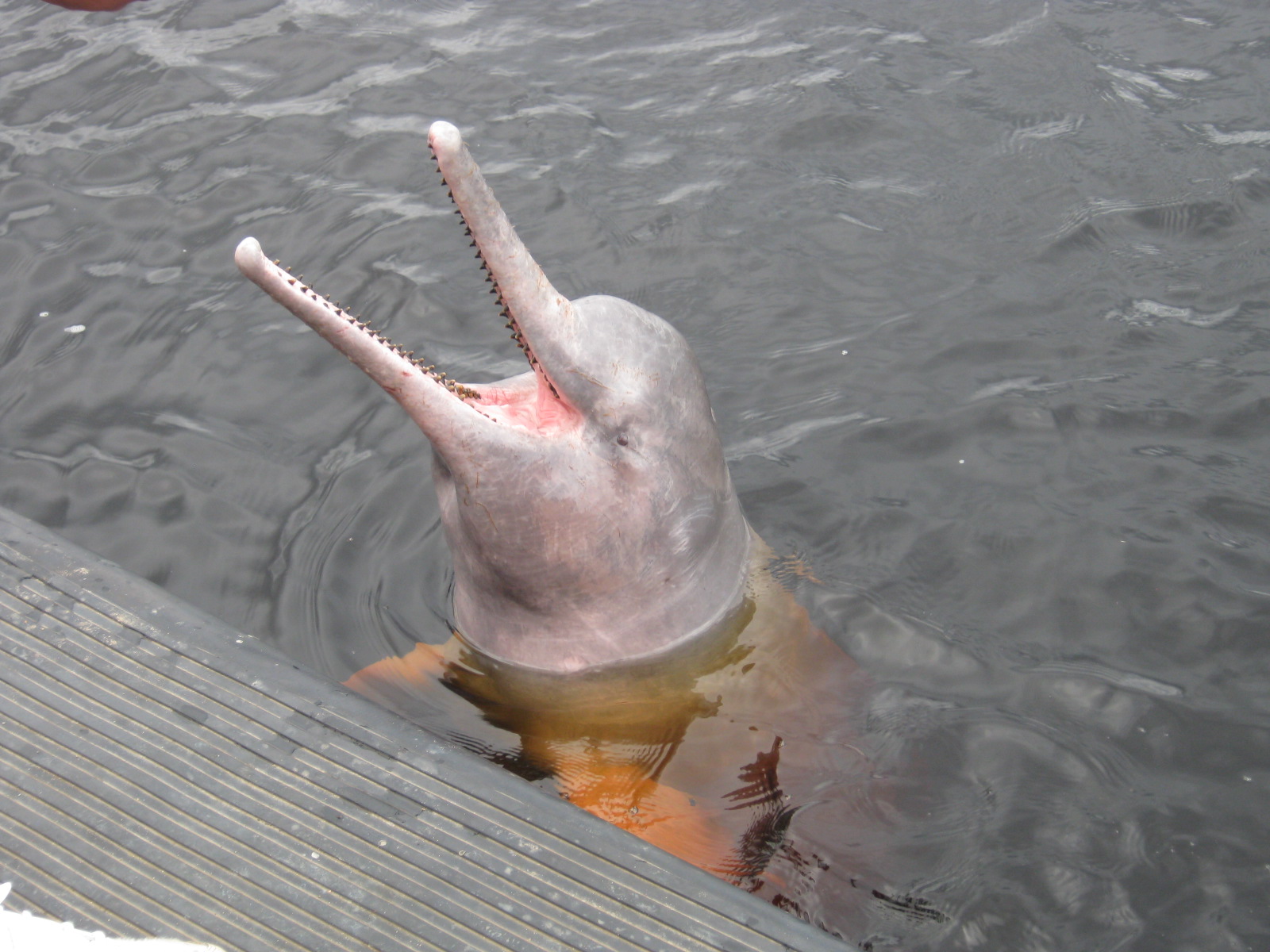
Amazon River Dolphin (Inia geoffrensis) is the largest river dolphin and a specialist of South America’s Amazon and Orinoco basins. Adults may appear gray, mottled or vivid pink. Broad flippers, a low dorsal ridge and unusually mobile neck help a boto turn through flooded forest where an oceanic dolphin’s speed would be less useful. This guide separates well-supported biology from common assumptions and covers identification, range, habitat, diet, behavior, reproduction and conservation.
Identification
A long narrow beak, rounded forehead and small eyes give the boto a distinctive profile. The dorsal fin is reduced to a long low ridge, while broad triangular flippers provide control at low speed. Neck vertebrae are not fused as they are in most dolphins, allowing the head to turn from side to side. Calves are dark gray; adults lighten with age, and males are often pinker because blood-rich skin and accumulated scars become visible. Males are substantially larger and often pinker and more scarred than females. The reversed size difference is unusual among river dolphins and reflects intense competition among males.
Identification should combine body shape, markings, size, voice or movement, and location. One feature by itself can overlap with a related animal, a juvenile, or an individual in unusual light.
Photographs are most useful when they preserve scale and show several diagnostic features. Handling or repositioning a wild amazon river dolphin for identification can cause stress and is unnecessary.
Size and physical adaptations
Amazon River Dolphin typically measures females commonly to about 2.15 m; males to about 2.55 m and weighs females to roughly 150 kg; males to roughly 185 kg. Maximum figures vary among populations and studies. Adult males are the largest freshwater dolphins.
Its useful adaptations include unfused neck vertebrae permit side-to-side head movement, broad flippers maneuver among submerged trees, echolocation finds prey in turbid water, heterodont teeth grip fish and crush armored prey, a low dorsal ridge reduces snagging in flooded forest, a long beak probes near roots and riverbeds, flexible pectoral movement supports tight turns. These traits work together in the animal’s normal setting rather than serving as isolated curiosities.
Published measurements may use different methods, life stages or sample locations. Comparing figures responsibly means checking what was measured rather than selecting the largest number available.
Range and distribution
Freshwater systems of the Amazon and Orinoco basins in Brazil, Peru, Colombia, Venezuela, Ecuador and Bolivia. Rapids, waterfalls and dams divide some populations. Taxonomic treatment of dolphins above the Madeira River rapids in Bolivia remains debated, so maps and counts should state which Inia classification they follow. The native range includes Brazil, Peru, Colombia, Venezuela, Ecuador, Bolivia.
A country-level map indicates broad distribution, not continuous occupation. Climate, elevation, water, vegetation, prey, breeding sites, barriers and survey effort all affect where records occur.
Records near the edge of the range deserve careful documentation because they may reflect natural movement, improved survey coverage, accidental transport or a genuine distribution change.
Habitat
Main rivers, tributaries, channels, confluences, floodplain lakes and seasonally flooded forests, from whitewater to blackwater and clearwater systems.
Water level controls movement. During rising floods, dolphins spread into channels, lakes and inundated forest to follow fish. Females and calves often remain longer in sheltered floodplains, while adult males use deeper main channels more frequently. As water falls, animals return to rivers, confluences and lake mouths where prey becomes concentrated. Rapids and shallow passages can limit connections among subpopulations. Protecting a population therefore requires the feeding, shelter and breeding features that make a site usable, along with connections that allow movement.
Microhabitat matters. Shade, soil, current, moisture, shelter or host plants can determine whether a small area is usable even when the surrounding landscape appears suitable.
Diet and feeding
Amazon River Dolphin is a carnivore. Important foods include croakers and drums, cichlids, characins and tetras, piranhas, armored catfish, freshwater crabs, occasional small river turtles. Botos have one of the broadest diets recorded for dolphins, taking dozens of fish species. Front teeth seize slippery prey, while flatter rear teeth crush armored fish, crabs and occasionally small turtles. Echolocation clicks reveal objects in muddy or tannin-dark water. Individuals hunt alone or in loose groups near confluences, riverbanks, floating vegetation and disturbed schools of fish. They sometimes feed near tucuxis, giant otters, fishing boats or canoes without forming permanent teams.
Diet changes with age, season, location and food supply. A dramatic prey record does not establish what most individuals eat most of the time; repeated field observations provide a stronger picture.
Feeding opportunities also create risk. An animal focused on prey may be less alert to predators, traffic or people, while contaminated prey can transfer pollutants through the food web.
Behavior and communication
Active throughout day and night, with feeding peaks often reported in morning and late afternoon. Amazon River Dolphins are usually seen alone, in pairs or in small temporary groups rather than stable pods. Mother-calf pairs are the strongest long-term bond. Individuals surface with little splash, expose the low back ridge and may lift the head to inspect surroundings. During flood season they weave through forests and around submerged trunks. Males carry tooth-rake scars and may handle branches, clay or vegetation during social displays.
Rapid echolocation clicks guide navigation and prey capture. Whistles and other tonal sounds maintain contact, while touch and body posture matter at close range. Murky water reduces visual range, but dolphins can still recognize movement, sound and echoes. Mothers and calves exchange frequent contact signals as the young learn complex seasonal waterways. Behavior should be interpreted in context: alarm, courtship, feeding and temperature regulation can produce very different actions from the same animal.
Daily schedules are flexible responses, not rigid rules. Weather, breeding condition, disturbance, tides or food can move activity into a different part of the day.
Reproduction and development
Mating behavior is incompletely known, but the larger size and heavy scarring of males suggest strong competition for females. Gestation lasts about eleven months. A female gives birth to one calf, with many births occurring around peak water levels when flooded habitats offer shelter and increasing prey. Birth intervals are long because mothers nurse and protect calves for more than a year. One calf A calf is roughly 80 cm long at birth and must surface immediately to breathe. Its mother provides milk, protection and prolonged access to feeding areas. Young dolphins learn routes through changing channels and flooded forest over several years. Weaning is usually after more than a year, and the mother-calf association may persist for two to three years, limiting how quickly populations can replace adults lost to human causes.
Young animals face different risks and may use different microhabitats or food than adults. Breeding success depends on adult condition, suitable sites and the survival of offspring through vulnerable early stages.
Counts of eggs or young describe reproductive output, not the number expected to reach adulthood. Mortality is normally greatest during eggs, larval or juvenile stages.
Predators and ecological role
As a large freshwater predator, the boto feeds across many fish families and can influence prey behavior and river food webs. Seasonal flooding links its feeding to forest fruit cycles and fish migrations. Carcasses return nutrients to aquatic scavengers. The dolphin also acts as an indicator of river connectivity, fish abundance and contamination because it is long-lived and stores pollutants through the food chain. Documented or likely predators include Black Caiman, Green Anaconda, Jaguar, Bull Shark, Humans.
This animal is both a consumer and a food source. Its influence comes through many repeated interactions, so ecological claims should be based on measured populations rather than assumptions drawn from appearance.
Predator and prey relationships differ among places. A species can be ecologically influential without being abundant everywhere, and its role can change across its range.
Relationship with people
Botos are central to Amazonian stories, including traditions of a dolphin becoming a person and visiting celebrations. Tourism offers viewing income, but feeding, touching and swimming programs can alter behavior and create injuries. Dolphins drown in fishing nets and have been killed for bait in catfish fisheries. Mercury from gold mining, boat traffic, dams and falling fish stocks add cumulative pressure.
Watch from a responsible boat at low speed and keep a generous distance. Do not feed, touch, chase or swim toward a dolphin, even where close-contact tourism is offered. Fishing gear should use local dolphin-safe practices, and entangled animals require trained rescue teams. Operators should avoid separating mothers and calves or blocking narrow channels. Responsible observation means keeping an appropriate distance, avoiding capture or feeding, protecting habitat and following local wildlife or invasive-species guidance.
Wildlife guidance should come from the responsible local agency because collection rules, reporting requests and appropriate responses differ between native and introduced ranges.
Conservation
The IUCN Red List classifies Inia geoffrensis as Endangered. Long generation time and slow reproduction make persistent adult mortality especially damaging. The reported global trend is Decreasing.
Important pressures include entanglement in gillnets, deliberate killing for fish bait, hydroelectric dams and fragmented rivers, mercury, pesticide and plastic pollution, boat strikes and underwater noise, overfishing and declining prey, extreme drought, heat and climate change. Global status can hide local decline or recovery, so current regional monitoring and habitat management remain necessary.
The most useful conservation action follows the documented pressure. Protecting breeding sites, reducing road deaths or limiting pollutants can require different tools in different populations.