
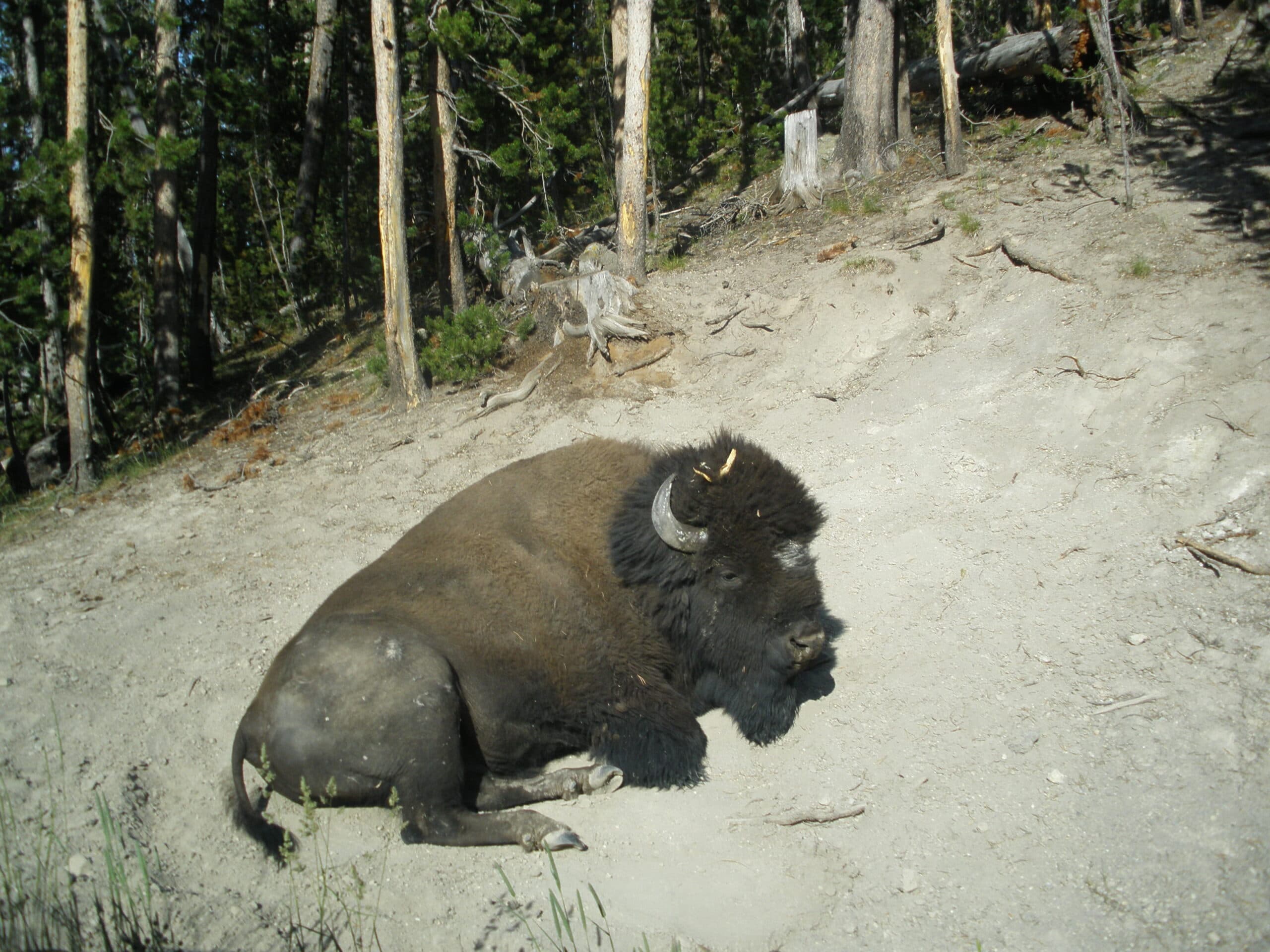
America’s largest land mammal
The American bison, Bison bison, is the largest living land mammal in North America. A high shoulder hump, massive head, short curved horns and shaggy forequarters give it a front-heavy outline unlike that of domestic cattle. Bulls can approach 2,000 pounds, while cows are commonly near 1,000 pounds. Both sexes carry permanent horns. The familiar name “buffalo” remains important in many cultural settings, although true buffalo belong to different bovine lineages in Africa and Asia.
Two living subspecies are generally recognized in North America. Plains bison, Bison bison bison, historically occupied grasslands across much of the continent. Wood bison, Bison bison athabascae, are associated with northern forests and meadows and tend to be larger, with a differently shaped hump and coat. This page covers the species and identifies subspecies-specific figures when necessary.
Built for grasslands and northern winters
The hump is supported by long vertebral spines and powerful muscles that move the head and forequarters. That construction helps bison sweep snow aside to reach buried forage. Dense hair covers the head, neck and shoulders, while shorter hair covers the hindquarters. Spring shedding can leave the coat ragged as animals rub against trees, rocks and the ground.
Bison are agile despite their size. The National Park Service reports running speeds around 35 to 40 miles per hour, and animals can pivot, climb slopes and cross rivers. Their senses of smell and hearing are strong. A bison may appear calm while grazing, but its posture can change quickly. A raised tail, pawing, head shaking or a direct orientation toward a person signals that more distance is needed.
Historic range and present distribution
Before the nineteenth-century collapse, tens of millions ranged from northern Mexico through the United States and Canada, reaching interior Alaska and occupying prairies, open woodlands, river valleys and northern meadows. Herds moved in response to water, snow, fire and new plant growth. Their distribution was broader than the Great Plains image that now dominates popular culture.
Modern conservation herds occupy only a small fraction of that historic range. Important free-ranging or conservation populations live in Yellowstone and other protected landscapes, tribal lands, Canadian parks and reserves, Alaska, and reintroduction sites in Mexico. Most herds are fenced, isolated or actively managed. Commercial bison are far more numerous than animals managed primarily for conservation, so a raw population total does not describe ecological recovery.
Grazing, wallowing and ecosystem change
Bison eat grasses and sedges along with forbs and some woody plants. Their broad muzzle lets them crop large mouthfuls. Seasonal movements once spread grazing pressure across vast landscapes. Today, managers match herd size with the carrying capacity of bounded areas so that animals have enough forage without degrading habitat.
Grazing creates patches of vegetation at different heights. Wallowing—rolling in shallow dusty depressions—disturbs soil, collects rainwater and produces small habitats used by insects, plants and other wildlife. Hooves expose soil, dung recycles nutrients, and shaggy coats transport seeds. These effects make bison ecosystem engineers. Their influence can increase grassland diversity when herds have room to move and natural processes such as fire remain part of the landscape.
Herd life, rut and calves
Cows, calves and young animals commonly form mixed herds. Mature bulls often spend much of the year alone or in smaller male groups. During the summer rut, bulls join cow groups, roar, wallow and compete for breeding opportunities. A bull may form a temporary tending bond with one cow, staying near her and excluding rivals. Displays settle many contests, though forceful clashes occur.
After a gestation of about nine and a half months, a cow usually gives birth to one calf in spring. Newborn calves have reddish-brown coats and lack the pronounced adult hump. They can stand and follow their mothers soon after birth. Nursing may continue for seven or eight months, and young are generally weaned within their first year. Females often begin reproducing at two or three years; males mature earlier physiologically than they typically succeed in competition.
Predators, weather and survival
Wolves can hunt bison, especially calves, older animals or individuals weakened by injury or deep snow. Grizzly bears sometimes take calves. Healthy adults defend themselves with size, horns, speed and group behavior. Winter storms, drought, disease, drowning and accidents also cause mortality. The National Park Service gives a typical wild lifespan near 15 years, though individuals under managed care may live longer.
Brucellosis is an important management concern in the Greater Yellowstone ecosystem because it can affect bison, elk and livestock. Disease policy, migration corridors and tolerance for animals outside park boundaries are therefore connected. Management decisions can involve capture, testing, quarantine, transfer to tribal conservation herds and regulated removal.
Collapse, recovery and unfinished conservation
Commercial killing, government policy, settlement, habitat conversion and deliberate attacks on Indigenous lifeways reduced bison from tens of millions to only hundreds of plains bison by the late 1800s. Private keepers, tribes, conservationists and governments preserved survivors and established new herds. That rescue prevented extinction and became a landmark in wildlife conservation.
Recovery by head count is incomplete. The U.S. Fish and Wildlife Service notes that many conservation herds are small and isolated, and cattle ancestry occurs at low levels in many herds. Long-term work aims to retain genetic diversity, natural selection, migration and the ecological role of large herds. Tribal restoration is central because bison are inseparable from the food systems, economies, histories and spiritual lives of many Indigenous nations. Canada, Mexico and the United States renewed cooperation on bison conservation in 2024.
Watching bison safely
Bison are wild, fast and unpredictable. The National Park Service advises staying at least 100 feet, or 30 meters, away and viewing from inside a vehicle when animals are close to a road. Visitors should never approach for a photograph, feed an animal, crowd a calf or walk between members of a herd. If a bison changes its behavior because of a person, that person is too close.
Use pullouts, keep roads clear and follow the rules of the specific park or reserve. Zoom lenses and binoculars provide a better view without changing the animal’s movement. Pets should remain controlled where they are permitted, because bison may perceive dogs as predators. Respectful distance protects visitors and lets herds graze, travel, rest and care for calves without disruption.