
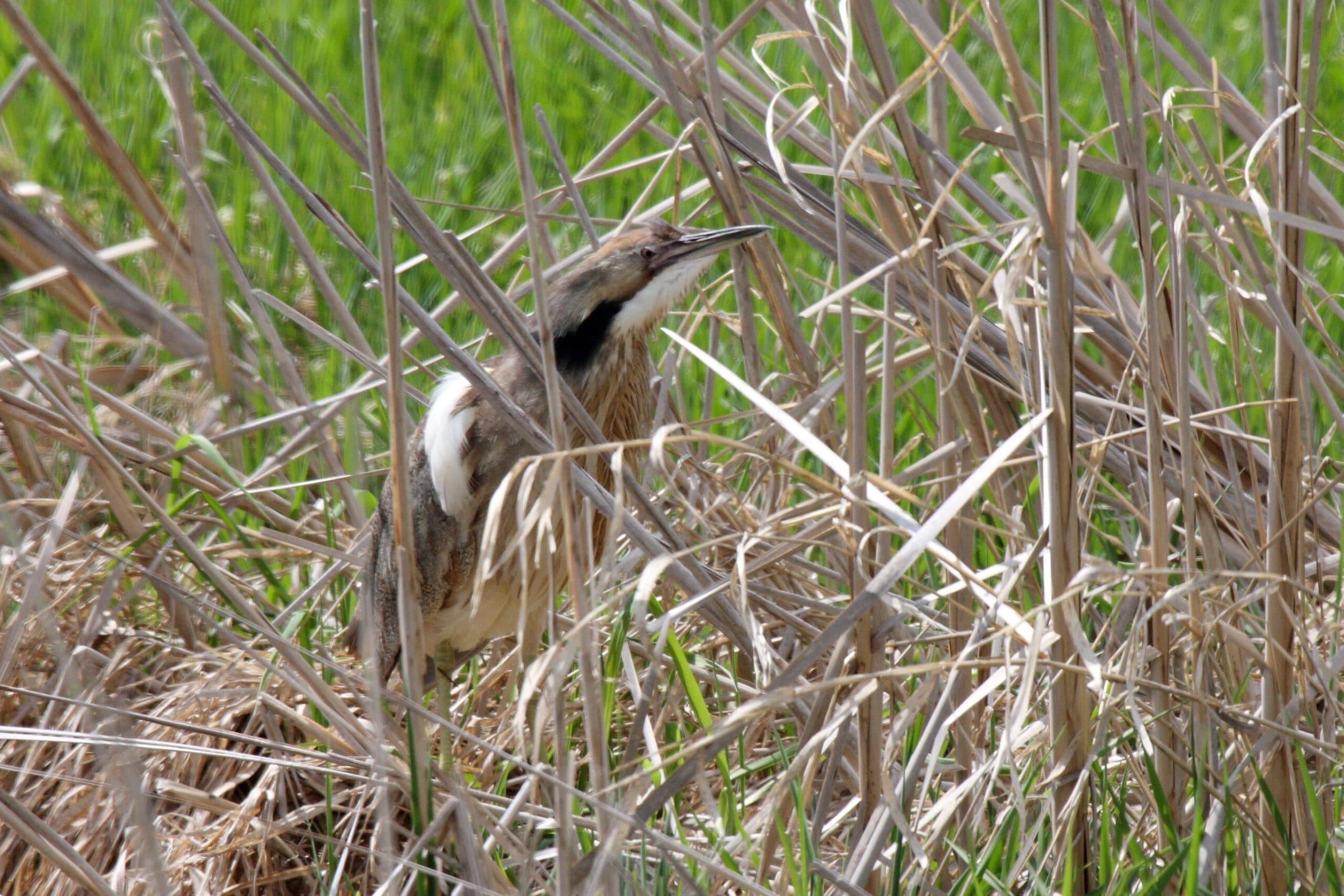
A secretive heron of the marsh
The American bittern, Botaurus lentiginosus, is a medium-sized heron of North American wetlands. It is heard more often than seen. A male’s spring call carries across the marsh as a resonant pumping sequence often written “pump-er-lunk.” Brown, buff and white streaks break up the bird’s outline among cattails and reeds, letting a motionless bittern disappear at remarkably close range.
This is a true species in the heron family Ardeidae, not a general name for every bittern. Its breeding range spans much of Canada and the northern United States, with scattered populations farther south. Most birds migrate to the southern United States, Mexico, the Caribbean and Central America for winter, although some remain year-round where shallow water stays open.
Built to blend with vertical stems
An American bittern is stocky, with a thick neck, long pointed bill, short yellowish legs and broad wings. Adults are about 58–85 centimetres long, with a wingspan near 92 centimetres. Their warm brown upperparts and strongly streaked pale underparts match dead and growing marsh vegetation. A dark stripe runs down each side of the neck, while dark flight feathers contrast with paler wing coverts in flight.
When alarmed, the bird compresses its feathers, stretches its neck and points the bill upward. It may sway with moving reeds, aligning the streaks on its neck and breast with stems. The pose is camouflage rather than paralysis; a bittern can explode into flight if danger gets too close. Its eyes are positioned to look downward while the bill remains raised, helping it monitor a threat without abandoning the disguise.
Shallow wetlands through the year
Breeding birds favor freshwater marshes with tall emergent plants such as cattails, bulrushes and sedges, interspersed with shallow open water. They use wetlands of many sizes but need enough edge for hunting and enough cover for nesting. Seasonal marshes, prairie potholes, wet meadows, beaver wetlands and managed impoundments can all contribute when water levels and vegetation create the right mosaic.
During migration, bitterns stop in marshes, flooded fields and other wet habitats. Wintering birds move to unfrozen wetlands, often nearer coasts, and sometimes use brackish marshes or damp grasslands. Water management matters: deep open water removes stalking habitat, while dense, uniform vegetation without pools reduces feeding edges. Maintaining varied water depths and connected wetland complexes supports birds across changing seasons.
A patient ambush predator
American bitterns eat fish, frogs, tadpoles, salamanders, crayfish, aquatic insects, snakes and small mammals. A hunting bird stands still or advances with extremely slow steps, toes spread across mud and floating vegetation. It gradually angles its bill toward prey, then strikes with a rapid thrust. Prey is shaken, bitten and usually swallowed headfirst; indigestible remains are later expelled as pellets.
Feeding is common at dawn and dusk, though birds also hunt during the day. The flexible diet links aquatic and terrestrial food webs. Bitterns consume predators and grazers in shallow water, while eggs, chicks and adults in turn may be taken by raccoons, mink, foxes, snakes and birds of prey. Wetland contamination can harm them directly or reduce the fish, amphibians and invertebrates on which they depend.
Booming calls and solitary lives
Outside migration and breeding encounters, American bitterns are usually solitary. Males advertise territories with low-frequency calls that travel efficiently through dense vegetation. The strange sound is produced through coordinated movements of the throat and esophagus, not by striking water or reeds. Rival males may display concealed white shoulder plumes and, if escalation continues, chase one another into the air.
Migration usually occurs at night, often singly or in small groups. In flight the neck retracts like that of other herons and the legs trail behind. Secretive behavior makes the species difficult to count, so call surveys are especially useful. Surveyors must account for time of day, season, weather and water level because silence does not necessarily mean a marsh is unoccupied.
Nesting above shallow water
The female chooses a concealed site among cattails, sedges or bulrushes and builds a low platform of dead stems, typically just above shallow water. She lays two to seven plain beige, buff or olive eggs. Incubation lasts about 24–28 days. Available observations indicate that the female builds, incubates, broods and feeds the young without regular help from the male.
Chicks hatch helpless and covered in yellow-green down. They begin leaving the immediate nest platform after roughly one to two weeks but continue depending on the female. A nest hidden in marsh vegetation remains vulnerable to abrupt water-level changes, mowing, burning and trampling. Protecting a broad buffer around occupied habitat is safer than trying to locate every well-concealed nest.
Wetland conservation is bittern conservation
The IUCN lists the American bittern as Least Concern across its broad range, yet continental status can hide serious regional declines. Cornell summarizes substantial losses in parts of the Northeast and Upper Midwest. Wetland drainage and development remove nesting and feeding sites, while siltation, nutrient pollution, pesticides, invasive plants and poorly timed water changes can degrade remaining marshes.
Conservation works best at landscape scale. USGS guidance emphasizes protecting wetlands together with adjacent uplands. Managers can retain a shifting mixture of emergent cover and open shallow water, prevent disturbance during nesting, control invasive vegetation selectively and avoid sudden drawdowns while nests are active. Networks of wetlands are valuable because drought, flooding and plant succession continually alter individual sites.
Watching without disturbing
Spring and early summer are the best times to listen for booming males from public boardwalks and observation platforms. Scan slowly along reed edges with binoculars and look for a vertical streak pattern that suddenly becomes a bird. Keep voices low, stay on established routes and never play repeated recordings close to a territorial male or nest.
Photographers should use long lenses and allow the bittern to remain concealed. A bird that freezes, compresses its feathers or points its bill upward has already noticed the observer. Backing away preserves normal feeding and nesting behavior. The most rewarding encounter is one in which the bird chooses when to move and the marsh remains quiet after the visitor leaves.