
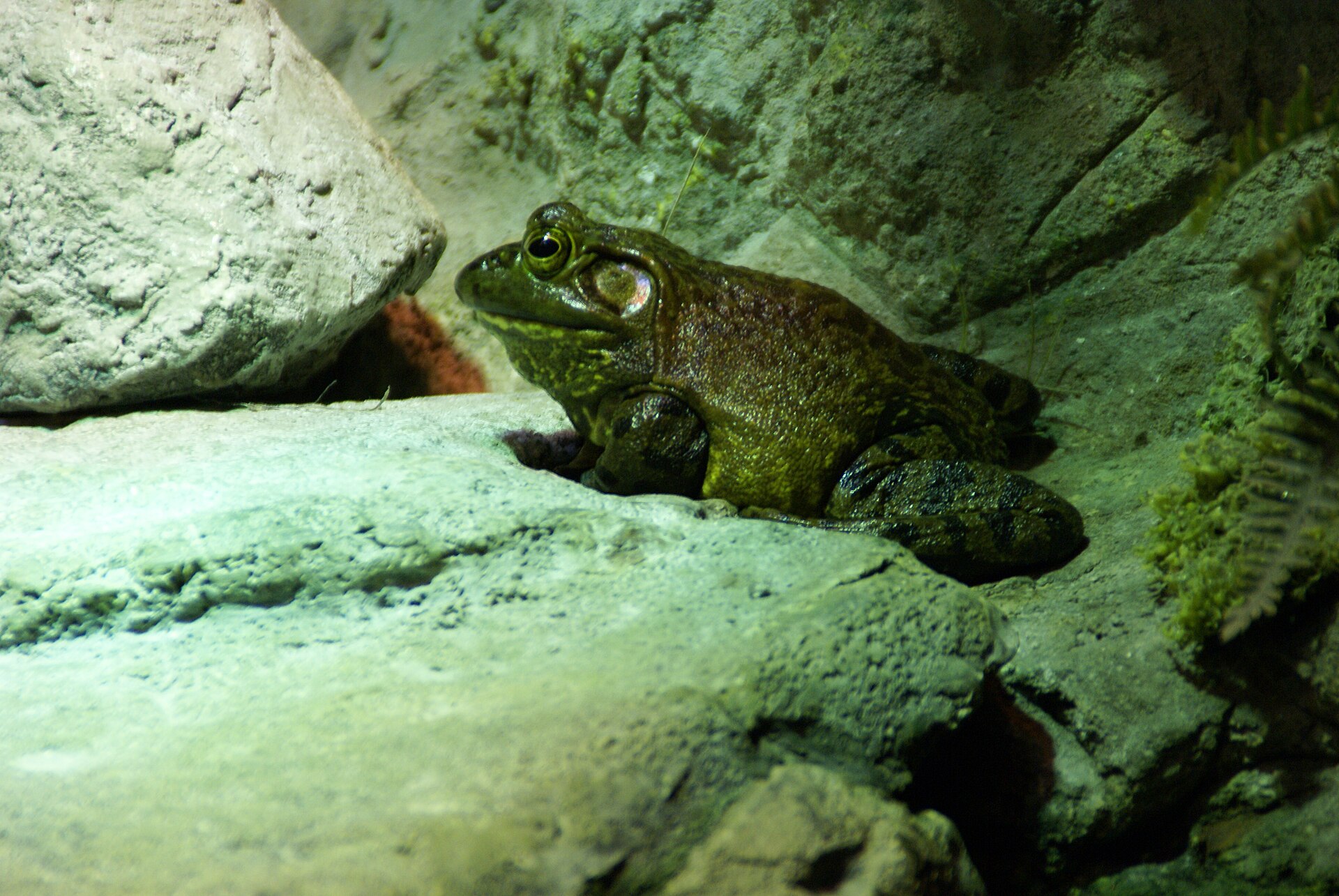
The American bullfrog is a large, highly aquatic frog native to eastern North America. Its deep breeding call is often written as “jug-o-rum,” and its size, appetite and ability to live in human-made ponds have helped it become one of the world’s best-known frogs. The same traits have also made it a damaging introduced predator in parts of western North America, Europe, Asia and South America.
Its scientific name is Lithobates catesbeianus, although readers will also encounter Rana catesbeiana and Rana (Lithobates) catesbeiana. These names reflect an ongoing difference in how specialists arrange North American true frogs. This profile uses Lithobates catesbeianus, the name used by the U.S. Geological Survey and Amphibian Species of the World, while recording the alternatives for search and identification.
How to identify an American bullfrog
Adult American bullfrogs usually measure about 9–15.2 centimeters from snout to vent, though exceptionally large animals can be longer and weigh more than 500 grams. Their skin is green, olive or brown, often with darker mottling. The belly is pale and may carry gray or brown markings. Long, powerful hind legs and extensively webbed rear feet make them strong swimmers.
A large round tympanum, or external eardrum, sits behind each eye. In mature males it is usually noticeably larger than the eye; in females it is about the same size as the eye. Breeding males commonly have a yellow throat, while females usually have a white or cream throat.
American bullfrogs lack the raised dorsolateral folds that run down the back of a green frog. A fold curves around the rear of the bullfrog’s tympanum instead. Identification should use several traits because young animals can be confused with other large green or brown frogs.
Native and introduced range
The native range covers much of the eastern and central United States and reaches into southeastern Canada. Historical boundaries are difficult to reconstruct in some northern and western watersheds because people have moved bullfrogs for food, sport and aquaculture for more than a century.
Established populations now occur far beyond the native range. Within the United States, bullfrogs have spread through much of the West. They have also been introduced to parts of Mexico, the Caribbean, South America, Europe and Asia. A country-level map shows the broad pattern, but it cannot distinguish individual native and introduced watersheds within the United States or Canada.
Introduced status matters. In the native East, the frog is part of long-established food webs. In regions where it was released, it may prey on native amphibians and other small animals, compete for food and habitat, and carry pathogens. People should never move bullfrogs, tadpoles or egg masses between waterways.
Ponds, lakes and wetland habitat
American bullfrogs favor permanent or long-lasting freshwater. They live around ponds, lakes, reservoirs, marshes, swamps, slow river backwaters, irrigation canals, ditches and cattle tanks. Deep water and emergent vegetation provide escape cover and allow tadpoles enough time to complete a lengthy larval period.
Adults usually remain near the water’s edge, sitting among vegetation or at the surface with only the eyes and nostrils exposed. Juveniles disperse overland more readily and can colonize new ponds. During cold weather, bullfrogs may overwinter underwater in bottom mud or sheltered aquatic sites, but they must remain able to exchange oxygen with the water.
Diet and hunting
Adult bullfrogs are opportunistic carnivores. They capture insects, spiders, crayfish, snails, worms, fish, other frogs and whatever other suitably sized prey comes within reach. Documented prey also includes small snakes, turtles, birds and mammals. Cannibalism occurs, especially where bullfrogs are abundant.
The frog often waits motionless, then lunges with a rapid opening of the mouth and movement of the tongue. Front feet may help push a large item into the mouth. This broad diet explains both the bullfrog’s success and concern about its effects in introduced ecosystems.
Tadpoles feed differently from adults. They graze algae, bacteria and organic material from submerged surfaces and may consume other available material. Their feeding and waste can alter nutrient movement in a pond, especially when larvae occur at high densities.
Calls, territories and daily behavior
Bullfrogs are most active from evening through night, although they may be seen by day. A disturbed frog usually makes a powerful leap into the water and swims to cover. Adults can be solitary outside breeding aggregations.
During the warm breeding season, males call from defended positions along the shoreline. The resonant call carries across water and attracts females while warning rival males. Neighboring males may posture, chase or wrestle when territorial boundaries break down.
The species hears both airborne sound and vibration through its tympana and inner ears. Its eyes sit high on the head, giving a partly submerged frog a wide view while most of the body remains concealed.
Eggs, tadpoles and metamorphosis
Breeding timing depends on latitude and temperature. Southern populations can breed across much of the warm season, while northern breeding is concentrated in late spring and summer. The male clasps the female in amplexus, and fertilization occurs externally as she releases eggs.
A female may deposit roughly 6,000–20,000 eggs in a thin floating film at the water surface. Eggs generally hatch in two to five days under suitable conditions. There is no continuing parental care after spawning.
The tadpole stage is long compared with that of many temporary-pond frogs. Transformation can occur within several months in warm regions but may take two years or longer where growing seasons are short. Tadpoles can overwinter before developing legs, absorbing the tail and leaving the water as froglets.
Slow larval development ties successful breeding to permanent water. It also helps explain why reservoirs, irrigation ponds and other human-created water bodies can support introduced populations.
Predators and defenses
Eggs, tadpoles and adults face different predators. Fish, aquatic insects, turtles, snakes, herons, mammals and larger bullfrogs may eat them. Green or brown camouflage and a motionless posture help adults avoid detection, while a sudden leap and strong swimming provide escape.
Bullfrog tadpoles contain chemicals that make them unpalatable to some predators, but this is not complete protection. Adults rely more on size, vigilance and access to deep water. When seized, a bullfrog may struggle, kick or release a distress call.
Conservation status and invasive impact
The American bullfrog is assessed as Least Concern on the IUCN Red List and is widespread overall. That global category does not mean every local population is stable, nor does it mean the species is beneficial everywhere. Native populations can still be affected by wetland loss, pollution, disease and harvesting.
Outside its native range, management often aims to prevent spread or remove breeding populations. Bullfrogs can consume native frogs and other wildlife, compete with native amphibians and act as hosts for pathogens including amphibian chytrid fungus and ranaviruses. The strength of each effect differs among ecosystems, so control programmes use local evidence rather than assuming the same outcome at every pond.
Effective prevention includes stopping releases, cleaning equipment used between water bodies and following regional invasive-species rules. Removal is difficult once a connected network of permanent ponds supports eggs, tadpoles and adults.
American bullfrogs and people
Bullfrogs have been transported for frog-leg production, hunting and pond stocking. Escapes and deliberate releases helped create many introduced populations. Their call and conspicuous shoreline behavior also make them familiar subjects for wildlife watching.
A wild bullfrog is not a suitable casual pet. Adults require large aquatic enclosures, live prey and careful water-quality management, and possession may be restricted where the species is invasive. Captive animals and tadpoles must never be released. Anyone who finds a suspected introduced bullfrog should follow the reporting guidance of the local wildlife agency.