
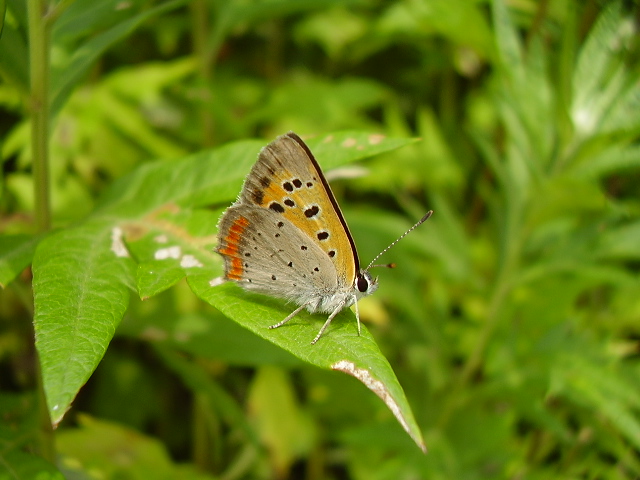
American Copper (Lycaena phlaeas) is a small gossamer-winged butterfly recognized by fiery copper forewings marked with black spots. In North America the name American Copper is standard, while the same widespread species is called the small copper across much of Eurasia. It often lives in disturbed sunny places where sheep sorrel and docks grow, but native populations also occupy Arctic tundra and western mountains. This guide separates well-supported biology from common assumptions and covers identification, range, habitat, diet, behavior, reproduction and conservation.
Identification
The upper forewing shines orange to copper-red with bold black spots and a dark outer border. The upper hindwing is brown or charcoal with an orange-red band near the edge. Below, the forewing remains orange and spotted while the hindwing is gray-brown with tiny dark marks and a zigzag orange border. Short tails are absent. Seasonal and regional forms vary in darkness, size and the width of the orange bands. Males and females are similar; females often have rounder wings and more extensive orange, while males may appear darker and more compact.
Identification should combine body shape, markings, size, voice or movement, and location. One feature by itself can overlap with a related animal, a juvenile, or an individual in unusual light.
Photographs are most useful when they preserve scale and show several diagnostic features. Handling or repositioning a wild american copper for identification can cause stress and is unnecessary.
Size and physical adaptations
American Copper typically measures Wingspan about 2.2–3.5 cm and weighs A fraction of a gram. High-elevation and Arctic populations may be smaller or darker than lowland butterflies.
Its useful adaptations include copper scales reflect warming sunlight, dark wing margins absorb heat, low fast flight evades predators, caterpillars feed within leaf tissues, pupae survive cold dormant periods, several annual broods exploit long warm seasons. These traits work together in the animal’s normal setting rather than serving as isolated curiosities.
Published measurements may use different methods, life stages or sample locations. Comparing figures responsibly means checking what was measured rather than selecting the largest number available.
Range and distribution
The species has a broad Holarctic distribution across North America, Europe and Asia and reaches northern Africa. In North America it occurs across boreal and eastern regions, Arctic country and isolated western mountain systems. Eastern populations from Nova Scotia south toward Georgia and west through the Great Lakes may reflect an early introduction from Scandinavia, while Arctic and western mountain populations are native lineages. The native range includes Canada, United States, United Kingdom, Ireland, France, Spain, Portugal, Germany, Italy, Greece, Turkey, Morocco, Japan, China, Russia.
A country-level map indicates broad distribution, not continuous occupation. Climate, elevation, water, vegetation, prey, breeding sites, barriers and survey effort all affect where records occur.
Records near the edge of the range deserve careful documentation because they may reflect natural movement, improved survey coverage, accidental transport or a genuine distribution change.
Habitat
Open sunny ground including old fields, roadsides, pastures, vacant lots, tundra, rocky slopes and alpine meadows.
The essential feature is low vegetation containing larval host plants in the buckwheat family. In eastern towns, sheep sorrel colonizes poor acidic soil along paths and abandoned lots, creating habitat in heavily modified landscapes. Arctic and alpine butterflies use sheltered, sun-warmed patches where low sorrels grow. Adults perch on bare ground, stones or flower heads and return repeatedly to favored sunny territories. Protecting a population therefore requires the feeding, shelter and breeding features that make a site usable, along with connections that allow movement.
Microhabitat matters. Shade, soil, current, moisture, shelter or host plants can determine whether a small area is usable even when the surrounding landscape appears suitable.
Diet and feeding
American Copper is a herbivore as a caterpillar; nectar feeder as an adult. Important foods include sheep sorrel leaves, curled dock leaves, mountain sorrel leaves, buttercup nectar, white clover nectar, yarrow nectar, ox-eye daisy nectar, goldenrod and other composite flowers. A young caterpillar hatches beside its host plant and chews the underside of a leaf, leaving the upper surface partly intact. Older larvae excavate channels or eat more openly while remaining well camouflaged against green tissue. Adults uncoil a long proboscis to drink nectar from low flowers. They also take minerals from damp soil, and feeding choices shift with local flowering seasons.
Diet changes with age, season, location and food supply. A dramatic prey record does not establish what most individuals eat most of the time; repeated field observations provide a stronger picture.
Feeding opportunities also create risk. An animal focused on prey may be less alert to predators, traffic or people, while contaminated prey can transfer pollutants through the food web.
Behavior and communication
Diurnal in sunny weather; flight pauses during cool, cloudy or windy conditions. Males perch on short vegetation or bare ground, watching for passing females and darting at rival butterflies. The flight is quick, close to the ground and punctuated by abrupt landings. Adults open their wings to bask, aligning the dark margins and copper surfaces with the sun. When disturbed they flash orange, then close the gray underside against the background.
Color, movement and scent guide courtship. A male detects a moving butterfly, approaches and assesses its wing pattern and chemical cues. Females inspect host plants through sight, smell and taste receptors on the legs before placing eggs. Caterpillars and pupae may produce faint vibrations or sounds, a trait found in several lycaenid butterflies, though its role in this species is not fully resolved. Behavior should be interpreted in context: alarm, courtship, feeding and temperature regulation can produce very different actions from the same animal.
Daily schedules are flexible responses, not rigid rules. Weather, breeding condition, disturbance, tides or food can move activity into a different part of the day.
Reproduction and development
A female lays pale eggs one at a time on the stems or leaves of sorrel and dock. Solitary larvae pass through several molts while eating the host. They become green, sometimes with a reddish dorsal stripe, and their flattened form resembles a small slug. The mature larva forms a chrysalis near the ground among leaves or debris. Depending on climate, the species may overwinter as a larva or pupa. Eggs laid singly; a female distributes many across suitable plants Egg, caterpillar, chrysalis and adult complete metamorphosis. Warm lowlands can produce two or three broods from spring through early autumn. Farther north or high in mountains, one summer generation is usual. Development slows sharply in cold conditions, and the dormant stage bridges winter until host growth and sunshine return.
Young animals face different risks and may use different microhabitats or food than adults. Breeding success depends on adult condition, suitable sites and the survival of offspring through vulnerable early stages.
Counts of eggs or young describe reproductive output, not the number expected to reach adulthood. Mortality is normally greatest during eggs, larval or juvenile stages.
Predators and ecological role
Caterpillars convert sorrel leaves into food for spiders, wasps, birds and other predators. Adults pollinate flowers while taking nectar, although their small size and short visits make them one member of a much larger pollinator community. Parasitoid wasps and flies can develop inside larvae or pupae. The butterfly’s ability to use weeds in disturbed ground helps it persist in cities, yet isolated alpine populations depend on intact cool microclimates. Documented or likely predators include Crab Spiders, Paper Wasps, Insectivorous Birds, Parasitoid Wasps.
This animal is both a consumer and a food source. Its influence comes through many repeated interactions, so ecological claims should be based on measured populations rather than assumptions drawn from appearance.
Predator and prey relationships differ among places. A species can be ecologically influential without being abundant everywhere, and its role can change across its range.
Relationship with people
American Coppers benefit from small patches of unmown sorrel and continuous nectar from spring through fall. Blanket herbicide use, frequent mowing and insecticides remove both host leaves and adult food. Gardeners can retain a sunny corner of sheep sorrel where appropriate, avoid spraying flowers and provide shallow damp mineral patches. Collecting should follow local rules, especially around isolated mountain populations.
The butterfly does not bite, sting or damage buildings. Observe without handling because wing scales rub off easily and pressure can damage the body. Host plants should never be added where they are regulated weeds, and pesticide labels should be followed to protect people and wildlife. Responsible observation means keeping an appropriate distance, avoiding capture or feeding, protecting habitat and following local wildlife or invasive-species guidance.
Wildlife guidance should come from the responsible local agency because collection rules, reporting requests and appropriate responses differ between native and introduced ranges.
Conservation
Lycaena phlaeas is globally widespread and NatureServe ranks it G5, or secure. Routine conservation is usually unnecessary across the broad range, but peripheral and isolated mountain populations can be rare. Local losses can follow intensive mowing, pesticide use, development or climate-driven changes that remove cool alpine habitat. The reported global trend is Stable overall, with local changes tied to land use and climate.
Important pressures include loss of open flower-rich habitat, herbicide removal of sorrel hosts, insecticide exposure, frequent mowing, climate warming in alpine refuges, development of vacant and rocky ground. Global status can hide local decline or recovery, so current regional monitoring and habitat management remain necessary.
The most useful conservation action follows the documented pressure. Protecting breeding sites, reducing road deaths or limiting pollutants can require different tools in different populations.
