
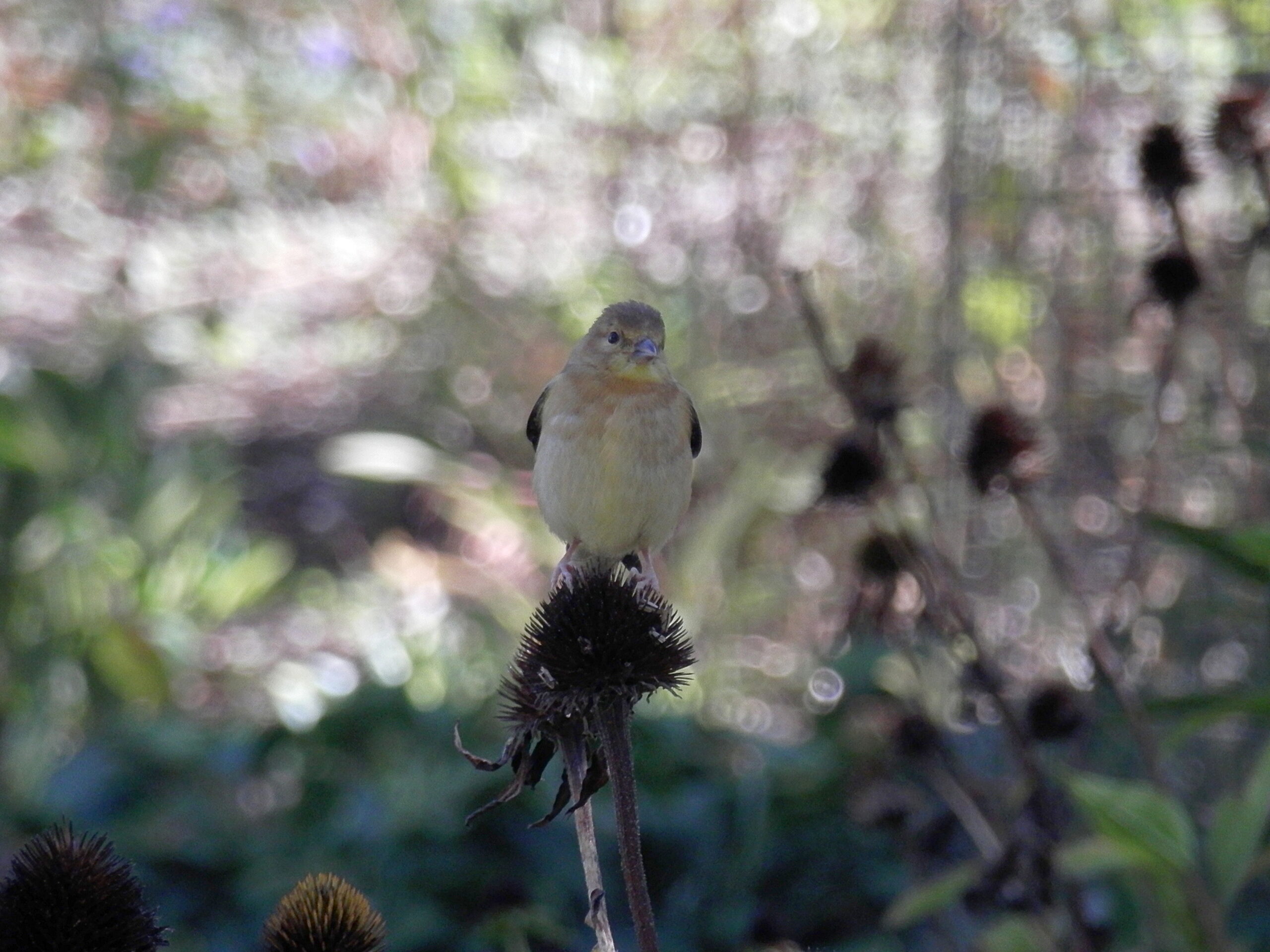
American Goldfinch (Spinus tristis) is a small nomadic finch of open fields, roadsides and gardens across much of North America. Its bounding flight, musical contact call and late summer nesting schedule are closely tied to ripening thistle and other seeds. This guide separates well-supported biology from common assumptions and covers identification, range, habitat, diet, behavior, reproduction and conservation.
Identification
Breeding males are lemon yellow with a black forehead, black wings marked by white bars and a black tail with white patches. Females are dull yellow-olive with darker wings. In winter both sexes become muted brownish olive, but retain a short conical bill, unstreaked body, contrasting wing bars and a pointed notched tail. Breeding males are brighter yellow with a black cap; females remain olive-yellow and lack the cap. Outside breeding season the difference narrows as males molt into dull winter plumage.
Identification should combine body shape, markings, size, voice or movement, and location. One feature by itself can overlap with a related animal, a juvenile, or an individual in unusual light.
Photographs are most useful when they preserve scale and show several diagnostic features. Handling or repositioning a wild american goldfinch for identification can cause stress and is unnecessary.
Size and physical adaptations
American Goldfinch typically measures 11–13 cm and weighs 11–20 g. A compact finch about the size of a small sparrow, with seasonal and individual variation in mass.
Its useful adaptations include conical bill removes small seeds from flower heads, feet grip swaying stems while feeding, bounding flight alternates flapping and closed-wing glides, twice-yearly molt changes seasonal camouflage and display, late nesting aligns chick rearing with peak seed supply. These traits work together in the animal’s normal setting rather than serving as isolated curiosities.
Published measurements may use different methods, life stages or sample locations. Comparing figures responsibly means checking what was measured rather than selecting the largest number available.
Range and distribution
Breeds across southern Canada and much of the contiguous United States, shifting southward and becoming more widespread in the southern United States and northern Mexico during winter. Some populations remain year-round where food persists. The native range includes Canada, United States, Mexico, Bahamas.
A country-level map indicates broad distribution, not continuous occupation. Climate, elevation, water, vegetation, prey, breeding sites, barriers and survey effort all affect where records occur.
Records near the edge of the range deserve careful documentation because they may reflect natural movement, improved survey coverage, accidental transport or a genuine distribution change.
Habitat
Weedy fields, meadows, floodplains, roadsides, orchards, open woodland edges, gardens and suburban plantings.
Birds forage wherever composite flowers, grasses, birches and alders provide seeds. They nest in shrubs and saplings near open feeding habitat and gather into flocks outside the breeding season. Protecting a population therefore requires the feeding, shelter and breeding features that make a site usable, along with connections that allow movement.
Microhabitat matters. Shade, soil, current, moisture, shelter or host plants can determine whether a small area is usable even when the surrounding landscape appears suitable.
Diet and feeding
American Goldfinch is a specialized granivore with minor seasonal animal food. Important foods include thistle seeds, sunflower seeds, nyjer seed, aster seeds, birch seeds, alder seeds, grass seeds. Goldfinches cling acrobatically to seed heads, using the bill to open husks and the tongue to extract kernels. Flocks also feed on fallen seeds and visit feeders. Tiny invertebrates may be swallowed incidentally, but seeds dominate even the food regurgitated to young.
Diet changes with age, season, location and food supply. A dramatic prey record does not establish what most individuals eat most of the time; repeated field observations provide a stronger picture.
Feeding opportunities also create risk. An animal focused on prey may be less alert to predators, traffic or people, while contaminated prey can transfer pollutants through the food web.
Behavior and communication
Diurnal, often traveling and feeding in flocks. Their flight rises and falls in a series of flaps and glides, often accompanied by a rhythmic flight call. Birds wander in response to seed crops, form mixed winter flocks and become territorial around nesting pairs in summer.
The familiar flight call is often rendered “po-ta-to-chip” or “per-chick-o-ree,” synchronized with bounding wingbeats. Males sing long musical series during courtship, and pairs use soft contact and alarm calls near the nest. Behavior should be interpreted in context: alarm, courtship, feeding and temperature regulation can produce very different actions from the same animal.
Daily schedules are flexible responses, not rigid rules. Weather, breeding condition, disturbance, tides or food can move activity into a different part of the day.
Reproduction and development
Pairs form after courtship flights and songs. The female builds a tightly woven cup in a shrub or small tree, using plant fibers and spider silk, and lines it with soft thistle down. She incubates while the male brings food. Usually 2–7 eggs, commonly 4–6 Chicks hatch helpless and sparsely downed. Both parents feed them regurgitated seeds. Young leave the nest around 11–17 days after hatching but remain dependent briefly while developing flight and foraging skill.
Young animals face different risks and may use different microhabitats or food than adults. Breeding success depends on adult condition, suitable sites and the survival of offspring through vulnerable early stages.
Counts of eggs or young describe reproductive output, not the number expected to reach adulthood. Mortality is normally greatest during eggs, larval or juvenile stages.
Predators and ecological role
Goldfinches disperse some seeds, consume enormous quantities of weed seed and serve as prey for raptors, snakes and mammals. Their late breeding season tracks the dependable seed and plant-down supply of midsummer fields. Documented or likely predators include Sharp-shinned Hawk, American Kestrel, Blue Jay, Domestic Cat.
This animal is both a consumer and a food source. Its influence comes through many repeated interactions, so ecological claims should be based on measured populations rather than assumptions drawn from appearance.
Predator and prey relationships differ among places. A species can be ecologically influential without being abundant everywhere, and its role can change across its range.
Relationship with people
American goldfinches are popular feeder and garden birds and are official state birds of Iowa, New Jersey and Washington. People benefit them by maintaining native seed plants, clean water and safely placed feeders.
Observe without handling. Keep feeders and baths clean, space them to reduce crowding, and take them down temporarily when disease is suspected. Keep cats indoors and place feeders to reduce window collisions. Responsible observation means keeping an appropriate distance, avoiding capture or feeding, protecting habitat and following local wildlife or invasive-species guidance.
Wildlife guidance should come from the responsible local agency because collection rules, reporting requests and appropriate responses differ between native and introduced ranges.
Conservation
The IUCN Red List classifies Spinus tristis as Least Concern. It remains widespread and numerous, though long-term monitoring indicates declines in some regions and climate change may shift its breeding range. The reported global trend is Declining in parts of the range.
Important pressures include loss of weedy open habitat, pesticide exposure, window collisions, domestic cats, feeder disease outbreaks, climate-driven range shifts. Global status can hide local decline or recovery, so current regional monitoring and habitat management remain necessary.
The most useful conservation action follows the documented pressure. Protecting breeding sites, reducing road deaths or limiting pollutants can require different tools in different populations.
