
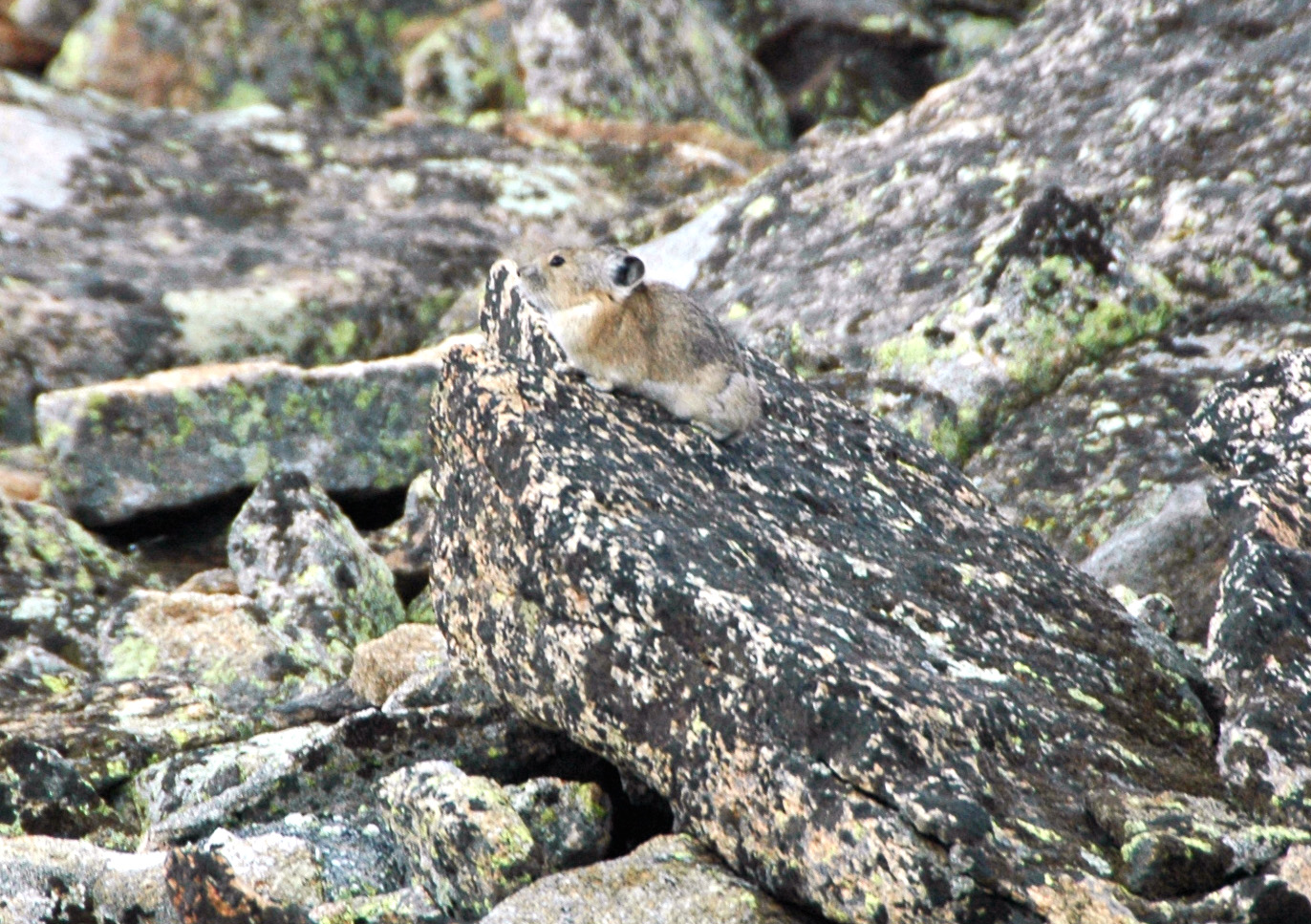
American Pika (Ochotona princeps) is a small relative of rabbits and hares that lives among broken rock slopes in the mountains of western North America. Round ears, dense fur, a nearly hidden tail and a sharp alarm call suit life in talus. Unlike many small alpine mammals, it does not hibernate; instead, it stores dried vegetation and remains active beneath snow. This guide separates well-supported biology from common assumptions and covers identification, range, habitat, diet, behavior, reproduction and conservation.
Identification
The American pika has a compact, egg-shaped body, short limbs, rounded ears edged in dark fur and no externally visible tail. Dense gray-brown to cinnamon fur blends with talus. Its silhouette is smaller and rounder than a rabbit, and its equal-length fore and hind limbs produce quick bounds rather than long leaps. Males and females are very similar in appearance; males may average slightly heavier in some populations.
Identification should combine body shape, markings, size, voice or movement, and location. One feature by itself can overlap with a related animal, a juvenile, or an individual in unusual light.
Photographs are most useful when they preserve scale and show several diagnostic features. Handling or repositioning a wild american pika for identification can cause stress and is unnecessary.
Size and physical adaptations
American Pika typically measures 17.8–21.6 cm and weighs 121–176 g commonly. Body size varies among mountain regions, seasons and subspecies; adults are roughly the size of a large potato.
Its useful adaptations include dense fur insulates in cold alpine weather, high metabolism supports year-round activity, rock crevices provide cool thermal refuges, haypiles store diverse plants for winter, short rounded ears reduce heat loss, sharp calls warn neighbors of danger. These traits work together in the animal’s normal setting rather than serving as isolated curiosities.
Published measurements may use different methods, life stages or sample locations. Comparing figures responsibly means checking what was measured rather than selecting the largest number available.
Range and distribution
American pikas occupy discontinuous mountain ranges from southern British Columbia and Alberta through the Cascade Range, Sierra Nevada, Great Basin and Rocky Mountains to California and northern New Mexico. Populations are separated by warm valleys and occur at lower elevations where lava flows, caves or cool rock interiors provide suitable microclimates. The native range includes Canada, United States.
A country-level map indicates broad distribution, not continuous occupation. Climate, elevation, water, vegetation, prey, breeding sites, barriers and survey effort all affect where records occur.
Records near the edge of the range deserve careful documentation because they may reflect natural movement, improved survey coverage, accidental transport or a genuine distribution change.
Habitat
Talus slopes, boulder fields, fractured lava and rocky mountain margins beside meadows or other vegetation.
Pikas shelter, nest and travel through cool spaces beneath rocks while feeding at the talus edge. Each adult defends a territory containing refuge crevices and one or more haypiles. Snow tunnels provide access to stored food and nearby vegetation during winter. Protecting a population therefore requires the feeding, shelter and breeding features that make a site usable, along with connections that allow movement.
Microhabitat matters. Shade, soil, current, moisture, shelter or host plants can determine whether a small area is usable even when the surrounding landscape appears suitable.
Diet and feeding
American Pika is a generalist herbivore. Important foods include grasses, sedges, wildflowers and forbs, shrub leaves and twigs, fern fronds, lichens, conifer needles and twigs. During the growing season a pika eats fresh plants and repeatedly carries mouthfuls back to drying sites. It spreads cut vegetation in the sun, turns or moves it as needed and stores the cured material under rocks. Like other lagomorphs, it re-ingests nutrient-rich cecal pellets to extract more value from fibrous food.
Diet changes with age, season, location and food supply. A dramatic prey record does not establish what most individuals eat most of the time; repeated field observations provide a stronger picture.
Feeding opportunities also create risk. An animal focused on prey may be less alert to predators, traffic or people, while contaminated prey can transfer pollutants through the food web.
Behavior and communication
Diurnal and active throughout the year, with summer activity concentrated in cooler hours. American pikas are conspicuous by voice but often difficult to see. They sit on lookout rocks, dash through crevices, defend haypiles and chase intruders. Adults are relatively asocial outside courtship, although neighboring territories and warning calls form a loose acoustic community.
A short, high call alerts neighbors to predators or intruders and advertises territory. Males may give a longer song during the breeding season. Cheek rubbing, urine and feces add scent information around territorial boundaries and haypiles. Behavior should be interpreted in context: alarm, courtship, feeding and temperature regulation can produce very different actions from the same animal.
Daily schedules are flexible responses, not rigid rules. Weather, breeding condition, disturbance, tides or food can move activity into a different part of the day.
Reproduction and development
Pairs usually form between adults on neighboring territories. Breeding begins before snow has fully melted so young can grow during the short alpine summer. Females may conceive a second litter soon after the first birth, but often rear the second only when the first fails. Usually about 2–4 young Young are born in a sheltered rock nest with closed eyes and sparse fur. They grow quickly on rich milk, begin taking solid food within weeks and are generally weaned at about four weeks. Juveniles must find and defend suitable talus territory before winter.
Young animals face different risks and may use different microhabitats or food than adults. Breeding success depends on adult condition, suitable sites and the survival of offspring through vulnerable early stages.
Counts of eggs or young describe reproductive output, not the number expected to reach adulthood. Mortality is normally greatest during eggs, larval or juvenile stages.
Predators and ecological role
Pikas clip plants, redistribute nutrients through haypiles and droppings, and provide prey for weasels, martens, foxes and raptors. Their sensitivity to temperature and snow conditions makes long-term occupancy useful for studying mountain ecosystem change. Documented or likely predators include Long-tailed Weasel, American Marten, Golden Eagle, Coyote.
This animal is both a consumer and a food source. Its influence comes through many repeated interactions, so ecological claims should be based on measured populations rather than assumptions drawn from appearance.
Predator and prey relationships differ among places. A species can be ecologically influential without being abundant everywhere, and its role can change across its range.
Relationship with people
Pikas are popular with hikers and important to climate research. Visitors can protect them by watching from trails, leaving haypiles and rock shelters undisturbed, and never offering food. Moving rocks can destroy refuge spaces that have taken centuries to form.
Observe quietly from a distance and do not handle, chase or feed pikas. Mountain talus is unstable, so avoid scrambling off trail for photographs. Responsible observation means keeping an appropriate distance, avoiding capture or feeding, protecting habitat and following local wildlife or invasive-species guidance.
Wildlife guidance should come from the responsible local agency because collection rules, reporting requests and appropriate responses differ between native and introduced ranges.
Conservation
The IUCN Red List classifies Ochotona princeps as Least Concern because it remains widespread and abundant across many mountain systems. Local populations have disappeared from some warm, low-elevation sites, and warming, altered snow cover, drought and vegetation change create uneven regional risk. The reported global trend is Stable overall but declining or shifting at some sites.
Important pressures include rising summer temperatures, reduced insulating snow cover, drought and changing forage, habitat isolation, disturbance of talus and haypiles, disease including rabbit hemorrhagic disease. Global status can hide local decline or recovery, so current regional monitoring and habitat management remain necessary.
The most useful conservation action follows the documented pressure. Protecting breeding sites, reducing road deaths or limiting pollutants can require different tools in different populations.
