
Identity and classification
The American robin is Turdus migratorius, a large thrush in the family Turdidae. It is native across most of North America and is not closely related to the smaller European robin, despite sharing a familiar common name. Its scientific name refers to migration, an important part of the species’ annual cycle even though many individuals remain in the same broad region throughout winter.
This profile covers the species as a whole. Plumage, body size, migration distance and timing vary among regions and recognized subspecies. A robin on a Canadian lawn, one wintering in Mexico and one living year-round in the southern United States are all members of the same adaptable species, but their schedules may be quite different.
Appearance and identification
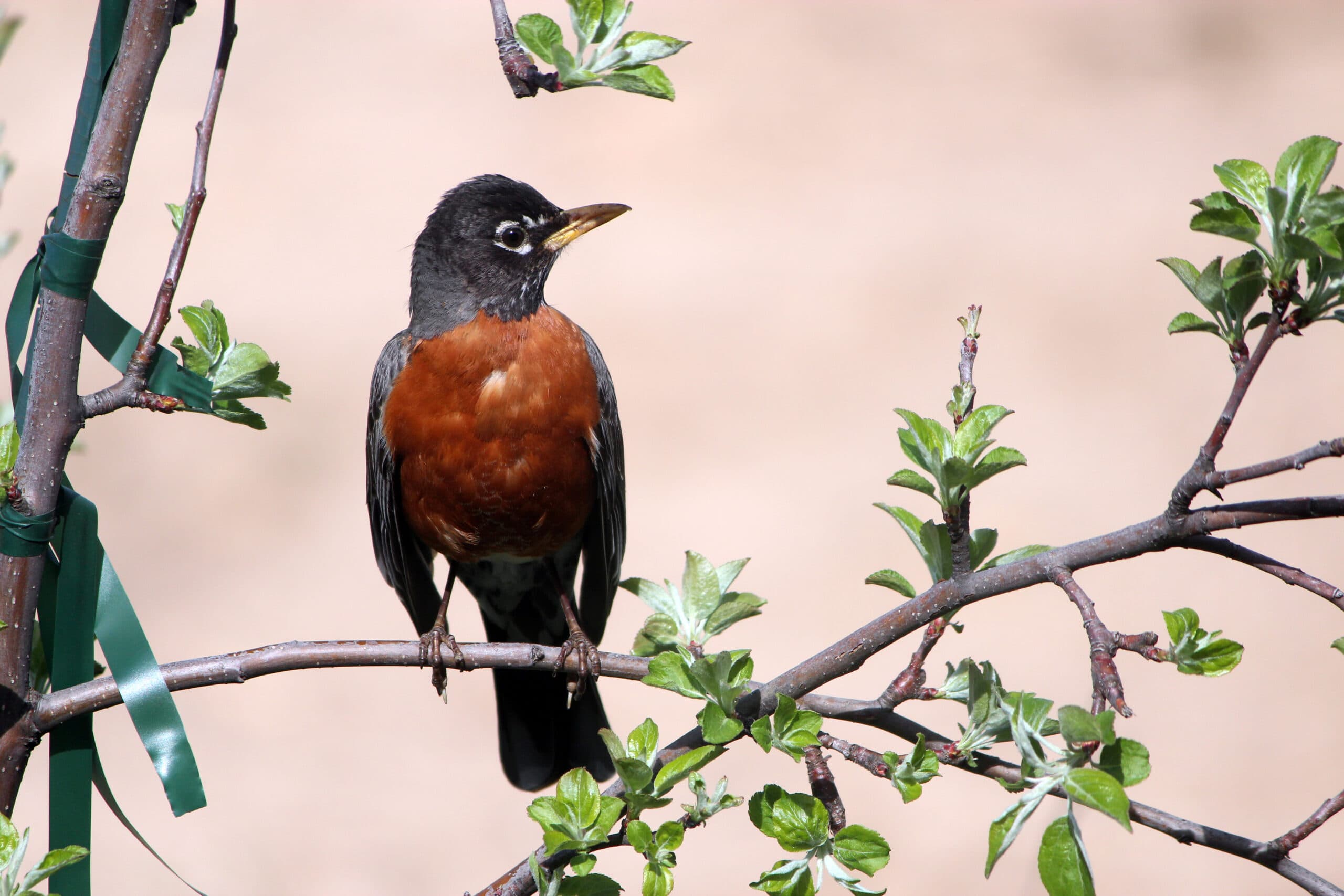
American robins are round-bodied thrushes with gray-brown backs, orange to rusty underparts, a white lower belly and white beneath the tail. The throat is pale with dark streaks, and the bill is mainly yellow. Adult males tend to have a darker head and richer breast color, while females are usually paler and less sharply contrasted. Juveniles have spotted breasts, a pattern typical of young thrushes.
Animal Diversity Web gives a length of about 23 to 28 centimeters and an average mass near 77 grams. The bird often stands upright on relatively long legs. In flight it shows a strong, direct course. On the ground its characteristic routine is to run several steps, stop abruptly, cock its head and then seize an earthworm or other invertebrate.
Range and seasonal movement
The breeding range reaches from much of the United States and southern Canada north across Alaska and northern Canada. In winter, many northern birds move into the United States, Mexico and parts of Central America. Cornell Lab of Ornithology describes the species as resident or a short-distance migrant overall, with movements shaped by latitude, weather and food. Some robins remain far north in winter but become less visible because they leave lawns and feed in wooded areas.
American robins use open woodland, forest edges, mountain forests, tundra margins, fields, farms, gardens, parks and city neighborhoods. They thrive where short ground vegetation provides feeding space and nearby trees or shrubs offer nesting and roosting sites. During winter, moist woods with berry-bearing trees and shrubs can support large flocks.
Diet and foraging
The diet shifts between invertebrates and fruit. Earthworms, beetles, caterpillars, other insects and snails are especially important in spring and summer, when adults are raising young. Cherries, dogwood fruit, hawthorn, sumac, juniper berries and many other fruits become more prominent later in the year. This seasonal flexibility lets robins remain in areas where soil prey becomes unavailable but fruit persists.
A robin does not simply listen for every worm. It uses vision, movement cues and close inspection while crossing the ground. The familiar head tilt helps position the eyes. Robins also forage in trees and shrubs, particularly when fruit is abundant. By eating fruit and later passing seeds elsewhere, they can contribute to seed dispersal across woodland edges and human landscapes.
Behavior, song and social life
During the breeding season, males defend territories and sing from elevated perches. Their musical phrases are often summarized as “cheerily, cheer up,” although real songs vary. Sharp calls warn of predators or disturbances. Visual displays, including tail spreading and wing shaking, also help with courtship and conflict.
Outside breeding, robins become much more social. Birds gather at communal night roosts, sometimes in very large numbers, then divide into smaller feeding groups by day. Seasonal flocking helps them use patchy fruit supplies and may improve predator detection. Their conspicuous daytime activity makes them familiar, but the size and location of a local group can change rapidly with weather and food.
Nesting and development
The female selects the nest site and does most of the construction. She shapes grasses and twigs into a cup, reinforces it with mud and lines it with fine dry grass. Nests commonly sit on tree branches, but robins also use ledges, gutters, outdoor light fixtures and other structures when these offer support and some concealment.
Cornell reports clutches of three to five unmarked blue or blue-green eggs. Incubation lasts about 12 to 14 days, and nestlings remain in the nest for roughly 13 days. A pair may raise one to three broods in a season, depending on latitude and conditions. Both parents feed nestlings. Young birds remain vulnerable after leaving the nest while their flight and foraging skills develop.
Ecological relationships
American robins link soil, plant and predator food webs. They consume many invertebrates and disperse seeds from a wide variety of fruits. Eggs and young may be taken by squirrels, snakes, crows and jays, while adults face hawks, falcons, owls and domestic cats. Their abundance makes them an important prey species as well as a familiar predator of lawn and forest-floor invertebrates.
Robins respond quickly to land management. Mown grass may make prey easier to reach, while mature shrubs and trees provide nesting and fruit. Pesticides can poison birds directly or reduce their food. Reflective windows and traffic add hazards in developed areas. Keeping cats indoors, reducing pesticide use and making windows safer can improve survival around homes.
Conservation
The American robin is widespread, numerous and classified as Least Concern by the IUCN. Cornell cites a Partners in Flight estimate of about 370 million breeding birds and a low continental concern score. These figures describe a secure species at the continental scale, but they do not remove local risks or guarantee equal trends everywhere.
Because robins forage on lawns and readily occupy towns, they can reveal environmental problems close to people. Chemical exposure, collisions and habitat simplification can all cause preventable deaths. Protecting native fruiting shrubs, leaving some leaf litter for invertebrates and avoiding disturbance near active nests support robins along with many less common birds.
