
Home/Animals/Amphibia/American Toad
Species profileIUCN: LC

American Toad

Anaxyrus americanus

A widespread North American toad recognized by dry warty skin, dark-spotted back and a musical spring trill.

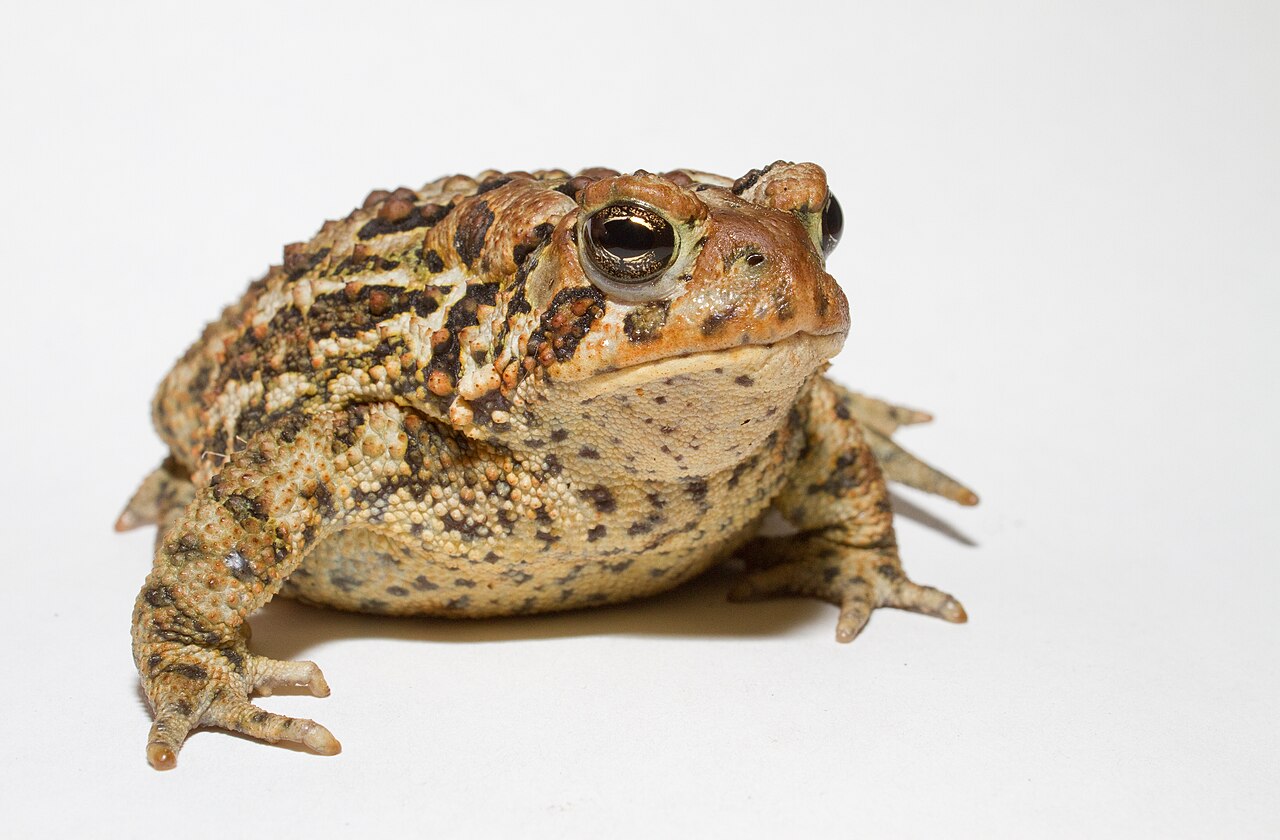
Adult American toad showing warty skin and dark dorsal spots
Brian Gratwicke / Wikimedia Commons / CC BY 2.0
🌐 Read in Language:

⚡ At a Glance

Species profile
Also Known As
Eastern American toad
Diet Category
Insectivore
Activity Rhythm
Mostly nocturnal in warm weather and inactive underground during winter.
Wild Lifespan
Often several years in the wild; exceptional individuals live longer
Typical Weight
commonly several tens of grams
Conservation Status
LC
💡 Key Biological Insight: Unlike frogs that make long leaps, American toads usually move in short hops.

🌳 Scientific Taxonomy Hierarchy

The American toad is a true toad in family Bufonidae. Modern references place it in genus Anaxyrus; older sources may use Bufo americanus.

KingdomAnimalia
PhylumChordata
ClassAmphibia
OrderAnura
FamilyBufonidae
GenusAnaxyrus
SpeciesAnaxyrus americanus

Distinguishing Anatomical Features

  • ✓It has a broad body, dry-looking glandular skin, prominent oval parotoid glands behind the eyes and usually one or two large warts inside each dark dorsal spot. Background color can shift among brown, gray, reddish and olive tones.
  • ✓Parotoid glands release defensive bufotoxins
  • ✓Warty skin provides camouflage
  • ✓Powerful hind limbs make short hops
  • ✓A sticky tongue captures moving prey

📏 Physical Measurements

Total Lengthabout 2–3.5 in snout-to-vent
Body Weightcommonly around 1–3 oz
Tail LengthAdults have no tail
WingspanNot applicable
Top SpeedNo dependable universal maximumMovement changes with context and conditions.

🎨 Appearance & Distinctive Markings

BrownGrayReddishOliveBlackCream

Skin / Covering: Glandular, warty skin

Sexual Dimorphism: Females average larger than males. Breeding males develop dark throat skin and nuptial pads on the thumbs.

🗺️ Geographic Distribution & Habitat

Native across much of eastern and central Canada and the United States, from Atlantic regions west into the Great Plains.

Deciduous and mixed woods, forest edges, meadows, gardens and fields with loose soil and nearby shallow breeding water.

Country-level distribution map

Native range
FijiTanzaniaWestern SaharaCanada — Native rangeUnited States — Native rangeKazakhstanUzbekistanPapua New GuineaIndonesiaArgentinaChileCongo - KinshasaSomaliaKenyaSudanChadHaitiDominican RepublicRussiaBahamasFalkland IslandsNorwayGreenlandFrench Southern TerritoriesTimor-LesteSouth AfricaLesothoMexicoUruguayBrazilBoliviaPeruColombiaPanamaCosta RicaNicaraguaHondurasEl SalvadorGuatemalaBelizeVenezuelaGuyanaSurinameFranceEcuadorPuerto RicoJamaicaCubaZimbabweBotswanaNamibiaSenegalMaliMauritaniaBeninNigerNigeriaCameroonTogoGhanaCôte d’IvoireGuineaGuinea-BissauLiberiaSierra LeoneBurkina FasoCentral African RepublicCongo - BrazzavilleGabonEquatorial GuineaZambiaMalawiMozambiqueEswatiniAngolaBurundiIsraelLebanonMadagascarPalestinian TerritoriesGambiaTunisiaAlgeriaJordanUnited Arab EmiratesQatarKuwaitIraqOmanVanuatuCambodiaThailandLaosMyanmar (Burma)VietnamNorth KoreaSouth KoreaMongoliaIndiaBangladeshBhutanNepalPakistanAfghanistanTajikistanKyrgyzstanTurkmenistanIranSyriaArmeniaSwedenBelarusUkrainePolandAustriaHungaryMoldovaRomaniaLithuaniaLatviaEstoniaGermanyBulgariaGreeceTürkiyeAlbaniaCroatiaSwitzerlandLuxembourgBelgiumNetherlandsPortugalSpainIrelandNew CaledoniaSolomon IslandsNew ZealandAustraliaSri LankaChinaTaiwanItalyDenmarkUnited KingdomIcelandAzerbaijanGeorgiaPhilippinesMalaysiaBruneiSloveniaFinlandSlovakiaCzechiaEritreaJapanParaguayYemenSaudi ArabiaCyprusMoroccoEgyptLibyaEthiopiaDjiboutiUgandaRwandaBosnia & HerzegovinaNorth MacedoniaSerbiaMontenegroKosovoTrinidad & TobagoSouth Sudan
Highlighted countries are recorded profile locations, not precise biological range boundaries.Map boundaries: Natural Earth

Recorded Native Countries & Territories:

💡 Did You Know?

  • 💡Parotoid glands release defensive bufotoxins
  • 💡Warty skin provides camouflage
  • 💡Powerful hind limbs make short hops
  • 💡A sticky tongue captures moving prey

🌿 Conservation Status & Threats

IUCN: LC — Least Concern

“Least Concern globally because of its broad distribution, although local populations can decline when breeding ponds and surrounding uplands are lost or polluted.”

Population Trend📈 Stable
Wild Population EstimateLarge and widespread, with no single current total.

⚠️ Major Threats to American Toad

  • •Wetland drainage
  • •Road mortality during breeding migrations
  • •Pesticide exposure
  • •Disease and climate-driven pond change

🔄 Life Cycle & Reproduction

Wild vs. Captivity Lifespan Comparison

🌿 In the WildOften several years in the wild; exceptional individuals live longer
🏠 In Captivity (with veterinary care)Can exceed a decade under expert care
Clutch / Litter SizeA female lays thousands of dark eggs in long paired gelatinous strings.
Incubation / GestationEggs often hatch within several days to two weeks depending on temperature
Fledging / WeaningAquatic tadpoles transform into tiny terrestrial toadlets after roughly five to ten weeks, with timing controlled by temperature and pond conditions.
Sexual MaturityUsually two to three years
Mating SystemAquatic amplexus with external fertilization
Nesting / Den TypeEgg strings attached to submerged vegetation or resting on shallow pond bottoms

🦅 Behavior & Field Ecology

Insectivore

🌐 Ecological Food Web & Relationships: It controls many small invertebrates and transfers energy between aquatic breeding pools and terrestrial food webs.

Social Group SizeSolitary outside seasonal breeding aggregations
Activity RhythmMostly nocturnal in warm weather and inactive underground during winter.
Feeding StrategyInsectivore

🥩 Primary Prey & Preferred Diet

✓ Beetles✓ Ants✓ Flies✓ Moths✓ Earthworms✓ Other small invertebrates

📢 Communication & Territorial Signals

  • Long musical breeding trill
  • Body posture
  • Chemical cues

🐾 Wild Temperament & Traits

• Secretive• Terrestrial• Defensive when handled

🤝 Human Interaction & Pet Advisory

⚠️ Strictly Wild Species
🚫

Can You Keep a American Toad as a Pet?

Wild individuals should be left in place; captive care requires amphibian expertise and attention to local collection laws.

Domestication StatusWild and not domesticated
Danger to HumansLow to people; defensive secretions can irritate
Economic & Ecotourism RoleConsumes garden invertebrates and serves as an indicator of connected wetland and upland habitat.

⚠️ Behavioral Risk Factors & Wildlife Safety

  • Parotoid-gland secretions irritate eyes and mucous membranes
  • Pets can become ill after mouthing a toad

🌐 Ecological Food Web & Relationships

🦅 Natural Predators (3)

Garter SnakesThamnophis species
RaccoonProcyon lotor
Wading BirdsArdeidae

🧬 Related Species (2)

Fowler’s ToadAnaxyrus fowleriSimilar eastern species with more warts in each dark spot
Canadian ToadAnaxyrus hemiophrysRelated northern and prairie species

American Toad (Anaxyrus americanus) is a terrestrial amphibian native to eastern and central North America. This guide separates well-supported biology from common assumptions and covers identification, range, habitat, diet, behavior, reproduction and conservation.

Identification

It has a broad body, dry-looking glandular skin, prominent oval parotoid glands behind the eyes and usually one or two large warts inside each dark dorsal spot. Background color can shift among brown, gray, reddish and olive tones. Females average larger than males. Breeding males develop dark throat skin and nuptial pads on the thumbs.

Identification should combine body shape, markings, size, voice or movement, and location. One feature by itself can overlap with a related animal, a juvenile, or an individual in unusual light.

Photographs are most useful when they preserve scale and show several diagnostic features. Handling or repositioning a wild american toad for identification can cause stress and is unnecessary.

Size and physical adaptations

American Toad typically measures about 5–9 cm snout-to-vent and weighs commonly several tens of grams. Size overlaps related toads and should not be used alone for identification.

Its useful adaptations include parotoid glands release defensive bufotoxins, warty skin provides camouflage, powerful hind limbs make short hops, a sticky tongue captures moving prey. These traits work together in the animal’s normal setting rather than serving as isolated curiosities.

Published measurements may use different methods, life stages or sample locations. Comparing figures responsibly means checking what was measured rather than selecting the largest number available.

Range and distribution

Native across much of eastern and central Canada and the United States, from Atlantic regions west into the Great Plains. The native range includes Canada, United States.

A country-level map indicates broad distribution, not continuous occupation. Climate, elevation, water, vegetation, prey, breeding sites, barriers and survey effort all affect where records occur.

Records near the edge of the range deserve careful documentation because they may reflect natural movement, improved survey coverage, accidental transport or a genuine distribution change.

Habitat

Deciduous and mixed woods, forest edges, meadows, gardens and fields with loose soil and nearby shallow breeding water.

Adults spend much of the year on land, sheltering under leaf litter, logs or soil, while eggs and tadpoles require fish-free or low-predator ponds and pools. Protecting a population therefore requires the feeding, shelter and breeding features that make a site usable, along with connections that allow movement.

Microhabitat matters. Shade, soil, current, moisture, shelter or host plants can determine whether a small area is usable even when the surrounding landscape appears suitable.

Diet and feeding

American Toad is a insectivore. Important foods include beetles, ants, flies, moths, earthworms, other small invertebrates. It waits or moves slowly on the ground, then flicks its tongue at suitably sized prey. Tadpoles graze algae, detritus and microorganisms.

Diet changes with age, season, location and food supply. A dramatic prey record does not establish what most individuals eat most of the time; repeated field observations provide a stronger picture.

Feeding opportunities also create risk. An animal focused on prey may be less alert to predators, traffic or people, while contaminated prey can transfer pollutants through the food web.

Behavior and communication

Mostly nocturnal in warm weather and inactive underground during winter. Males gather at shallow water in spring and produce a long, high musical trill. Adults inflate the body and lower the head when threatened.

The male advertisement call attracts females and separates calling individuals; touch and chemical cues also matter at close range. Behavior should be interpreted in context: alarm, courtship, feeding and temperature regulation can produce very different actions from the same animal.

Daily schedules are flexible responses, not rigid rules. Weather, breeding condition, disturbance, tides or food can move activity into a different part of the day.

Reproduction and development

Breeding occurs mainly in spring after rain and warming temperatures. A female lays thousands of dark eggs in long paired gelatinous strings. undefined

Young animals face different risks and may use different microhabitats or food than adults. Breeding success depends on adult condition, suitable sites and the survival of offspring through vulnerable early stages.

Counts of eggs or young describe reproductive output, not the number expected to reach adulthood. Mortality is normally greatest during eggs, larval or juvenile stages.

Predators and ecological role

It controls many small invertebrates and transfers energy between aquatic breeding pools and terrestrial food webs. Documented or likely predators include Garter Snakes, Raccoon, Wading Birds.

This animal is both a consumer and a food source. Its influence comes through many repeated interactions, so ecological claims should be based on measured populations rather than assumptions drawn from appearance.

Predator and prey relationships differ among places. A species can be ecologically influential without being abundant everywhere, and its role can change across its range.

Relationship with people

American toads frequently use gardens and yards where cover, moisture and insect prey remain available.

Skin secretions can irritate eyes and mouths. Do not let pets mouth a toad, avoid unnecessary handling, and wash hands after accidental contact. Responsible observation means keeping an appropriate distance, avoiding capture or feeding, protecting habitat and following local wildlife or invasive-species guidance.

Wildlife guidance should come from the responsible local agency because collection rules, reporting requests and appropriate responses differ between native and introduced ranges.

Conservation

Least Concern globally because of its broad distribution, although local populations can decline when breeding ponds and surrounding uplands are lost or polluted. The reported global trend is Stable.

Important pressures include wetland drainage, road mortality during breeding migrations, pesticide exposure, disease and climate-driven pond change. Global status can hide local decline or recovery, so current regional monitoring and habitat management remain necessary.

The most useful conservation action follows the documented pressure. Protecting breeding sites, reducing road deaths or limiting pollutants can require different tools in different populations.

Sources and further reading

❓ Frequently Asked Questions

Answers to frequently asked questions verified against peer-reviewed zoological research.

Their parotoid glands produce defensive secretions that can irritate eyes and mouths, but the toads do not inject venom. Avoid handling and prevent pets from mouthing them.