
Home/Animals/Aves/American White Pelican
Species profileIUCN: LC

American White Pelican

Pelecanus erythrorhynchos

A huge inland-breeding waterbird that soars on broad black-tipped wings and cooperatively corrals fish.

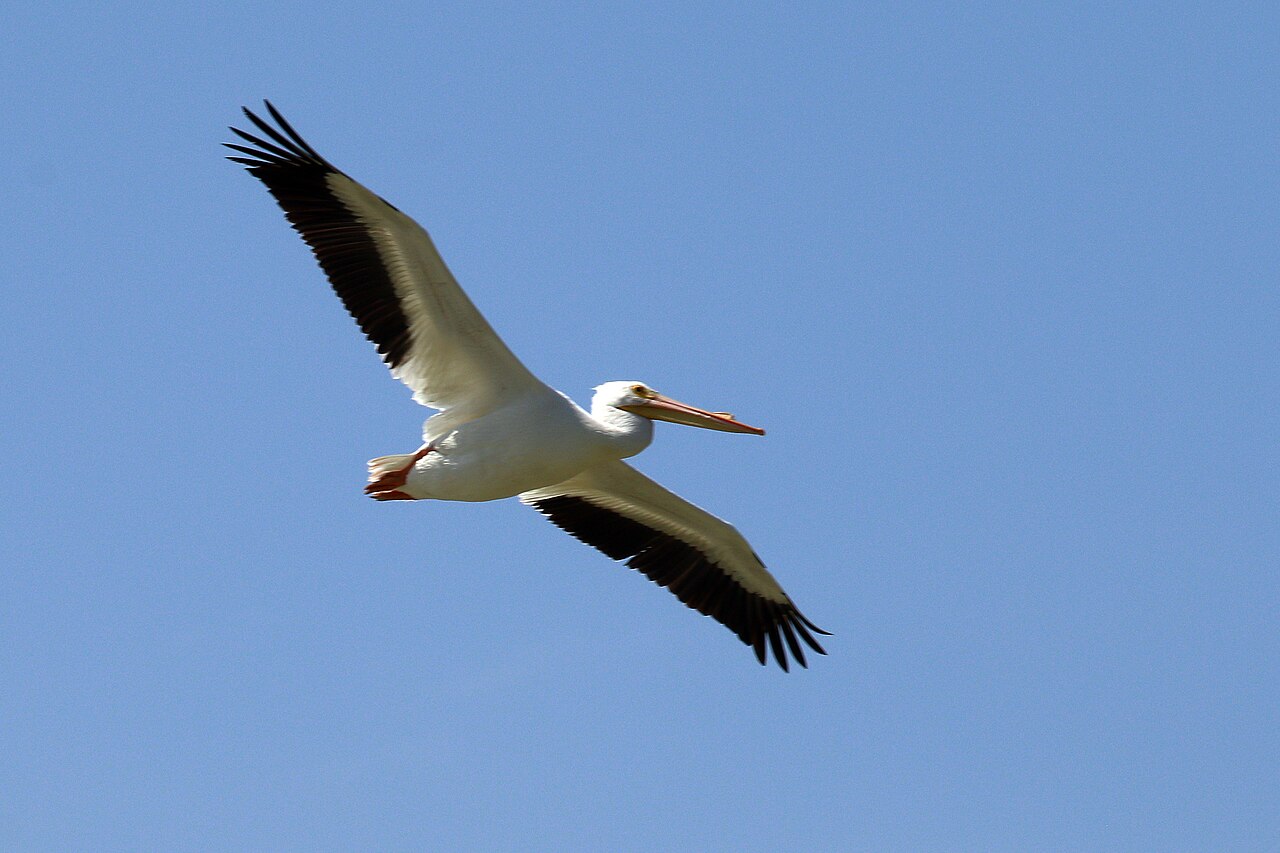
Wild American white pelican Pelecanus erythrorhynchos soaring in flight over Cuba
Charles J. Sharp / Wikimedia Commons / CC BY-SA 4.0
🌐 Read in Language:

⚡ At a Glance

Species profile
Also Known As
White pelican, rough-billed pelican
Diet Category
Primarily small fish, with other aquatic prey taken opportunistically
Activity Rhythm
Feeds by day year-round and also at night during the breeding season.
Wild Lifespan
Can live more than 20 years; the oldest banded bird exceeded 23 years
Typical Weight
about 4.5–9 kg
Conservation Status
LC
💡 Key Biological Insight: The pouch is a temporary fishing net rather than a storage bag; prey is swallowed before the pelican flies away.

🌳 Scientific Taxonomy Hierarchy

The American white pelican is the species Pelecanus erythrorhynchos in the pelican family Pelecanidae. It is distinct from the brown pelican and the Old World great white pelican.

KingdomAnimalia
PhylumChordata
ClassAves
OrderPelecaniformes
FamilyPelecanidae
GenusPelecanus
SpeciesPelecanus erythrorhynchos

Distinguishing Anatomical Features

  • ✓Adults are immense white waterbirds with a long neck, short legs and a massive yellow-orange bill with an expandable pouch. Black flight feathers form a bold trailing edge visible in flight but mostly hidden on a resting bird. Breeding adults grow a flat hornlike plate on the upper bill that is shed after nesting.
  • ✓Expandable throat pouch scoops fish and drains water
  • ✓Broad wings exploit rising air for efficient soaring
  • ✓Webbed feet provide strong swimming and water-ski landings
  • ✓Cooperative groups herd fish into shallow water
  • ✓Vascular pouch flutter releases body heat

📏 Physical Measurements

Total Lengthabout 50–65 in
Body Weightabout 10–20 lb
Tail LengthShort square tail relative to the body
Wingspanabout 8–9.5 ft
Top SpeedNo dependable universal maximumMovement changes with context and conditions.

🎨 Appearance & Distinctive Markings

WhiteBlackYellowOrangeDusky gray

Skin / Covering: Feathers with bare bill pouch and webbed feet

Sexual Dimorphism: Males and females share the same plumage. Males average larger and have longer bills, but overlap makes field sexing unreliable.

🗺️ Geographic Distribution & Habitat

Breeding colonies are concentrated on isolated islands in lakes and wetlands of western and central North America. Migrants cross much of the United States, and wintering birds gather along the Pacific, Gulf and Mexican coasts and locally farther south.

Large freshwater lakes, shallow marshes, reservoirs, rivers, estuaries, coastal bays, lagoons and protected nesting islands.

Country-level distribution map

Native range
FijiTanzaniaWestern SaharaCanada — Native rangeUnited States — Native rangeKazakhstanUzbekistanPapua New GuineaIndonesiaArgentinaChileCongo - KinshasaSomaliaKenyaSudanChadHaitiDominican RepublicRussiaBahamas — Native rangeFalkland IslandsNorwayGreenlandFrench Southern TerritoriesTimor-LesteSouth AfricaLesothoMexico — Native rangeUruguayBrazilBoliviaPeruColombiaPanama — Native rangeCosta Rica — Native rangeNicaragua — Native rangeHonduras — Native rangeEl Salvador — Native rangeGuatemala — Native rangeBelize — Native rangeVenezuelaGuyanaSurinameFranceEcuadorPuerto RicoJamaicaCuba — Native rangeZimbabweBotswanaNamibiaSenegalMaliMauritaniaBeninNigerNigeriaCameroonTogoGhanaCôte d’IvoireGuineaGuinea-BissauLiberiaSierra LeoneBurkina FasoCentral African RepublicCongo - BrazzavilleGabonEquatorial GuineaZambiaMalawiMozambiqueEswatiniAngolaBurundiIsraelLebanonMadagascarPalestinian TerritoriesGambiaTunisiaAlgeriaJordanUnited Arab EmiratesQatarKuwaitIraqOmanVanuatuCambodiaThailandLaosMyanmar (Burma)VietnamNorth KoreaSouth KoreaMongoliaIndiaBangladeshBhutanNepalPakistanAfghanistanTajikistanKyrgyzstanTurkmenistanIranSyriaArmeniaSwedenBelarusUkrainePolandAustriaHungaryMoldovaRomaniaLithuaniaLatviaEstoniaGermanyBulgariaGreeceTürkiyeAlbaniaCroatiaSwitzerlandLuxembourgBelgiumNetherlandsPortugalSpainIrelandNew CaledoniaSolomon IslandsNew ZealandAustraliaSri LankaChinaTaiwanItalyDenmarkUnited KingdomIcelandAzerbaijanGeorgiaPhilippinesMalaysiaBruneiSloveniaFinlandSlovakiaCzechiaEritreaJapanParaguayYemenSaudi ArabiaCyprusMoroccoEgyptLibyaEthiopiaDjiboutiUgandaRwandaBosnia & HerzegovinaNorth MacedoniaSerbiaMontenegroKosovoTrinidad & TobagoSouth Sudan
Highlighted countries are recorded profile locations, not precise biological range boundaries.Map boundaries: Natural Earth

💡 Did You Know?

  • 💡Expandable throat pouch scoops fish and drains water
  • 💡Broad wings exploit rising air for efficient soaring
  • 💡Webbed feet provide strong swimming and water-ski landings
  • 💡Cooperative groups herd fish into shallow water
  • 💡Vascular pouch flutter releases body heat

🌿 Conservation Status & Threats

IUCN: LC — Least Concern

“The IUCN Red List classifies the American white pelican as Least Concern. Continental numbers recovered strongly, but nesting is concentrated in relatively few colonies that remain vulnerable to disturbance, water change and disease.”

Population TrendIncreasing over recent decades, with regional variation
Wild Population EstimatePartners in Flight estimates roughly 450,000 breeding adults.
CITESProtected under the Migratory Bird Treaty Act; not listed by CITES

⚠️ Major Threats to American White Pelican

  • •Disturbance at nesting colonies
  • •Changing lake levels and drought
  • •Fishing-line entanglement
  • •Disease outbreaks
  • •Contaminants
  • •Collision and electrocution
  • •Conflict at aquaculture facilities

🔄 Life Cycle & Reproduction

Wild vs. Captivity Lifespan Comparison

🌿 In the WildCan live more than 20 years; the oldest banded bird exceeded 23 years
🏠 In Captivity (with veterinary care)Long-lived when protected, though wild colonies and migration define its natural life.
Clutch / Litter SizeUsually two chalky white eggs.
Incubation / GestationAbout 30 days.
Fledging / WeaningBoth parents feed the chicks. Although two eggs are common, competition between siblings means only one chick often survives.
Sexual MaturityUsually breeds from about three years of age
Mating SystemSeasonally monogamous pair within a dense colony
Nesting / Den TypeShallow scrape on gravel, sand or soil of an isolated island

🦅 Behavior & Field Ecology

Primarily small fish, with other aquatic prey taken opportunistically

🌐 Ecological Food Web & Relationships: American white pelicans consume abundant small aquatic animals and move nutrients between feeding wetlands and nesting islands. Their colonies also overlap with cormorants, gulls and other colonial waterbirds.

Social Group SizeHighly colonial and flocking
Activity RhythmFeeds by day year-round and also at night during the breeding season.
Feeding StrategyPrimarily small fish, with other aquatic prey taken opportunistically

🥩 Primary Prey & Preferred Diet

✓ Minnows✓ Carp✓ Suckers✓ Tui chub✓ Crayfish✓ Salamanders✓ Tadpoles

📢 Communication & Territorial Signals

  • Grunts
  • Bill displays
  • Courtship bows
  • Chick begging calls

🐾 Wild Temperament & Traits

• Social• Wary at colonies• Cooperative feeder

🤝 Human Interaction & Pet Advisory

⚠️ Strictly Wild Species
🚫

Can You Keep a American White Pelican as a Pet?

A migratory colonial waterbird with enormous space, dietary and legal requirements; it is not a pet and is protected by wildlife law.

Domestication StatusWild and not domesticated
Danger to HumansLow to people, but the bill can injure at close range
Economic & Ecotourism RoleWetland food-web function, ecotourism, education and a visible indicator of productive aquatic habitat.

⚠️ Behavioral Risk Factors & Wildlife Safety

  • Large bill can jab defensively
  • Nesting birds are highly sensitive to disturbance
  • Fishing hooks and line endanger birds and handlers

🌐 Ecological Food Web & Relationships

🦅 Natural Predators (5)

CoyoteCanis latrans
Red FoxVulpes vulpes
GullLaridae
Bald EagleHaliaeetus leucocephalus
Common RavenCorvus corax

🧬 Related Species (3)

Brown PelicanPelecanus occidentalisCoastal pelican that commonly plunge-dives
Great White PelicanPelecanus onocrotalusOld World white pelican
Dalmatian PelicanPelecanus crispusVery large Eurasian relative

American White Pelican (Pelecanus erythrorhynchos) is one of North America’s largest flying birds, nesting in colonies on remote islands and wintering around southern coasts, bays and large open waters. This guide separates well-supported biology from common assumptions and covers identification, range, habitat, diet, behavior, reproduction and conservation.

Identification

Adults are immense white waterbirds with a long neck, short legs and a massive yellow-orange bill with an expandable pouch. Black flight feathers form a bold trailing edge visible in flight but mostly hidden on a resting bird. Breeding adults grow a flat hornlike plate on the upper bill that is shed after nesting. Males and females share the same plumage. Males average larger and have longer bills, but overlap makes field sexing unreliable.

Identification should combine body shape, markings, size, voice or movement, and location. One feature by itself can overlap with a related animal, a juvenile, or an individual in unusual light.

Photographs are most useful when they preserve scale and show several diagnostic features. Handling or repositioning a wild american white pelican for identification can cause stress and is unnecessary.

Size and physical adaptations

American White Pelican typically measures about 127–165 cm and weighs about 4.5–9 kg. Both sexes are extremely large, with males averaging heavier. Body condition and breeding stage affect mass.

Its useful adaptations include expandable throat pouch scoops fish and drains water, broad wings exploit rising air for efficient soaring, webbed feet provide strong swimming and water-ski landings, cooperative groups herd fish into shallow water, vascular pouch flutter releases body heat. These traits work together in the animal’s normal setting rather than serving as isolated curiosities.

Published measurements may use different methods, life stages or sample locations. Comparing figures responsibly means checking what was measured rather than selecting the largest number available.

Range and distribution

Breeding colonies are concentrated on isolated islands in lakes and wetlands of western and central North America. Migrants cross much of the United States, and wintering birds gather along the Pacific, Gulf and Mexican coasts and locally farther south. The native range includes Canada, United States, Mexico, Bahamas, Cuba, Belize, Guatemala, Honduras, El Salvador, Nicaragua, Costa Rica, Panama.

A country-level map indicates broad distribution, not continuous occupation. Climate, elevation, water, vegetation, prey, breeding sites, barriers and survey effort all affect where records occur.

Records near the edge of the range deserve careful documentation because they may reflect natural movement, improved survey coverage, accidental transport or a genuine distribution change.

Habitat

Large freshwater lakes, shallow marshes, reservoirs, rivers, estuaries, coastal bays, lagoons and protected nesting islands.

Pairs nest on bare or sparsely vegetated islands protected from mammalian predators. Feeding birds may travel dozens of kilometers to shallow wetlands, while migrants rest on sandbars and open shorelines. Protecting a population therefore requires the feeding, shelter and breeding features that make a site usable, along with connections that allow movement.

Microhabitat matters. Shade, soil, current, moisture, shelter or host plants can determine whether a small area is usable even when the surrounding landscape appears suitable.

Diet and feeding

American White Pelican is a primarily small fish, with other aquatic prey taken opportunistically. Important foods include minnows, carp, suckers, tui chub, crayfish, salamanders, tadpoles. A bird swims and dips its open bill beneath the surface, raises it to drain water, then swallows the prey. Groups sometimes form a line or semicircle and drive schooling fish into shallows. Unlike brown pelicans, they rarely plunge-dive from height.

Diet changes with age, season, location and food supply. A dramatic prey record does not establish what most individuals eat most of the time; repeated field observations provide a stronger picture.

Feeding opportunities also create risk. An animal focused on prey may be less alert to predators, traffic or people, while contaminated prey can transfer pollutants through the food web.

Behavior and communication

Feeds by day year-round and also at night during the breeding season. Flocks soar in synchronized lines or circles, alternating white and black as the birds bank. On water they cooperate around fish schools; at colonies they defend only a small space around the nest and later gather mobile chicks into crèches.

Adults grunt and use bill jabs, bows and upright postures at close range. Chicks vocalize to parents, and embryos can call before hatching when conditions become uncomfortable. Behavior should be interpreted in context: alarm, courtship, feeding and temperature regulation can produce very different actions from the same animal.

Daily schedules are flexible responses, not rigid rules. Weather, breeding condition, disturbance, tides or food can move activity into a different part of the day.

Reproduction and development

Pairs form after group courtship and build simple ground nests close to other pelicans. Both parents incubate and later regurgitate food for their young. Usually two chalky white eggs. Chicks hatch naked and helpless, grow dense down, and often leave the nest at two to three weeks to join a crèche. Flight begins around nine to ten weeks.

Young animals face different risks and may use different microhabitats or food than adults. Breeding success depends on adult condition, suitable sites and the survival of offspring through vulnerable early stages.

Counts of eggs or young describe reproductive output, not the number expected to reach adulthood. Mortality is normally greatest during eggs, larval or juvenile stages.

Predators and ecological role

American white pelicans consume abundant small aquatic animals and move nutrients between feeding wetlands and nesting islands. Their colonies also overlap with cormorants, gulls and other colonial waterbirds. Documented or likely predators include Coyote, Red Fox, Gull, Bald Eagle, Common Raven.

This animal is both a consumer and a food source. Its influence comes through many repeated interactions, so ecological claims should be based on measured populations rather than assumptions drawn from appearance.

Predator and prey relationships differ among places. A species can be ecologically influential without being abundant everywhere, and its role can change across its range.

Relationship with people

Recovery followed protection from shooting, disturbance and persistent pesticides. Conflict still occurs around aquaculture and sport fisheries, although most prey is small and of little commercial value.

Watch colonies only from permitted distances because adults may abandon eggs or chicks when disturbed. Never feed pelicans, discard fishing line or approach an entangled bird; contact a wildlife rehabilitator. Responsible observation means keeping an appropriate distance, avoiding capture or feeding, protecting habitat and following local wildlife or invasive-species guidance.

Wildlife guidance should come from the responsible local agency because collection rules, reporting requests and appropriate responses differ between native and introduced ranges.

Conservation

The IUCN Red List classifies the American white pelican as Least Concern. Continental numbers recovered strongly, but nesting is concentrated in relatively few colonies that remain vulnerable to disturbance, water change and disease. The reported global trend is Increasing over recent decades, with regional variation.

Important pressures include disturbance at nesting colonies, changing lake levels and drought, fishing-line entanglement, disease outbreaks, contaminants, collision and electrocution, conflict at aquaculture facilities. Global status can hide local decline or recovery, so current regional monitoring and habitat management remain necessary.

The most useful conservation action follows the documented pressure. Protecting breeding sites, reducing road deaths or limiting pollutants can require different tools in different populations.

Sources and further reading

❓ Frequently Asked Questions

Answers to frequently asked questions verified against peer-reviewed zoological research.

Adults measure about 127 to 165 centimeters long, weigh roughly 4.5 to 9 kilograms and span about 244 to 290 centimeters across the wings.