
Home/Animals/Reptilia/Amethystine Python
Species profileIUCN: LC

Amethystine Python

Simalia amethistina

A large iridescent New Guinea python whose common name is often confused with related island and Australian scrub pythons.

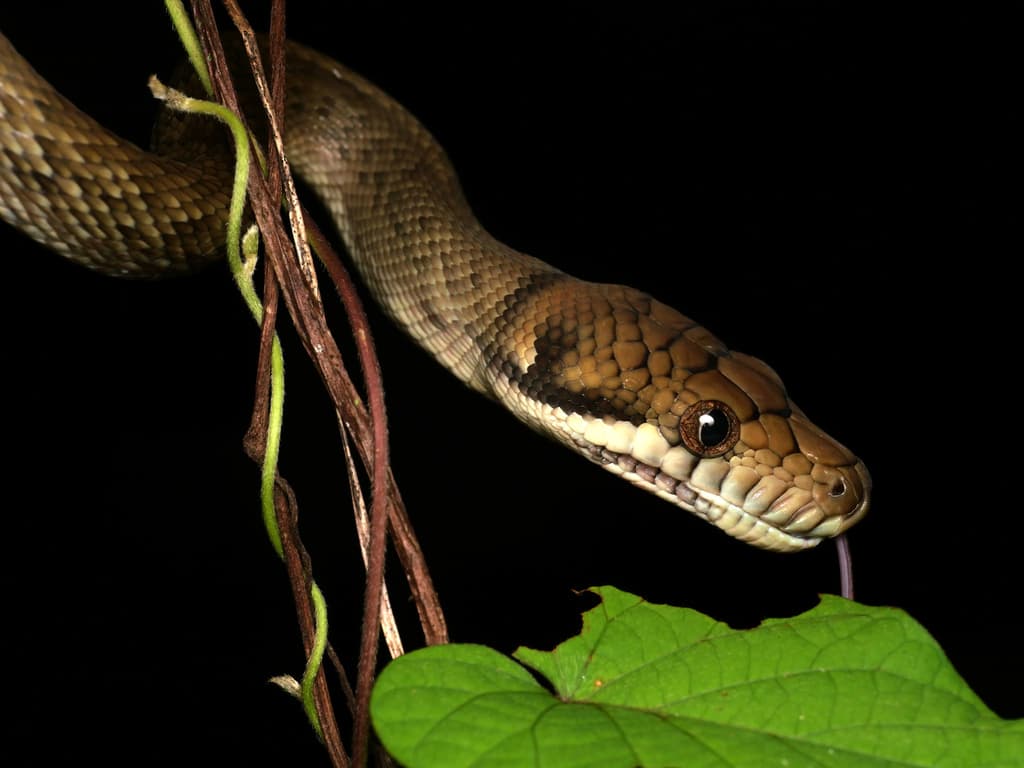
Wild Amethystine Python Simalia amethistina moving among vines at night in Papua New Guinea
Philipp Hoenle / Wikimedia Commons / CC0 1.0
🌐 Read in Language:

⚡ At a Glance

Species profile
Also Known As
Amethyst python; New Guinea amethystine python; scrub python; sanca permata
Diet Category
Carnivore
Activity Rhythm
Often nocturnal or crepuscular; varies with temperature and rain
Wild Lifespan
No dependable species-wide field estimate
Typical Weight
Highly variable; no reliable universal wild average
Conservation Status
LC
💡 Key Biological Insight: The Australian Scrub Python is Simalia kinghorni, not the species covered by this page.

🌳 Scientific Taxonomy Hierarchy

This profile covers Simalia amethistina in the modern narrow sense: the New Guinea Amethystine Python. It excludes the Australian Scrub Python Simalia kinghorni and the island species S. clastolepis, S. nauta and S. tracyae.

KingdomAnimalia
PhylumChordata
ClassReptilia
OrderSquamata
FamilyPythonidae
GenusSimalia
SpeciesSimalia amethistina

Distinguishing Anatomical Features

  • ✓Large long-bodied python
  • ✓Smooth iridescent scales
  • ✓Brown to olive ground color
  • ✓Darker bands or zigzag markings
  • ✓Heat-sensitive labial pits
  • ✓Backward-curving gripping teeth

📏 Physical Measurements

Total LengthLarge adults commonly exceed 9.8 ft; verified maxima are difficult to separate from related species
Body WeightNo reliable universal wild average
Tail LengthLong tapering tail used in climbing
WingspanNot applicable
Top SpeedNo dependable universal maximumMovement changes with temperature, terrain and motivation.

🎨 Appearance & Distinctive Markings

BrownOliveTanYellow-brownDark brownBlackCream

Skin / Covering: Smooth overlapping scales with an iridescent sheen

Sexual Dimorphism: Females may become heavier than males, but color and pattern do not reliably identify sex.

🗺️ Geographic Distribution & Habitat

Native to New Guinea in Indonesia and Papua New Guinea, plus some nearby islands; the map is country-level and does not imply occupancy everywhere.

Lowland tropical rainforest, forest edges, dense vegetation, trees and human-modified margins with cover and prey.

Country-level distribution map

Native range
FijiTanzaniaWestern SaharaCanadaUnited StatesKazakhstanUzbekistanPapua New Guinea — Native rangeIndonesia — Native rangeArgentinaChileCongo - KinshasaSomaliaKenyaSudanChadHaitiDominican RepublicRussiaBahamasFalkland IslandsNorwayGreenlandFrench Southern TerritoriesTimor-LesteSouth AfricaLesothoMexicoUruguayBrazilBoliviaPeruColombiaPanamaCosta RicaNicaraguaHondurasEl SalvadorGuatemalaBelizeVenezuelaGuyanaSurinameFranceEcuadorPuerto RicoJamaicaCubaZimbabweBotswanaNamibiaSenegalMaliMauritaniaBeninNigerNigeriaCameroonTogoGhanaCôte d’IvoireGuineaGuinea-BissauLiberiaSierra LeoneBurkina FasoCentral African RepublicCongo - BrazzavilleGabonEquatorial GuineaZambiaMalawiMozambiqueEswatiniAngolaBurundiIsraelLebanonMadagascarPalestinian TerritoriesGambiaTunisiaAlgeriaJordanUnited Arab EmiratesQatarKuwaitIraqOmanVanuatuCambodiaThailandLaosMyanmar (Burma)VietnamNorth KoreaSouth KoreaMongoliaIndiaBangladeshBhutanNepalPakistanAfghanistanTajikistanKyrgyzstanTurkmenistanIranSyriaArmeniaSwedenBelarusUkrainePolandAustriaHungaryMoldovaRomaniaLithuaniaLatviaEstoniaGermanyBulgariaGreeceTürkiyeAlbaniaCroatiaSwitzerlandLuxembourgBelgiumNetherlandsPortugalSpainIrelandNew CaledoniaSolomon IslandsNew ZealandAustraliaSri LankaChinaTaiwanItalyDenmarkUnited KingdomIcelandAzerbaijanGeorgiaPhilippinesMalaysiaBruneiSloveniaFinlandSlovakiaCzechiaEritreaJapanParaguayYemenSaudi ArabiaCyprusMoroccoEgyptLibyaEthiopiaDjiboutiUgandaRwandaBosnia & HerzegovinaNorth MacedoniaSerbiaMontenegroKosovoTrinidad & TobagoSouth Sudan
Highlighted countries are recorded profile locations, not precise biological range boundaries.Map boundaries: Natural Earth

Recorded Native Countries & Territories:

💡 Did You Know?

  • 💡Iridescent smooth scales
  • 💡Heat-sensitive lip pits
  • 💡Powerful constricting muscles
  • 💡Flexible jaws
  • 💡Strong climbing ability
  • 💡Chemical sensing with the tongue

🌿 Conservation Status & Threats

IUCN: LC — Least Concern

“Major biodiversity compilations treat Simalia amethistina as Least Concern, but monitoring is incomplete and local pressures can be significant.”

Population TrendUnknown across much of the range
Wild Population EstimateNo reliable global estimate
CITESAppendix II as a member of Pythonidae

⚠️ Major Threats to Amethystine Python

  • •Lowland forest loss
  • •Road mortality
  • •Deliberate killing
  • •Illegal or unsustainable collection
  • •Prey decline
  • •Fragmentation

🔄 Life Cycle & Reproduction

Wild vs. Captivity Lifespan Comparison

🌿 In the WildNo dependable species-wide field estimate
🏠 In Captivity (with veterinary care)Long-lived under expert care, but no single figure applies to all conditions
Clutch / Litter SizeVariable; dependable species-wide field range is not established
Incubation / GestationVaries with temperature and maternal brooding conditions
Fledging / WeaningIndependent after hatching
Sexual MaturityVaries with sex, growth and food availability
Mating SystemInternal fertilization; egg laying
Nesting / Den TypeSheltered egg-laying site guarded by the female

🦅 Behavior & Field Ecology

Carnivorous ambush constrictor

🌐 Ecological Food Web & Relationships: A large rainforest predator that transfers energy from birds and mammals to higher trophic levels and helps regulate vertebrate prey populations.

Social Group SizeUsually solitary
Activity RhythmOften nocturnal or crepuscular; varies with temperature and rain
Feeding StrategyCarnivorous ambush constrictor

🥩 Primary Prey & Preferred Diet

✓ Small mammals✓ Medium-sized mammals✓ Birds✓ Other suitable vertebrates

📢 Communication & Territorial Signals

  • Tongue-flick scent sampling
  • Pheromone trails
  • Ground vibration
  • Courtship touch
  • Hissing
  • Defensive posture

🐾 Wild Temperament & Traits

• Secretive• Powerful• Alert• Mostly solitary• Defensive if cornered or restrained

🤝 Human Interaction & Pet Advisory

⚠️ Strictly Wild Species
🚫

Can You Keep a Amethystine Python as a Pet?

A very large specialist python requiring secure professional housing, legal documentation, expert handling protocols and experienced reptile veterinary care. Wild animals should not be collected or handled.

Domestication StatusWild reptile; never domesticated
Danger to HumansModerate mechanical risk; nonvenomous
Economic & Ecotourism RoleRainforest food-web function, research, regulated wildlife trade monitoring and public education.

⚠️ Behavioral Risk Factors & Wildlife Safety

  • Large adults can inflict deep bites
  • Powerful coils can restrict breathing or circulation
  • Wild handling stresses the snake and person
  • Reptiles can carry Salmonella bacteria

🌐 Ecological Food Web & Relationships

🦅 Natural Predators (2)

Large raptorsAccipitridae
Monitor lizardsVaranus spp.

🧬 Related Species (4)

Australian Scrub PythonSimalia kinghorniAustralian species formerly included within a broad amethistina concept
Halmahera PythonSimalia tracyaeIsland relative split from the former species complex
Tanimbar PythonSimalia nautaIsland relative split from the former species complex
Southern Moluccan PythonSimalia clastolepisIsland relative split from the former species complex

What is the Amethystine Python?

The Amethystine Python, Simalia amethistina, is a large nonvenomous python native to New Guinea and nearby islands. This profile uses the current species concept accepted by the Reptile Database and separates it from the Australian Scrub Python, Simalia kinghorni. Older books placed both snakes, plus several island forms, inside a broad Morelia amethistina complex. That history explains why “scrub python” is still used for several related animals and why locality matters when a photograph or record is identified.

The name “amethystine” refers to the iridescent sheen visible on clean scales in angled light. The snake is usually brown, olive, tan or yellowish with darker bands, blotches or zigzags. Color and pattern vary across New Guinea populations, and juveniles can differ strongly from adults. A glossy appearance is useful for recognition, but it is not enough to identify the species without range and scale characters.

Taxonomy and the scrub-python complex

Harvey and colleagues revised the amethystine-python complex in 2000 using museum specimens, morphology and mitochondrial evidence. Their work recognized the Australian form as S. kinghorni and the Halmahera, Tanimbar and southern Moluccan forms as S. tracyae, S. nauta and S. clastolepis. Later phylogenetic work restored the genus Simalia. The Reptile Database currently lists six species in that genus and treats S. amethistina as a species without accepted subspecies.

This narrower scope has practical consequences. Size records attributed to an “amethystine python” in Queensland may concern S. kinghorni, while a snake from Halmahera could belong to S. tracyae. This page therefore does not transfer Australian measurements, behavior studies or conservation claims to the New Guinea species. Where species-specific evidence is thin, the honest answer is that the detail remains uncertain.

Range and rainforest habitat

Simalia amethistina occurs on New Guinea, divided politically between Indonesia and Papua New Guinea, and on some adjacent islands. CITES guidance describes its Indonesian range in Papua and West Papua and associates it primarily with lowland tropical rainforest rather than the highest mountains or open southern woodland. Country-level maps are necessarily coarse: they show Indonesia and Papua New Guinea, not continuous occupancy across every part of either country.

Within rainforest landscapes the python uses trees, dense vegetation, forest edges and ground-level cover. Individuals may enter farms, village margins or buildings where rodents and other prey are concentrated. Such encounters do not make the species domesticated. They reflect a large adaptable predator moving through a human-modified part of its native environment.

Body form, movement and senses

The Amethystine Python has a long muscular body, a distinct head and smooth overlapping scales. Heat-sensitive pits along the lips help it detect warm-bodied prey, while tongue flicking carries chemical particles to the vomeronasal system. Its backward-curving teeth grip rather than inject venom. Once a strike secures prey, muscular coils restrict circulation until the animal can be swallowed whole.

Published maximum lengths are difficult to interpret because old records often combine members of the former species complex or lack preserved vouchers. CITES identification material describes large adults and gives practical measurements for traded specimens, but those figures should not be treated as a universal wild average. Females generally become heavier than males in many pythons, yet reliable sex-specific field ranges for this exact species remain limited. No defensible universal top speed has been measured.

Diet and hunting behavior

Amethystine Pythons are ambush predators. They wait along branches, trails or cover used by prey, strike rapidly and constrict. Their diet includes mammals and birds, with prey size changing as the snake grows. Young animals take smaller vertebrates, while large adults can handle heavier mammals. Reports should distinguish direct observation from assumptions based on python anatomy; a list of possible prey is not proof that every population eats the same animals.

The species is usually solitary outside courtship and temporary concentrations around shelter or food. Activity can shift with temperature, rain, prey movements and disturbance. The wild photograph used on this profile shows an individual moving among thin vines at night in Papua New Guinea, consistent with use of vegetation and nocturnal activity. One photograph documents that individual and setting, not the entire behavioral range of the species.

Reproduction and growth

Like other pythons, the species lays eggs. A female coils around the clutch and can stabilize temperature through muscular activity and posture. Exact clutch size, incubation time and maturity age vary with female size, locality and conditions, and well-documented species-level field data are scarce. Captive breeding records can describe what happened under managed temperatures but should not automatically be presented as a natural timetable.

Hatchlings are independent after emerging and receive no prolonged feeding care. Their smaller size exposes them to raptors, monitor lizards and other predators. Survivors grow through repeated shedding, and growth depends on food, temperature and health. Large body size does not mean limitless growth; mature snakes continue to change slowly, but exaggerated internet claims often confuse exceptional individuals, different species or unverified measurements.

Conservation, trade and coexistence

The species is treated as Least Concern in major biodiversity compilations, but there is no reliable global count of wild individuals. Forest clearing, road building, deliberate killing and poorly regulated collection can affect local populations. Pythonidae are listed in CITES Appendix II, so international trade requires permits and findings that exports are legal and not detrimental. CITES guidance specifically uses S. amethistina in Indonesia as an example for estimating distribution and evaluating harvest.

People should never handle a wild individual. Although nonvenomous, a large python can cause deep puncture wounds and powerful constriction. Keep children and pets away, remove attractants such as unsecured poultry feed, and contact a trained local wildlife responder. Captive ownership, where legal, demands secure professional housing, long-term veterinary access and strict hygiene; it does not make the species a conventional pet.

Why accurate identification matters

Clear species boundaries improve conservation records, trade monitoring and public safety. Calling every large Australasian python an “amethystine” can mix evidence from different islands and hide restricted-range species. A useful record includes locality, date, photographs of the whole animal without handling, and notes about habitat. Researchers can then compare it with verified museum material and current taxonomy.

For this profile, the common name Amethystine Python means Simalia amethistina from New Guinea and associated islands. The Australian Scrub Python is S. kinghorni and deserves its own account. That distinction keeps measurements, distribution, conservation and photographs attached to the correct biological subject.

Sources

❓ Frequently Asked Questions

Answers to frequently asked questions verified against peer-reviewed zoological research.

Simalia amethistina is native to New Guinea in Indonesia and Papua New Guinea, plus some nearby islands, especially in lowland tropical rainforest.