
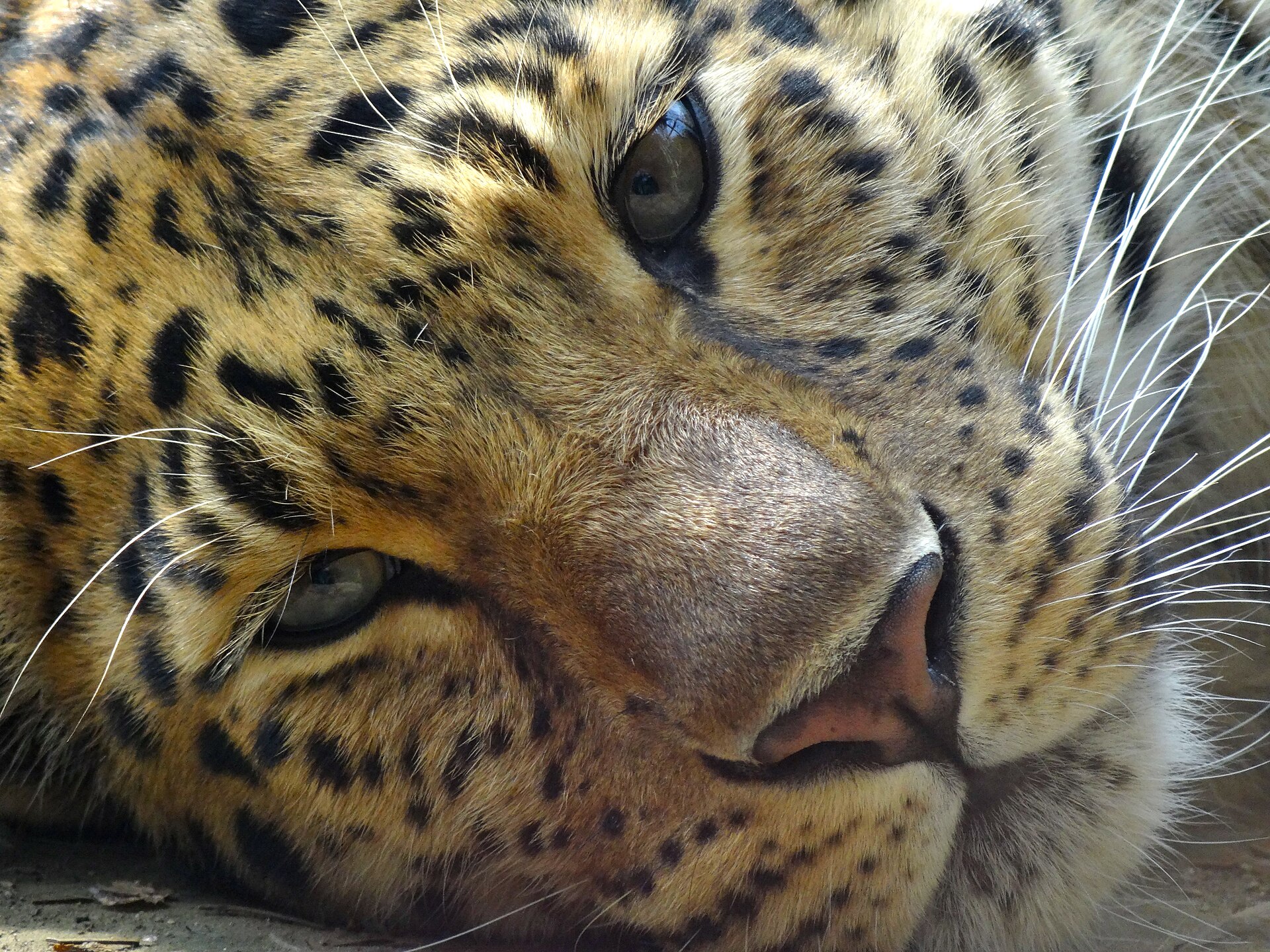
The Amur leopard is a cold-adapted leopard subspecies from the temperate forests of the Russian Far East and northeastern China. Its scientific name is Panthera pardus orientalis. It remains Critically Endangered, but long-term protection, anti-poaching work, prey recovery and coordinated camera-trap monitoring have documented a substantial recovery from the few dozen animals estimated near the beginning of this century.
In July 2026, Russian and Chinese conservation authorities announced the first combined analysis across their connected protected areas. Researchers registered 223 Amur leopards, including adults and cubs. The national records included 135 animals in Russia and 115 in China, with 27 photographed in both countries. Those national figures overlap and should not be added together.
Taxonomy and scientific name
The Amur leopard is a subspecies of leopard, not a separate leopard species. It belongs to family Felidae, genus Panthera and species Panthera pardus. The IUCN Cat Specialist Group recognizes P. p. orientalis across eastern Asia and includes the historically named North Chinese form japonensis within it.
Subspecies boundaries are still studied. Genetic sampling across the leopard’s enormous Asian range remains incomplete, and some analyses suggest fewer divisions. “Amur leopard” nevertheless remains the established conservation name for the far-eastern population centered on the Russia–China border.
Appearance and winter adaptations
Amur leopards have pale coats patterned with widely spaced black rosettes. Every animal’s pattern is unique enough for researchers to identify individuals in camera-trap photographs. The coat becomes longer and paler in winter, providing insulation and camouflage in snow, then becomes shorter and richer in color during summer.
WWF reports hairs of about 2.5 centimeters in the summer coat and about 7 centimeters in winter. Relatively long legs help the cat move through snow. The long tail assists balance on steep ground and in trees and may be wrapped near the body while resting in cold conditions.
Published weights differ by sex, age and source. A broad adult range often given for the subspecies is roughly 30–70 kilograms, with males generally larger. Measurements should not be presented as one fixed value for every individual.
Where Amur leopards live
The surviving wild population is concentrated in southwestern Primorsky Krai in Russia and adjoining forest in Jilin and Heilongjiang provinces in northeastern China. Leopards regularly cross the international border, which is why joint identification is necessary for a reliable population count.
The historic range extended more widely through the Russian Far East, northeastern China and the Korean Peninsula. Today’s core includes Land of the Leopard National Park in Russia and Northeast China Tiger and Leopard National Park. In 2024, the countries agreed to create the transboundary “Land of Big Cats” reserve linking protected landscapes.
Forest habitat and climate
Amur leopards occupy temperate broadleaf and mixed forests with rugged hills, rocky ridges and severe winters. Forest cover provides stalking habitat, resting places and routes away from roads and settlements. Snow can be deep, and temperatures fall far below freezing.
Habitat quality depends on prey as well as trees. Sika deer, roe deer and wild boar support both leopards and Amur tigers. Fire, logging, road construction and other fragmentation can reduce cover, prey and safe movement between territories.
Diet and hunting
Amur leopards are carnivores and solitary ambush hunters. Roe deer and sika deer are major prey, supplemented by wild boar, musk deer, hares, badgers and other available mammals. The exact mix changes with season, prey abundance and the size and experience of the cat.
A leopard stalks under cover and closes the final distance with a short rush. It kills with a bite and may drag food into dense cover or up a tree. The rough papillae on its tongue help remove tissue from bones.
Territories and daily behavior
Adults generally live alone except during mating and while females raise cubs. They maintain large home ranges and communicate through scent marks, scrapes, tracks and vocalizations. Home ranges can overlap, particularly between a male and several females.
Camera traps show that Amur leopards are often active at night and around dawn or dusk, although activity changes with prey and human disturbance. They are strong climbers and may rest, watch or protect food in trees. They also travel long distances along ridges, forest tracks and valleys.
Breeding and cub development
Amur leopards do not have one narrowly fixed breeding season. After a gestation of roughly 12 weeks, a female commonly gives birth to two or three cubs in a sheltered den. Cubs are born blind and dependent and remain hidden during their earliest weeks.
The mother supplies milk, protection and later meat while the cubs learn to follow and hunt. Young leopards generally separate from their mother at about one and a half to two years old. Mortality can be high before independence, so the presence of cubs in one survey does not guarantee that all will enter the adult population.
Population and Critically Endangered status
The Amur leopard is classified as Critically Endangered. The 2026 transboundary camera-trap analysis registered 223 adults and cubs across the shared Russia–China reserve. It was a count of identified animals in the monitored landscape, not proof that exactly 223 animals existed everywhere on the same day.
The recovery is still significant. Earlier estimates placed the population near 30–35 animals in the early 2000s. Camera traps now document breeding and movement on both sides of the border. A larger population reduces immediate extinction risk, but the subspecies remains confined to a small region and vulnerable to disease, fire, prey loss and genetic problems.
Threats
Poaching threatens leopards directly and also removes their deer and wild boar prey. Roads and development fragment habitat and increase access for people. Forest fires can simplify woodland and destroy cover, while conflict may arise when predators approach farms or take domestic animals.
A population descended from very few survivors carries low genetic diversity. This can reduce resilience and makes every breeding adult important. Disease transmission from domestic animals and other wild carnivores is another concern requiring surveillance.
How conservation works
Land of the Leopard National Park and Northeast China Tiger and Leopard National Park protect most of the current core. Rangers patrol for poaching, remove snares, investigate wildlife crime and reduce fire risk. Camera networks identify cats by rosette patterns and track survival, reproduction and cross-border movement.
Conservation also requires healthy prey, connected forest corridors and cooperation with local communities. Russia and China now share monitoring information so the same animal is not counted twice. Captive breeding programmes maintain a managed population, but protecting and expanding wild habitat remains essential.