
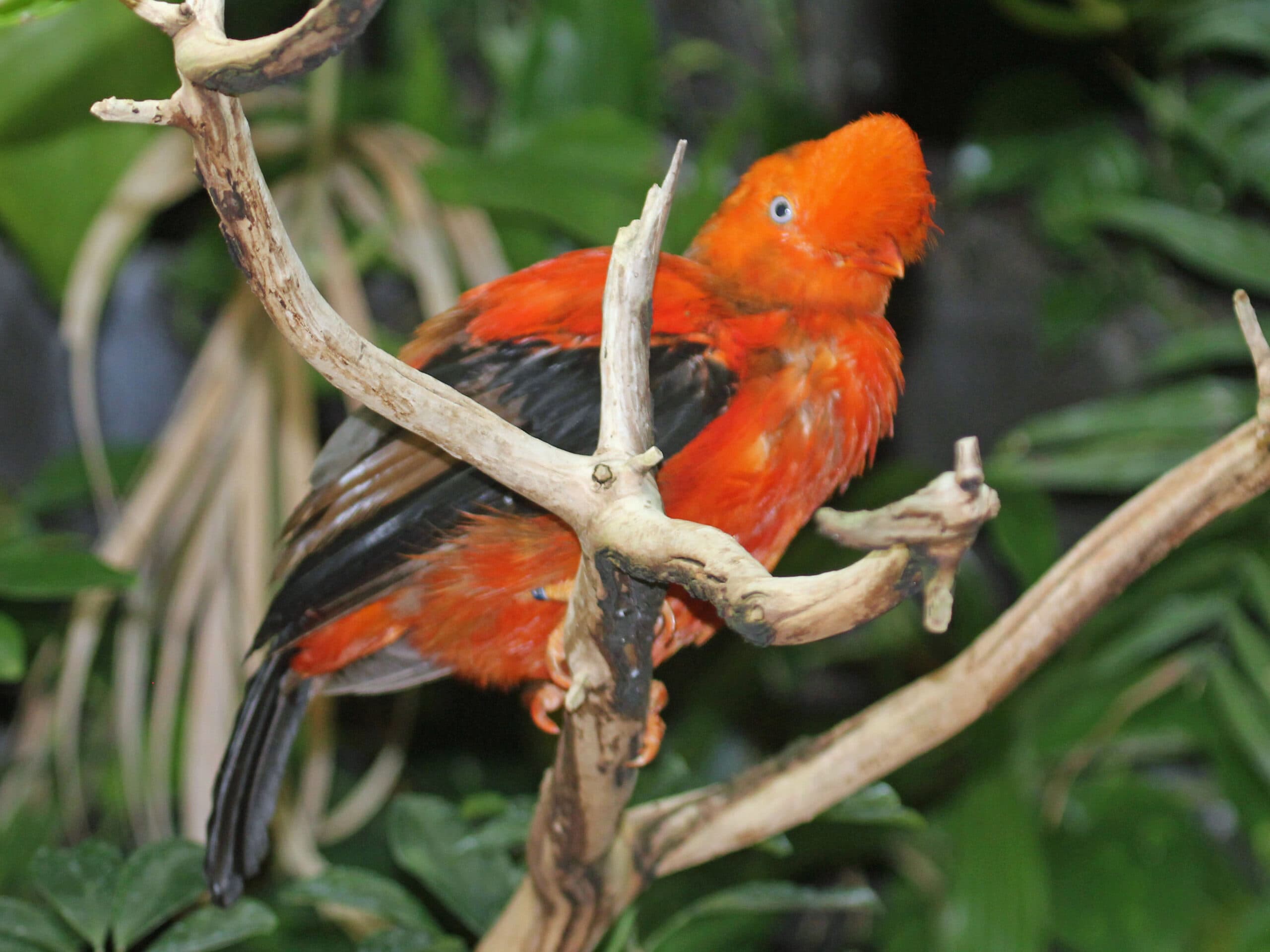
Andean Cock-of-the-Rock (Rupicola peruvianus) is a fruit-eating bird of the eastern Andean cloud forest and the national bird of Peru. Adult males are famous for a circular crest and intense red-orange plumage, while chestnut-brown females remain inconspicuous near the rock ledges where they raise young alone. This guide separates well-supported biology from common assumptions and covers identification, range, habitat, diet, behavior, reproduction and conservation.
Identification
A broad disk-like crest covers much of the bill and gives the head a rounded profile. Adult males are bright orange, scarlet or red with black wings and tail, pale silvery wing coverts and strong orange legs. Females are cinnamon to dark chestnut with a smaller crest, darker bill and less conspicuous legs. Both sexes have a compact body, powerful feet and relatively short bill suited to plucking fruit. The sexes look dramatically different. Males are brilliant and highly crested for lek display; females are brown with a smaller crest, providing camouflage at the nest.
Identification should combine body shape, markings, size, voice or movement, and location. One feature by itself can overlap with a related animal, a juvenile, or an individual in unusual light.
Photographs are most useful when they preserve scale and show several diagnostic features. Handling or repositioning a wild andean cock-of-the-rock for identification can cause stress and is unnecessary.
Size and physical adaptations
Andean Cock-of-the-Rock typically measures about 30–32 cm and weighs about 200–275 g. Values vary by sex, subspecies and source; males are generally heavier and more robust.
Its useful adaptations include broad crest exaggerates male display profile, strong feet grip branches and rocky nest sites, wide gape helps swallow whole fruits, brown female plumage conceals the nesting bird, short rounded wings maneuver through dense forest, digestive passage disperses viable seeds, loud calls carry through rushing water and vegetation. These traits work together in the animal’s normal setting rather than serving as isolated curiosities.
Published measurements may use different methods, life stages or sample locations. Comparing figures responsibly means checking what was measured rather than selecting the largest number available.
Range and distribution
A long, discontinuous band along the eastern slopes of the Andes from western Venezuela through Colombia, Ecuador and Peru into Bolivia. Populations follow humid foothill and cloud forest rather than the high open Andes, and recognized subspecies replace one another geographically. The native range includes Venezuela, Colombia, Ecuador, Peru, Bolivia.
A country-level map indicates broad distribution, not continuous occupation. Climate, elevation, water, vegetation, prey, breeding sites, barriers and survey effort all affect where records occur.
Records near the edge of the range deserve careful documentation because they may reflect natural movement, improved survey coverage, accidental transport or a genuine distribution change.
Habitat
Humid montane and cloud forest, forested ravines and foothill woodland, commonly around 500–2,400 meters and often near streams, cliffs or rocky gullies.
Birds feed through the middle and upper forest where fruiting trees are scattered. Males use traditional display clearings, or leks, within shaded forest. Females seek damp, protected rock walls, caves, overhangs, waterfalls or bridge-like structures for nests. Daily movements connect fruiting trees, leks and nesting ravines, making intact forest corridors important even when individual sites are locally protected. Protecting a population therefore requires the feeding, shelter and breeding features that make a site usable, along with connections that allow movement.
Microhabitat matters. Shade, soil, current, moisture, shelter or host plants can determine whether a small area is usable even when the surrounding landscape appears suitable.
Diet and feeding
Andean Cock-of-the-Rock is a omnivore. Important foods include wild figs, palms and laurels, berries and drupes, other cloud-forest fruits, large insects, small frogs or lizards on occasion. Fruit makes up most of the diet. A bird plucks a fruit while perched or in a short flight, swallows it whole and later deposits or regurgitates the seed. Different plants fruit at different places and seasons, so individuals travel among feeding trees and often forage quietly beneath the canopy. Insects and other small animal prey add protein, especially during breeding and chick rearing.
Diet changes with age, season, location and food supply. A dramatic prey record does not establish what most individuals eat most of the time; repeated field observations provide a stronger picture.
Feeding opportunities also create risk. An animal focused on prey may be less alert to predators, traffic or people, while contaminated prey can transfer pollutants through the food web.
Behavior and communication
Diurnal, with strong feeding and lek activity in early morning and late afternoon. Most of the year, birds move alone or in loose feeding groups. At a lek, several males defend small display perches close together. They face rivals and visiting females, bow, hop, flap, snap the bill and call loudly. The crest and pale wing patches become conspicuous during these movements. Females visit, compare males and leave after mating. A male does not control food or a nest site, so the arena is devoted mainly to courtship.
Lek sounds include harsh squawks, grunts and mechanical noises made with wings or bill. Visual signals are equally important: crest shape, body angle, wing patches and rapid bows advertise a male at close range. Females use quieter calls around nests, while chicks beg for food. Dense vegetation limits long views, so repeated sound and movement reveal the display court. Behavior should be interpreted in context: alarm, courtship, feeding and temperature regulation can produce very different actions from the same animal.
Daily schedules are flexible responses, not rigid rules. Weather, breeding condition, disturbance, tides or food can move activity into a different part of the day.
Reproduction and development
Breeding timing varies across the long Andean range and often follows local rainfall and fruit availability. Males display communally at a lek and may mate with several females. After selecting a male, the female handles all parental work. She builds a cup of mud mixed with plant fibers and saliva, attaching it to a sheltered vertical rock surface. Usually two eggs Chicks hatch helpless and sparsely covered. The female brings fruit and animal food, often arriving cautiously so predators do not discover the nest. Young remain in the secure cup for several weeks while flight feathers develop. After fledging they continue to depend on the female and gradually learn where seasonal fruit occurs. Young males acquire full bright adult plumage over time.
Young animals face different risks and may use different microhabitats or food than adults. Breeding success depends on adult condition, suitable sites and the survival of offspring through vulnerable early stages.
Counts of eggs or young describe reproductive output, not the number expected to reach adulthood. Mortality is normally greatest during eggs, larval or juvenile stages.
Predators and ecological role
By carrying seeds away from fruiting trees, Andean Cocks-of-the-Rock help regenerate cloud forest and can concentrate diverse seeds near leks and nest ravines. They are also prey for raptors, snakes and forest cats. Their dependence on fruiting trees, display courts and protected rock nests links several forest layers and makes them useful ambassadors for watershed and cloud-forest conservation. Documented or likely predators include Black-and-chestnut Eagle, Forest Falcons, Boa Constrictor, Ocelot, Humans.
This animal is both a consumer and a food source. Its influence comes through many repeated interactions, so ecological claims should be based on measured populations rather than assumptions drawn from appearance.
Predator and prey relationships differ among places. A species can be ecologically influential without being abundant everywhere, and its role can change across its range.
Relationship with people
The bird is Peru’s national emblem and a major attraction for cloud-forest bird tourism in several countries. Carefully managed lek viewing can support local guides and forest protection. Crowding, flash photography, playback and trampling near display or nest sites can interrupt natural behavior. Deforestation for farms, roads and extraction remains the larger long-term pressure.
Watch from established hides or trails, keep voices low and follow local guide limits. Do not enter the display court, approach nests, use flash at close range or repeatedly play calls. Keep enough distance that males continue normal display and females approach nests without hesitation. Responsible observation means keeping an appropriate distance, avoiding capture or feeding, protecting habitat and following local wildlife or invasive-species guidance.
Wildlife guidance should come from the responsible local agency because collection rules, reporting requests and appropriate responses differ between native and introduced ranges.
Conservation
The species is currently assessed as Least Concern because it remains widespread, but local populations decline when cloud forest is cleared or fragmented and breeding sites are disturbed. The reported global trend is Suspected decreasing in parts of the range.
Important pressures include cloud-forest clearing for agriculture, road building and mining, fragmentation of fruiting-tree corridors, disturbance at leks and nests, illegal capture and trade, climate-driven shifts in cloud forest. Global status can hide local decline or recovery, so current regional monitoring and habitat management remain necessary.
The most useful conservation action follows the documented pressure. Protecting breeding sites, reducing road deaths or limiting pollutants can require different tools in different populations.