
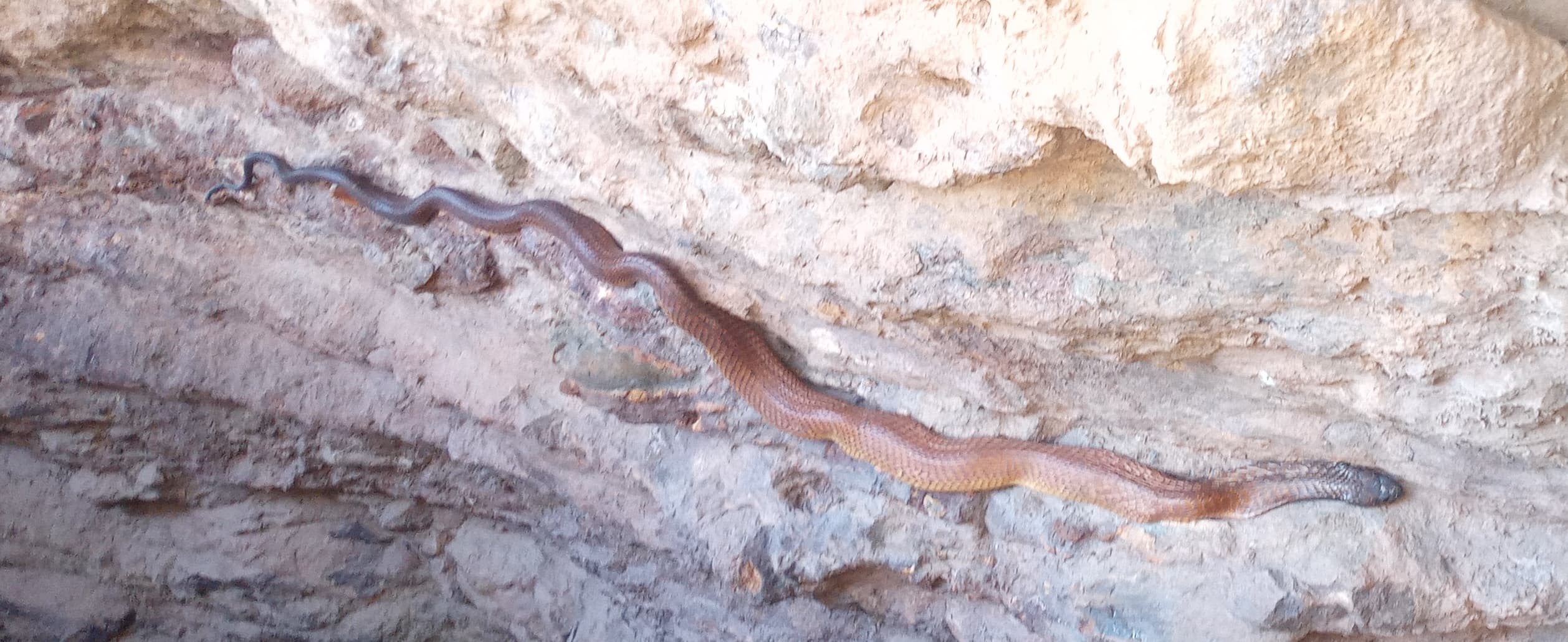
What is the Arabian cobra?
The Arabian cobra, Naja arabica, is a venomous elapid snake native to the Arabian Peninsula. It is a true cobra in the genus Naja, the same genus that contains several other hood-spreading snakes from Africa and Asia. This profile covers one species rather than every cobra found in Arabia. Older references often called it Naja haje arabica and treated it as a subspecies of the Egyptian cobra, but modern systematic work recognizes Naja arabica as a distinct species.
Its familiar defensive display can make the snake conspicuous: it lifts the front of the body, spreads the neck into a hood and may hiss when it feels threatened. That warning is meant to create distance. The safest response is to stop approaching, give the snake a clear escape route and contact trained local wildlife or emergency services when necessary. People should never try to handle, corner or kill it.
Identification and hood display
The Arabian cobra has the elongated body, broad head and expandable neck associated with true cobras. Color varies, so a single shade is not a dependable field mark. Individuals may appear dark brown, blackish, yellow-brown or more mottled depending on age, location, lighting and recent shedding. Smooth scales can reflect light, and the head becomes visually broader when the snake spreads its hood.
The hood forms when elongated ribs in the neck rotate outward and stretch the overlying skin. It is a temporary posture rather than a fixed body shape. Photographs taken during a display can therefore look very different from a relaxed snake moving across the ground. Identification from color or hood shape alone is risky because other regional snakes may flatten their necks. A qualified local specialist should confirm uncertain records.
Range and habitat
The Reptile Database records Naja arabica from Saudi Arabia, Yemen and Oman. Within that range it is associated especially with the wetter southwestern and southern parts of the peninsula rather than the most barren open sand. Records come from rocky slopes, wadis, cultivated valleys, scrub, foothills and places where shelter and prey remain available. Its distribution is patchy because the Arabian landscape contains sharp differences in rainfall, elevation and vegetation.
Wadis can concentrate water, plants and small animals, creating useful hunting and refuge sites in otherwise dry country. Agricultural land may also attract rodents and frogs, but it brings cobras closer to roads, buildings and people. A mapped country should not be read as evidence that the species occurs everywhere within its borders. Local habitat, elevation and verified observations matter more than national outlines.
Diet and hunting
Arabian cobras are predators of vertebrates. Available regional accounts describe a varied diet that can include rodents, birds, lizards, frogs and other snakes. The mix changes with habitat, season, prey availability and the cobra’s size. A snake living near irrigated fields may encounter a different prey community from one using a rocky mountain wadi.
Like other cobras, the Arabian cobra detects chemical traces with its forked tongue and transfers them to the vomeronasal organs in the roof of the mouth. Vision and sensitivity to movement also help at close range. The snake subdues prey with venom delivered through fixed front fangs, then swallows it whole. By consuming rodents and other small animals, it participates in the food web as both predator and potential prey for larger wildlife.
Daily activity and defensive behavior
Activity can shift with temperature. In very hot conditions a cobra may remain sheltered during the brightest part of the day and move in cooler evening or night hours. In milder weather it may also be active by day. Rock crevices, burrows, dense vegetation and other protected spaces help it avoid heat, cold and dehydration. Seasonal rain can change where prey and surface water are available.
A hood display signals that the animal feels threatened; it does not show that the cobra is hunting a person. A cornered snake may face the threat, raise its forebody, hiss or strike. Most dangerous encounters arise when someone steps close without seeing the snake, tries to capture it or blocks its retreat. Boots, a light after dark and care around rocks or stored materials reduce accidental proximity in cobra habitat.
Venom and human safety
The Arabian cobra is medically important. The World Health Organization’s regional review includes it among the terrestrial venomous snakes of the Middle East. Cobra venom can interfere with nerve signaling and may lead to weakness, difficulty speaking or swallowing, and respiratory paralysis. Effects vary, and a bite may initially look less severe than it becomes. Any suspected bite is a medical emergency.
The correct priorities are distance, urgent professional help and rapid transport to suitable medical care. Keep the bitten person as still as practical and follow current local emergency guidance. Do not cut the wound, suck out venom, apply chemicals, use electric shock or attempt to catch the snake. A photograph taken from a safe distance may help identification, but treatment must never wait for a photograph or exact species name.
Reproduction and life cycle
The Reptile Database records the Arabian cobra as oviparous, meaning females lay eggs. Reliable species-specific figures for clutch size, incubation time, maturity and longevity are limited in accessible authoritative references, so precise universal numbers would give a false sense of certainty. Temperature, maternal condition and local climate can affect development and breeding timing.
Hatchlings are independent and already venomous. Juveniles probably take smaller prey while growing into the ecological role of adults. Like other snakes, they shed their skin as growth and wear require. Field research that documents nests, seasonal movements and age structure would clarify much of the species’ life history without relying on assumptions transferred from better-studied cobras.
Taxonomy and scientific history
For many years, zoologists commonly placed the Arabian population within the Egyptian cobra as Naja haje arabica. A systematic revision of the Naja haje complex used morphology and molecular evidence to separate several evolutionary lineages and recognize Naja arabica at species rank. The Integrated Taxonomic Information System and the Reptile Database both list the Arabian cobra as a valid species.
This history explains why older books, museum labels and online records may use different scientific names for the same Arabian snake. The change does not mean the animal recently appeared or that every old observation is invalid. It reflects an improved interpretation of relationships within a widespread cobra complex. Records should be evaluated with their date, locality and identification method in mind.
Conservation and coexistence
A peninsula-wide assessment of Arabian reptiles provides the regional conservation context for this species. Even when a species is not considered globally threatened, local populations can be harmed by deliberate killing, road traffic, habitat conversion and unregulated collection. Snakes are especially vulnerable to persecution because fear can prompt people to kill them on sight.
Coexistence starts with reducing surprise encounters: keep outdoor areas clear of rodent food and hiding places, use a torch at night, seal gaps around occupied buildings and avoid reaching blindly into crevices. Wildlife authorities can advise on safe removal where cobras enter homes or workplaces. Protecting wadis and native vegetation also preserves the broader community of reptiles, amphibians, birds and mammals on which healthy Arabian ecosystems depend.