
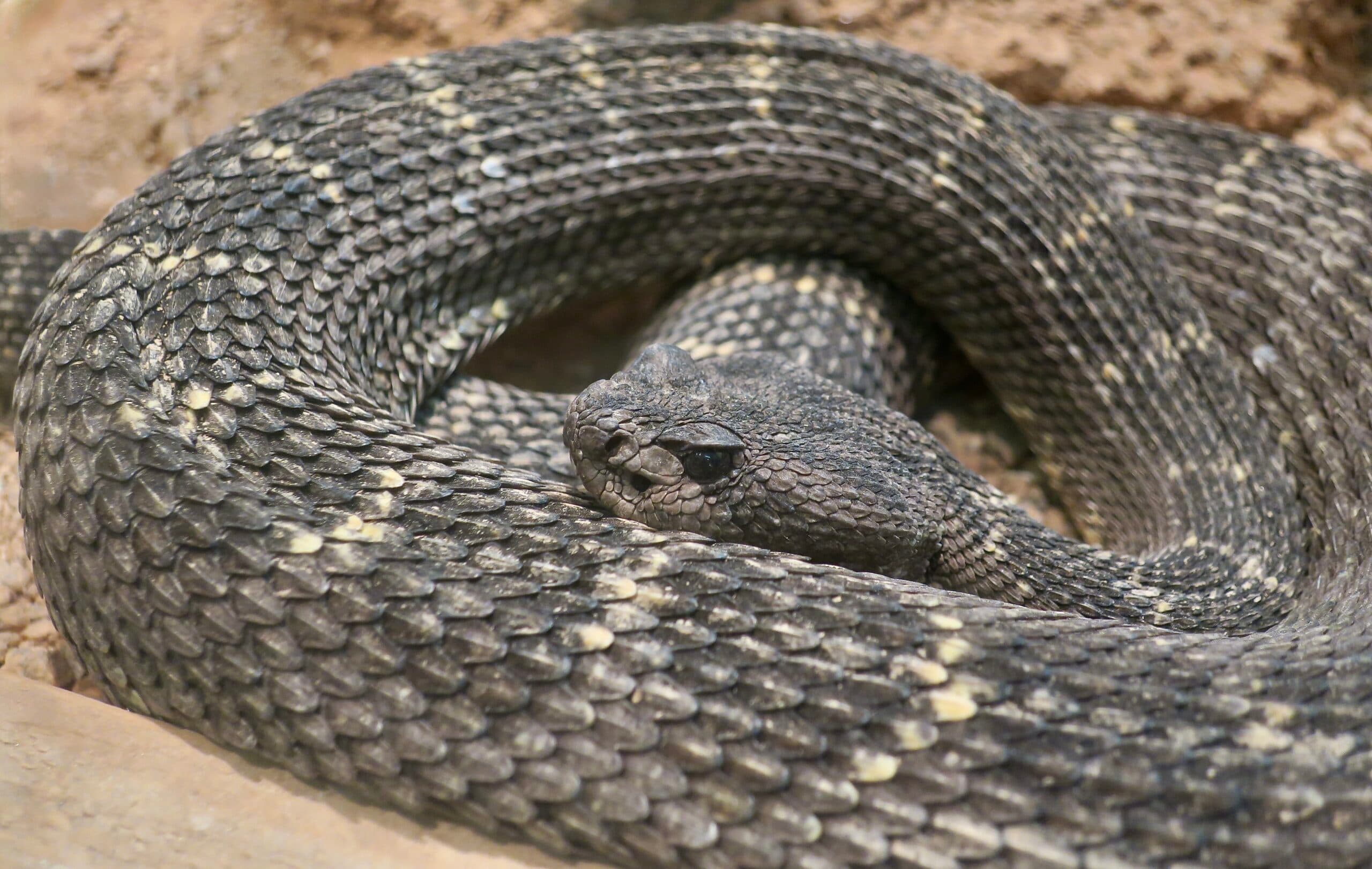
Arizona Black Rattlesnake (Crotalus cerberus) is a venomous pit viper of cool forests, chaparral, rocky canyons and highlands in the southwestern United States. Young snakes are pale gray with bold brown blotches, while most adults darken toward charcoal or black. They use heat-sensitive facial pits to locate prey, venom to subdue it and communal dens to survive freezing winters. This guide separates well-supported biology from common assumptions and covers identification, range, habitat, diet, behavior, reproduction and conservation.
Identification
Adults are dark gray-brown to nearly black with black dorsal blotches edged in pale yellow, white or orange. Some old individuals look almost solid black except for thin crossbars. The head is broad, the neck narrow, pupils vertical and scales strongly keeled. A heat-sensing pit lies between each eye and nostril. Juveniles are much paler with crisp brown blotches and facial stripes. The tail ends in a segmented keratin rattle. Males usually have longer, thicker tails beyond the vent and often grow somewhat longer, but color and pattern overlap strongly between sexes.
Identification should combine body shape, markings, size, voice or movement, and location. One feature by itself can overlap with a related animal, a juvenile, or an individual in unusual light.
Photographs are most useful when they preserve scale and show several diagnostic features. Handling or repositioning a wild arizona black rattlesnake for identification can cause stress and is unnecessary.
Size and physical adaptations
Arizona Black Rattlesnake typically measures most adults about 60–90 cm; exceptional individuals about 106 cm excluding the rattle and weighs commonly several hundred grams; large adults can exceed 1 kg. Body size varies with sex, elevation, prey and age, and the fragile terminal rattle is not included in standard length.
Its useful adaptations include facial pits detect infrared radiation from warm prey, hinged hollow fangs inject venom, rattle warns large animals without physical conflict, dark color absorbs solar heat in cool highlands, keeled scales improve traction on rock and litter, communal dens buffer winter cold, long fasting ability bridges inactive seasons. These traits work together in the animal’s normal setting rather than serving as isolated curiosities.
Published measurements may use different methods, life stages or sample locations. Comparing figures responsibly means checking what was measured rather than selecting the largest number available.
Range and distribution
Central, northern and southeastern Arizona with a narrow extension into extreme western New Mexico. The range follows mountain systems and cool drainages rather than the hottest open desert. Accurate identification requires locality because several other dark or patterned rattlesnakes occur in Arizona. The native range includes United States.
A country-level map indicates broad distribution, not continuous occupation. Climate, elevation, water, vegetation, prey, breeding sites, barriers and survey effort all affect where records occur.
Records near the edge of the range deserve careful documentation because they may reflect natural movement, improved survey coverage, accidental transport or a genuine distribution change.
Habitat
Pine-oak woodland, ponderosa forest, chaparral, rocky mountain slopes, talus, canyon bottoms and cool moist desert drainages.
At high elevations snakes use blocky volcanic outcrops and deep talus cracks that remain above lethal freezing temperatures. During spring they disperse into woodland, meadow edges and drainages to feed and mate. Pregnant females often select warm protected rock sites for gestation. At lower elevations the species stays close to cooler, moister canyons rather than exposed desert flats, making shade, rock structure and den access essential habitat features. Protecting a population therefore requires the feeding, shelter and breeding features that make a site usable, along with connections that allow movement.
Microhabitat matters. Shade, soil, current, moisture, shelter or host plants can determine whether a small area is usable even when the surrounding landscape appears suitable.
Diet and feeding
Arizona Black Rattlesnake is a venomous ambush predator. Important foods include woodrats, mice, ground squirrels, chipmunks, small birds, lizards, occasional amphibians. The snake waits beside rodent routes or follows scent trails, then delivers a rapid strike with folding front fangs. Venom immobilizes prey and begins digestion. After releasing a mammal, the snake follows its chemical trail and swallows it headfirst. Young snakes take proportionally more lizards, while adults depend heavily on small mammals and occasionally birds.
Diet changes with age, season, location and food supply. A dramatic prey record does not establish what most individuals eat most of the time; repeated field observations provide a stronger picture.
Feeding opportunities also create risk. An animal focused on prey may be less alert to predators, traffic or people, while contaminated prey can transfer pollutants through the food web.
Behavior and communication
Mostly crepuscular or nocturnal in warm weather; active by day during cool spring and autumn conditions. An Arizona Black Rattlesnake usually avoids confrontation, relying on camouflage, retreat and the rattle. It basks near cover, moves deliberately between seasonal sites and spends winter underground in groups containing several age classes. Field studies show repeated association, female aggregation and apparent kin-related sociality. A rattle is a warning, not evidence that the snake intends to chase or attack.
The forked tongue samples airborne and ground chemicals and transfers them to the vomeronasal organ. Body posture, scent and touch help organize courtship and male competition. The rattle produces a rapidly repeated warning sound directed at large threats. Snakes also detect substrate vibration and may recognize familiar individuals through repeated chemical and spatial cues. Behavior should be interpreted in context: alarm, courtship, feeding and temperature regulation can produce very different actions from the same animal.
Daily schedules are flexible responses, not rigid rules. Weather, breeding condition, disturbance, tides or food can move activity into a different part of the day.
Reproduction and development
Mating occurs mainly after emergence and may also occur in late summer. Males locate females by scent and may perform ritual combat, raising and pushing against one another without using venom. Females retain embryos internally and give birth to live young, commonly at warm rookery sites shared with other females. They may remain near newborns for several days. Often about 4–10 live young; litter size varies with female size Newborns are fully formed, venomous and paler than adults. They remain near the birth site through their first shed, then begin independent hunting. Juveniles add a new rattle segment at each shed, but segments break and shedding varies, so the rattle cannot reveal exact age. Young snakes must locate a winter refuge before cold weather.
Young animals face different risks and may use different microhabitats or food than adults. Breeding success depends on adult condition, suitable sites and the survival of offspring through vulnerable early stages.
Counts of eggs or young describe reproductive output, not the number expected to reach adulthood. Mortality is normally greatest during eggs, larval or juvenile stages.
Predators and ecological role
This rattlesnake limits rodents and transfers energy to hawks, eagles and mammalian predators. It links forest, meadow and rocky habitats during seasonal movements. Communal dens concentrate many individuals in a few irreplaceable places, so disturbing one rock outcrop can affect a large local population. Slow maturity and infrequent reproduction make adult survival especially important. Documented or likely predators include Red-Tailed Hawk, Golden Eagle, Kingsnake, Coyote, Human.
This animal is both a consumer and a food source. Its influence comes through many repeated interactions, so ecological claims should be based on measured populations rather than assumptions drawn from appearance.
Predator and prey relationships differ among places. A species can be ecologically influential without being abundant everywhere, and its role can change across its range.
Relationship with people
Most encounters occur on mountain trails, roads, yards near rocky habitat and research sites. The species controls rodents and should not be moved or killed by untrained people. Local relocation services can handle snakes around buildings. Its complex social behavior has also made it valuable for research on snake family relationships, den fidelity and maternal care.
Stop, locate the snake and back away slowly. Do not touch, harass, photograph at close range or try to move it. Keep children and dogs beside you on trails. If bitten, call emergency services, remove rings, remain still and reach a hospital quickly. Do not cut, suck, ice, tourniquet or electrically shock the bite. Responsible observation means keeping an appropriate distance, avoiding capture or feeding, protecting habitat and following local wildlife or invasive-species guidance.
Wildlife guidance should come from the responsible local agency because collection rules, reporting requests and appropriate responses differ between native and introduced ranges.
Conservation
The species is generally treated as Least Concern because it occupies multiple mountain systems and protected lands, but no simple global number is available. Den destruction, roads, persecution, severe fire and climate-driven drying can cause important local losses. The reported global trend is Probably stable overall with local declines and data gaps.
Important pressures include road mortality, deliberate killing, den and rookery disturbance, severe wildfire, forest drying and climate change, development in mountain corridors, illegal collection. Global status can hide local decline or recovery, so current regional monitoring and habitat management remain necessary.
The most useful conservation action follows the documented pressure. Protecting breeding sites, reducing road deaths or limiting pollutants can require different tools in different populations.