
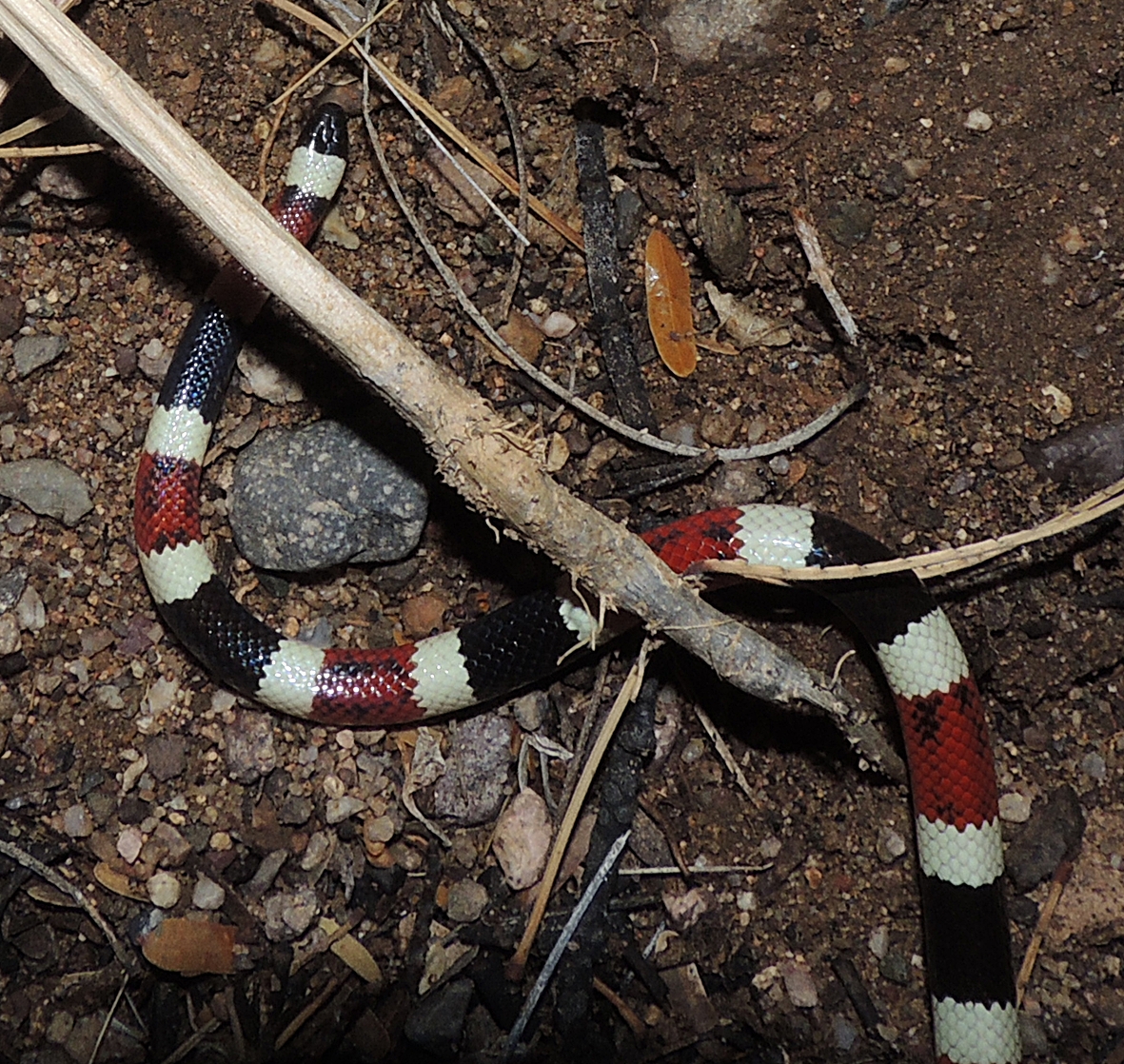
Arizona Coral Snake (Micruroides euryxanthus) is the only living species in the genus Micruroides. It occupies dry country in Arizona, southwestern New Mexico and western Mexico, spending much of its life beneath soil, stones or plant litter. Its slender body carries complete rings of red, cream or yellow, and black. Although medically important venom demands caution, the snake is shy, has a small mouth and is rarely involved in bites. This guide separates well-supported biology from common assumptions and covers identification, range, habitat, diet, behavior, reproduction and conservation.
Identification
The body is narrow and cylindrical, with smooth glossy scales and rings that continue across the belly. Red rings touch pale yellow, cream or white rings and are separated from the next red ring by black. The snout and front of the head are black, the head is barely wider than the neck, the pupils are round and the short blunt tail usually lacks red bands. Arizona individuals often have pale cream rather than saturated yellow rings and dark edging can create a net-like pattern within the red. Males and females look broadly alike. Tail proportions and scale counts can help specialists sex specimens, but observers should never handle a venomous snake to investigate sex.
Identification should combine body shape, markings, size, voice or movement, and location. One feature by itself can overlap with a related animal, a juvenile, or an individual in unusual light.
Photographs are most useful when they preserve scale and show several diagnostic features. Handling or repositioning a wild arizona coral snake for identification can cause stress and is unnecessary.
Size and physical adaptations
Arizona Coral Snake typically measures usually under 50 cm, with exceptional individuals about 61.5 cm total length and weighs light-bodied and generally only a few dozen grams; dependable population-wide mass data are limited. Published size is total length including the short tail; this species is much smaller and slimmer than most regional rattlesnakes.
Its useful adaptations include fixed front fangs deliver neurotoxic venom, smooth scales ease movement through soil and litter, complete warning rings advertise danger, blunt head enters narrow burrows, secretive habits reduce heat and water loss, upturned tail can distract a predator from the head, low profile allows shelter beneath small rocks. These traits work together in the animal’s normal setting rather than serving as isolated curiosities.
Published measurements may use different methods, life stages or sample locations. Comparing figures responsibly means checking what was measured rather than selecting the largest number available.
Range and distribution
Southern and central Arizona, extreme southwestern New Mexico and western Mexico through Sonora and adjacent Pacific-slope states. The subspecies occupy different portions of this range, and records extend through dry valleys and foothills rather than forming a uniform blanket. The native range includes United States, Mexico.
A country-level map indicates broad distribution, not continuous occupation. Climate, elevation, water, vegetation, prey, breeding sites, barriers and survey effort all affect where records occur.
Records near the edge of the range deserve careful documentation because they may reflect natural movement, improved survey coverage, accidental transport or a genuine distribution change.
Habitat
Sonoran desert scrub, semidesert grassland, thornscrub, rocky canyons, bajadas, oak woodland edges and loose soils from low desert into foothills.
Most activity is concealed beneath rocks, logs, litter or soil, especially during hot dry periods. Rain and mild nighttime temperatures bring snakes to the surface, where they may cross roads or search for small reptiles. Loose substrate, natural cover and intact prey communities matter more than open bare ground. Individuals also use rodent burrows and crevices as cool refuges. Protecting a population therefore requires the feeding, shelter and breeding features that make a site usable, along with connections that allow movement.
Microhabitat matters. Shade, soil, current, moisture, shelter or host plants can determine whether a small area is usable even when the surrounding landscape appears suitable.
Diet and feeding
Arizona Coral Snake is a specialized predator of small reptiles and snakes. Important foods include small snakes, threadsnakes, juvenile lizards, skinks, occasional reptile eggs. The snake searches within litter and burrows, seizes narrow prey with small fixed fangs and holds on while venom acts. Its slender head suits elongate prey. Field diet records are relatively uncommon because the species is secretive, so dramatic single observations should not be mistaken for a complete dietary census.
Diet changes with age, season, location and food supply. A dramatic prey record does not establish what most individuals eat most of the time; repeated field observations provide a stronger picture.
Feeding opportunities also create risk. An animal focused on prey may be less alert to predators, traffic or people, while contaminated prey can transfer pollutants through the food web.
Behavior and communication
Mostly crepuscular or nocturnal and most visible after warm-season rain, while remaining hidden through much of the year. An Arizona Coral Snake usually attempts to escape or remain concealed. If cornered, it may coil, flatten parts of the body, make abrupt movements and raise the tail while hiding the head. Unlike a rattlesnake it has no rattle. Its defensive display communicates risk, but a quiet snake is still venomous and should be given distance.
Chemical cues collected by the forked tongue help locate prey and mates. Touch and body alignment guide courtship. Bright rings provide a visual warning to predators, while sudden tail movements can redirect an attack. The snake also detects ground vibration, but it does not use a rattle or loud call. Behavior should be interpreted in context: alarm, courtship, feeding and temperature regulation can produce very different actions from the same animal.
Daily schedules are flexible responses, not rigid rules. Weather, breeding condition, disturbance, tides or food can move activity into a different part of the day.
Reproduction and development
This species lays eggs. Courtship and mating occur during the warm season, followed by deposition of a small clutch in a protected humid site beneath ground cover or within soil. There is no evidence of extended parental care. Reproductive timing shifts with elevation, rainfall and latitude across the broad north-south range. Usually a small clutch of several elongate eggs; exact counts vary and are infrequently documented Hatchlings emerge fully formed with venom apparatus and complete warning bands. They begin hunting very small snakes and lizards and must avoid rapid dehydration and predators. Growth is gradual, and juveniles use the same concealed microhabitats as adults at a smaller scale.
Young animals face different risks and may use different microhabitats or food than adults. Breeding success depends on adult condition, suitable sites and the survival of offspring through vulnerable early stages.
Counts of eggs or young describe reproductive output, not the number expected to reach adulthood. Mortality is normally greatest during eggs, larval or juvenile stages.
Predators and ecological role
The Arizona Coral Snake is a mid-level predator that removes small snakes and lizards and can itself be eaten by raptors, mammals and larger snakes. Its burrowing connects surface litter with underground food webs. Warning coloration has also shaped mimicry by harmless regional snakes, although color rules are imperfect and should never replace safe distance. Documented or likely predators include Kingsnake, Roadrunner, Hawk, Coyote, Human.
This animal is both a consumer and a food source. Its influence comes through many repeated interactions, so ecological claims should be based on measured populations rather than assumptions drawn from appearance.
Predator and prey relationships differ among places. A species can be ecologically influential without being abundant everywhere, and its role can change across its range.
Relationship with people
Encounters are uncommon and usually happen when gardening, moving cover, walking after rain or finding a snake on a road. The species helps control small reptiles and should be left in place. Identification rhymes are unreliable outside limited regions and even damaged or atypical individuals can confuse observers, so nobody should test an identification by touching.
Keep several metres away, bring children and pets inside and let the snake leave. Do not pin, pick up, photograph at close range or attempt relocation. After any suspected bite, call emergency services and a poison center immediately and reach a hospital even if pain and swelling are slight, because neurologic symptoms can be delayed. Do not cut, suck, ice or tourniquet the wound. Responsible observation means keeping an appropriate distance, avoiding capture or feeding, protecting habitat and following local wildlife or invasive-species guidance.
Wildlife guidance should come from the responsible local agency because collection rules, reporting requests and appropriate responses differ between native and introduced ranges.
Conservation
The species is listed as Least Concern because it has a broad range and occurs in multiple protected landscapes. No reliable global population total exists, and secretive behavior makes trends difficult to measure. Local losses can follow road expansion, development, persecution and removal of surface cover. The reported global trend is Unknown to probably stable overall, with local data gaps.
Important pressures include road mortality, deliberate killing, urban expansion, loss of rock and litter cover, illegal collection, pesticide effects on prey, hotter and drier climate conditions. Global status can hide local decline or recovery, so current regional monitoring and habitat management remain necessary.
The most useful conservation action follows the documented pressure. Protecting breeding sites, reducing road deaths or limiting pollutants can require different tools in different populations.