
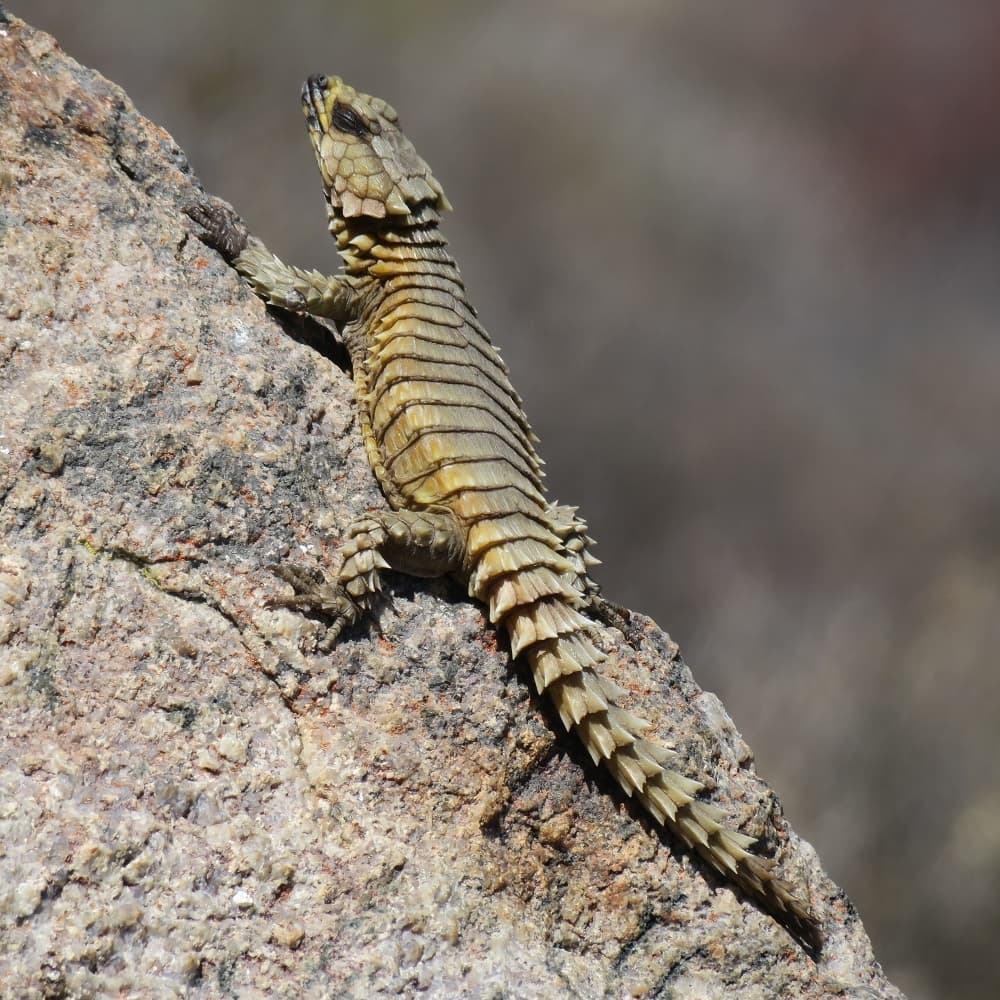
Armadillo Girdled Lizard (Ouroborus cataphractus) is a small, strongly armored cordylid found only in western South Africa. It lives in narrow rock crevices, often in unusually large social groups, and feeds heavily on termites. When exposed to danger it can seize its tail in its mouth and curl into a spiny ring that protects its softer underside. This famous defense depends on an intact tail, so the lizard sheds its tail only as a last resort. This guide separates well-supported biology from common assumptions and covers identification, range, habitat, diet, behavior, reproduction and conservation.
Identification
Rows of large, sharply keeled scales armor the broad, flattened head, back, flanks and tail. The body is usually yellowish brown to dark brown above, with darker markings and a paler yellow belly marked by dark blotches. A broad triangular head, short sturdy limbs and a tail ringed with prominent spines give the animal a compact armored appearance. The tail is flexible enough to be gripped in the mouth during the characteristic defensive curl. Adult males tend to have broader heads and more prominent femoral pores than females, but size and color overlap. Reliable sexing requires close expert examination and should not justify handling wild animals.
Identification should combine body shape, markings, size, voice or movement, and location. One feature by itself can overlap with a related animal, a juvenile, or an individual in unusual light.
Photographs are most useful when they preserve scale and show several diagnostic features. Handling or repositioning a wild armadillo girdled lizard for identification can cause stress and is unnecessary.
Size and physical adaptations
Armadillo Girdled Lizard typically measures usually 12–16 cm total length and weighs commonly several tens of grams; dependable population-wide mass ranges are limited. Published size figures normally report total length including the spiny tail. Age, sex and local food conditions affect adult size.
Its useful adaptations include interlocking spiny scales protect the body, tail-biting curl shields the softer underside, flattened body enters narrow rock fissures, strong claws grip rough stone, live birth avoids exposed eggs, group living supports shared vigilance, seasonal termite feeding exploits abundant prey. These traits work together in the animal’s normal setting rather than serving as isolated curiosities.
Published measurements may use different methods, life stages or sample locations. Comparing figures responsibly means checking what was measured rather than selecting the largest number available.
Range and distribution
Endemic to western South Africa, from the southern Richtersveld through Namaqualand south toward the Piketberg Mountains, with inland records toward the Tankwa Karoo and Matjiesfontein. Its distribution is patchy because colonies require suitable rocky refuges. The native range includes South Africa.
A country-level map indicates broad distribution, not continuous occupation. Climate, elevation, water, vegetation, prey, breeding sites, barriers and survey effort all affect where records occur.
Records near the edge of the range deserve careful documentation because they may reflect natural movement, improved survey coverage, accidental transport or a genuine distribution change.
Habitat
Rocky outcrops, sandstone ledges and crevice-rich slopes in the arid Succulent Karoo and nearby dwarf-shrub landscapes.
Individuals use deep, narrow crevices as long-term shelters from temperature extremes and predators. Several animals may share the same rock system, and groups can include many age classes. Nearby open ground and sparse shrubland provide termite foraging areas, so intact rock refuges and the surrounding feeding habitat are both essential. Protecting a population therefore requires the feeding, shelter and breeding features that make a site usable, along with connections that allow movement.
Microhabitat matters. Shade, soil, current, moisture, shelter or host plants can determine whether a small area is usable even when the surrounding landscape appears suitable.
Diet and feeding
Armadillo Girdled Lizard is a specialized insectivore. Important foods include southern harvester termites, other termites, beetles, millipedes, other arthropods, occasional plant material. Southern Harvester Termites, Microhodotermes viator, are a particularly important food and may draw lizards away from their crevices when workers are abundant. They also take other insects and arthropods opportunistically. Diet varies seasonally, and occasional reports of plant material or scorpions should not be mistaken for the main diet.
Diet changes with age, season, location and food supply. A dramatic prey record does not establish what most individuals eat most of the time; repeated field observations provide a stronger picture.
Feeding opportunities also create risk. An animal focused on prey may be less alert to predators, traffic or people, while contaminated prey can transfer pollutants through the food web.
Behavior and communication
Diurnal, with surface activity concentrated in suitable temperatures and strong termite availability. This is one of the most social lizards known. Colonies use shared rocky refuges and may contain a few individuals or several dozen, although animals forage individually. When threatened in the open, a lizard may roll onto its side, bite its tail and present a ring of spines. It normally retreats into a crevice first, inflating its body to resist extraction.
Visual posture, touch and chemical cues help group members and potential mates recognize one another. Lizards tongue-flick surfaces and other animals to sample scent. Defensive curling and body inflation communicate that capture will be difficult, while basking position and movement help maintain spacing near crowded crevices. Behavior should be interpreted in context: alarm, courtship, feeding and temperature regulation can produce very different actions from the same animal.
Daily schedules are flexible responses, not rigid rules. Weather, breeding condition, disturbance, tides or food can move activity into a different part of the day.
Reproduction and development
Mating occurs during the warmer season, and fertilization is internal. Females retain developing young rather than laying exposed eggs, an advantage in a dry climate with large temperature swings. Reproductive output is low, which limits how quickly a depleted colony can recover. Usually one live young; twins are occasionally reported The newborn is fully formed, armored and able to move independently. It remains within the colony environment, where crevices provide shelter. Slow reproduction means juvenile survival and the persistence of established adult groups are especially important.
Young animals face different risks and may use different microhabitats or food than adults. Breeding success depends on adult condition, suitable sites and the survival of offspring through vulnerable early stages.
Counts of eggs or young describe reproductive output, not the number expected to reach adulthood. Mortality is normally greatest during eggs, larval or juvenile stages.
Predators and ecological role
By consuming large numbers of termites and other arthropods, Armadillo Girdled Lizards connect insect pulses with rocky-karoo food webs. They are prey for raptors, snakes and small carnivores when away from shelter. Their dense colonies also make them useful indicators of intact crevice habitat, but the same concentration makes local collection especially damaging. Documented or likely predators include Rock Kestrel, Black-Chested Snake Eagle, Cape Cobra, Yellow Mongoose, Domestic Cat.
This animal is both a consumer and a food source. Its influence comes through many repeated interactions, so ecological claims should be based on measured populations rather than assumptions drawn from appearance.
Predator and prey relationships differ among places. A species can be ecologically influential without being abundant everywhere, and its role can change across its range.
Relationship with people
The species became internationally sought after for its dramatic armor and defensive behavior, and past collection removed whole animals from vulnerable colonies. It is now regulated nationally and listed under CITES Appendix II. Researchers and visitors should observe without lifting rocks, blocking crevices or handling animals. Any legal captive animal should have traceable, verified captive-bred origin and the permits required by the relevant authority.
It is nonvenomous and normally avoids people, but a restrained animal can bite and its spines can scratch. Do not pull one from a crevice or force it to curl. If accidental contact occurs, wash minor wounds with soap and water and seek medical care for a deep bite or signs of infection. Responsible observation means keeping an appropriate distance, avoiding capture or feeding, protecting habitat and following local wildlife or invasive-species guidance.
Wildlife guidance should come from the responsible local agency because collection rules, reporting requests and appropriate responses differ between native and introduced ranges.
Conservation
The IUCN Red List reassessed the species as Near Threatened in 2022. It has a restricted, fragmented South African range, low reproductive output and colonies vulnerable to illegal collection and habitat pressure. Earlier sources may still display Least Concern, so the current assessment should be used. The reported global trend is Decreasing or uncertain, with local colonies vulnerable to removal.
Important pressures include illegal collection for the pet trade, removal of entire social colonies, habitat degradation, agricultural expansion, mining and quarrying, road development, climate change, small fragmented populations. Global status can hide local decline or recovery, so current regional monitoring and habitat management remain necessary.
The most useful conservation action follows the documented pressure. Protecting breeding sites, reducing road deaths or limiting pollutants can require different tools in different populations.