
Home/Animals/Reptilia/Asian Vine Snake
Species profileIUCN: LC

Asian Vine Snake

Ahaetulla prasina

A slender Southeast Asian tree snake whose pointed face, horizontal pupils and swaying movements make it almost disappear among leaves and twigs.

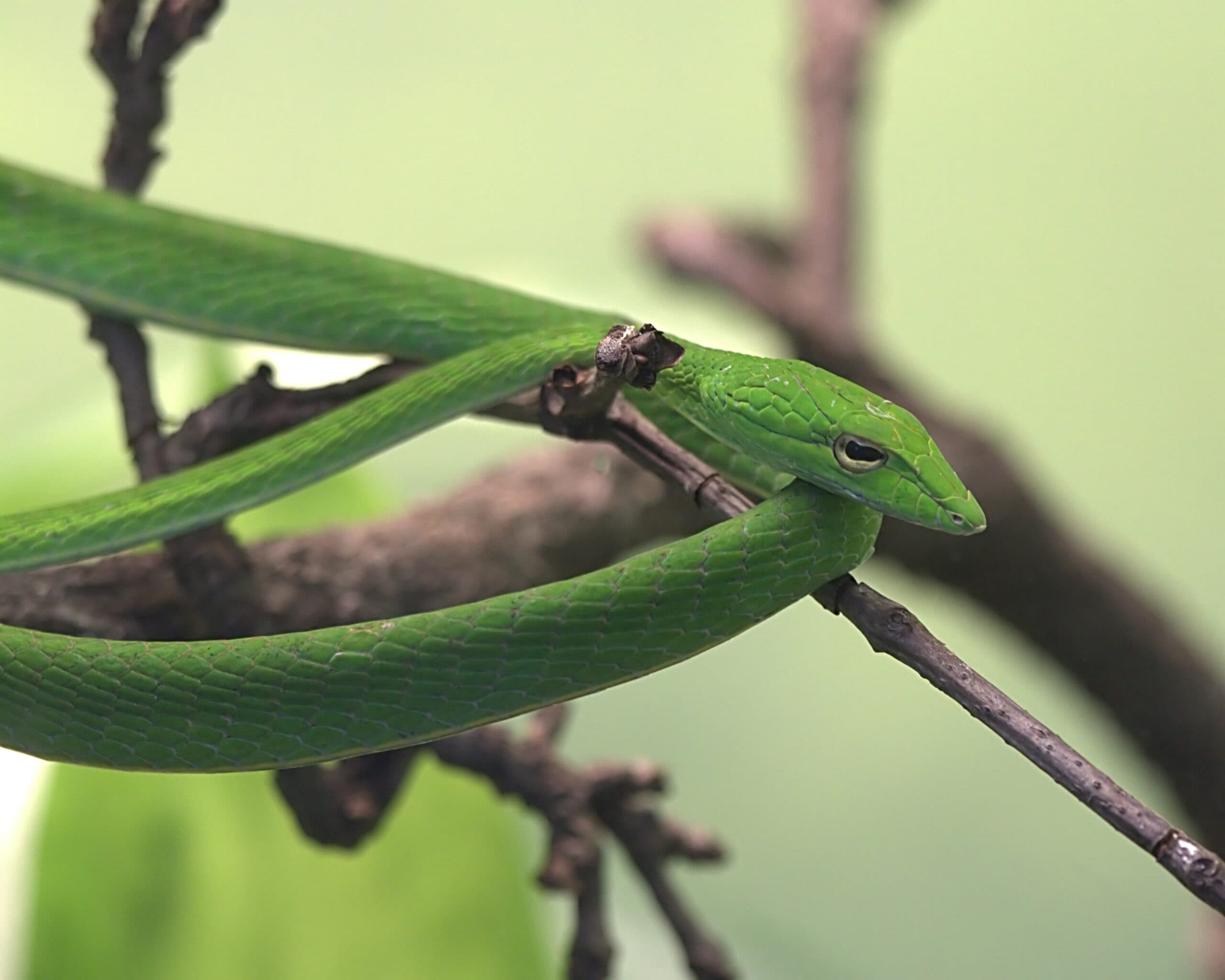
Green Asian Vine Snake showing its pointed snout and long slender body among branches
Greg Hume / Wikimedia Commons / CC BY-SA 3.0
๐ŸŒ Read in Language:

โšก At a Glance

Species profile
Also Known As
Oriental Whip Snake; Oriental Vine Snake; Boieโ€™s Whip Snake
Diet Category
Visual hunter of small arboreal vertebrates
Activity Rhythm
Diurnal, with most foraging and travel during daylight; rests concealed in foliage at night.
Wild Lifespan
Wild longevity is poorly documented; managed individuals may live roughly 8โ€“12 years
Typical Weight
commonly about 100โ€“300 g because the body is exceptionally slender
Conservation Status
LC
๐Ÿ’ก Key Biological Insight: Unlike snakes with round or vertical pupils, the Asian Vine Snake has horizontally elongated pupils that contribute to forward-focused vision while it hunts in branches.

๐ŸŒณ Scientific Taxonomy Hierarchy

Ahaetulla prasina belongs to the family Colubridae, subfamily Ahaetuliinae, and order Squamata. Asian vine-snake taxonomy has changed as genetic work separates previously combined lineages. This profile covers Ahaetulla prasina in its current Southeast Asian sense and does not apply its measurements or status to every species in Ahaetulla.

KingdomAnimalia
PhylumChordata
ClassReptilia
OrderSquamata
FamilyColubridae
GenusAhaetulla
SpeciesAhaetulla prasina

Distinguishing Anatomical Features

  • โœ“The body and tail are extraordinarily long and thin, with a distinct spear-shaped head and an extended pointed snout. The eyes are large and have horizontal, keyhole-like pupils. Adults are often leaf green above and pale green below, with a yellow line along each side of the belly, but yellow, gray, brown and orange forms occur. When threatened, the snake expands its neck to reveal black-and-white skin between the scales.
  • โœ“Pointed snout parts foliage
  • โœ“Horizontal pupils support binocular depth judgment
  • โœ“Extremely slender body mimics vines
  • โœ“Green and brown morphs match different vegetation
  • โœ“Swaying movement resembles a branch in wind
  • โœ“Long tail balances the body on narrow supports
  • โœ“Rear fangs deliver mild prey-subduing venom

๐Ÿ“ Physical Measurements

Total Lengthusually 3.9โ€“5.9 ft, with large individuals near 6.2 ft
Body Weightcommonly about 3.5โ€“10.6 oz
Tail LengthVery long, slender and prehensile-looking, used for balance rather than true grasping
WingspanNot applicable
Top SpeedNo dependable universal maximumMovement changes with context and conditions.

๐ŸŽจ Appearance & Distinctive Markings

GreenYellowBrownGrayOrangeYellowBrownOrange

Skin / Covering: Dry overlapping smooth scales

Sexual Dimorphism: Females are generally heavier and may grow longer, while males tend to have proportionally longer tails. Color is not a dependable guide to sex.

๐Ÿ—บ๏ธ Geographic Distribution & Habitat

The species occurs from northeastern India, Bangladesh and Bhutan through Myanmar, southern China and mainland Southeast Asia, then through the Malay Peninsula, Sumatra, Borneo, Java, Sulawesi and parts of the Philippines. Taxonomic revisions may refine the edges of this broad range, and country-level mapping does not show its uneven local occurrence.

Lowland and hill forest, secondary woodland, forest edge, bamboo, scrub, mangrove margin, plantation, wooded park and leafy garden.

Country-level distribution map

Native range
FijiTanzaniaWestern SaharaCanadaUnited StatesKazakhstanUzbekistanPapua New GuineaIndonesia โ€” Native rangeArgentinaChileCongo - KinshasaSomaliaKenyaSudanChadHaitiDominican RepublicRussiaBahamasFalkland IslandsNorwayGreenlandFrench Southern TerritoriesTimor-LesteSouth AfricaLesothoMexicoUruguayBrazilBoliviaPeruColombiaPanamaCosta RicaNicaraguaHondurasEl SalvadorGuatemalaBelizeVenezuelaGuyanaSurinameFranceEcuadorPuerto RicoJamaicaCubaZimbabweBotswanaNamibiaSenegalMaliMauritaniaBeninNigerNigeriaCameroonTogoGhanaCรดte dโ€™IvoireGuineaGuinea-BissauLiberiaSierra LeoneBurkina FasoCentral African RepublicCongo - BrazzavilleGabonEquatorial GuineaZambiaMalawiMozambiqueEswatiniAngolaBurundiIsraelLebanonMadagascarPalestinian TerritoriesGambiaTunisiaAlgeriaJordanUnited Arab EmiratesQatarKuwaitIraqOmanVanuatuCambodia โ€” Native rangeThailand โ€” Native rangeLaos โ€” Native rangeMyanmar (Burma) โ€” Native rangeVietnam โ€” Native rangeNorth KoreaSouth KoreaMongoliaIndia โ€” Native rangeBangladesh โ€” Native rangeBhutan โ€” Native rangeNepalPakistanAfghanistanTajikistanKyrgyzstanTurkmenistanIranSyriaArmeniaSwedenBelarusUkrainePolandAustriaHungaryMoldovaRomaniaLithuaniaLatviaEstoniaGermanyBulgariaGreeceTรผrkiyeAlbaniaCroatiaSwitzerlandLuxembourgBelgiumNetherlandsPortugalSpainIrelandNew CaledoniaSolomon IslandsNew ZealandAustraliaSri LankaChina โ€” Native rangeTaiwanItalyDenmarkUnited KingdomIcelandAzerbaijanGeorgiaPhilippines โ€” Native rangeMalaysia โ€” Native rangeBrunei โ€” Native rangeSloveniaFinlandSlovakiaCzechiaEritreaJapanParaguayYemenSaudi ArabiaCyprusMoroccoEgyptLibyaEthiopiaDjiboutiUgandaRwandaBosnia & HerzegovinaNorth MacedoniaSerbiaMontenegroKosovoTrinidad & TobagoSouth Sudan
Highlighted countries are recorded profile locations, not precise biological range boundaries.Map boundaries: Natural Earth

๐Ÿ’ก Did You Know?

  • ๐Ÿ’กPointed snout parts foliage
  • ๐Ÿ’กHorizontal pupils support binocular depth judgment
  • ๐Ÿ’กExtremely slender body mimics vines
  • ๐Ÿ’กGreen and brown morphs match different vegetation
  • ๐Ÿ’กSwaying movement resembles a branch in wind
  • ๐Ÿ’กLong tail balances the body on narrow supports
  • ๐Ÿ’กRear fangs deliver mild prey-subduing venom

๐ŸŒฟ Conservation Status & Threats

IUCN: LC โ€” Least Concern

โ€œThe Asian Vine Snake is widely distributed and remains common in many parts of its range, including some wooded urban landscapes. Its broad status does not protect local populations from forest clearing, road mortality, persecution or collection.โ€

Population TrendNot well quantified; likely locally declining where connected vegetation is removed
Wild Population EstimateNo reliable global total; common in suitable habitat in parts of Southeast Asia
CITESInternational trade should comply with national wildlife and veterinary rules; verify current CITES treatment before any movement

โš ๏ธ Major Threats to Asian Vine Snake

  • โ€ขDeforestation
  • โ€ขFragmented tree cover
  • โ€ขRoad mortality
  • โ€ขDeliberate killing
  • โ€ขPesticide-driven prey loss
  • โ€ขWildlife trade
  • โ€ขFree-ranging cats
  • โ€ขTaxonomic uncertainty masking local decline

๐Ÿ”„ Life Cycle & Reproduction

Wild vs. Captivity Lifespan Comparison

๐ŸŒฟ In the WildWild longevity is poorly documented; managed individuals may live roughly 8โ€“12 years
๐Ÿ  In Captivity (with veterinary care)Specialist institutions and experienced legal keepers need tall planted enclosures, precise climate control, quarantine, feeding plans and veterinary oversight.
Clutch / Litter SizeOften about 4โ€“10 live young, with litter size varying by female size and locality
Incubation / GestationNo external incubation; embryos develop within the female for several months
Fledging / WeaningIndependent slender neonate roughly 30โ€“50 cm long
Sexual MaturityLikely after about 2โ€“3 years, varying with growth and locality
Mating SystemInternal fertilization; live-bearing
Nesting / Den TypeNo nest; embryos develop inside the female

๐Ÿฆ… Behavior & Field Ecology

Visual hunter of small arboreal vertebrates

๐ŸŒ Ecological Food Web & Relationships: Asian Vine Snakes control populations of small lizards and frogs and provide prey for raptors, larger snakes and carnivorous mammals. Their slender form allows them to use fine branches unavailable to heavier predators. Because they depend on continuous vegetation and diverse small vertebrates, they are affected by simplified landscapes even where scattered trees remain.

Social Group SizeSolitary except during courtship
Activity RhythmDiurnal, with most foraging and travel during daylight; rests concealed in foliage at night.
Feeding StrategyVisual hunter of small arboreal vertebrates

๐Ÿฅฉ Primary Prey & Preferred Diet

โœ“ Geckosโœ“ Skinksโœ“ Tree frogsโœ“ Other small frogsโœ“ Small birdsโœ“ Nestlingsโœ“ Occasional small rodents

๐Ÿ“ข Communication & Territorial Signals

  • Tongue-flick scent sampling
  • Visual prey tracking
  • Pheromones
  • Body inflation
  • Contrasting skin display
  • Defensive gaping

๐Ÿพ Wild Temperament & Traits

โ€ข Watchfulโ€ข Slow-movingโ€ข Arborealโ€ข Mostly solitaryโ€ข Visually orientedโ€ข Defensive if restrained

๐Ÿค Human Interaction & Pet Advisory

โš ๏ธ Strictly Wild Species
๐Ÿšซ

Can You Keep a Asian Vine Snake as a Pet?

This is a demanding display animal rather than a beginner pet. Many individuals require live or carefully transitioned lizard and frog prey, spacious planted vertical housing, stable humidity, ultraviolet light and an experienced reptile veterinarian. Wild capture damages populations and commonly produces stressed animals with parasites; only legal captive-bred stock should ever be considered.

Domestication StatusWild snake; not domesticated
Danger to HumansLow medical risk for most people, but a bite still warrants professional advice
Economic & Ecotourism RoleControl of small reptiles and amphibians, tropical forest food webs, research on vision and camouflage, and education about coexistence with urban wildlife.

โš ๏ธ Behavioral Risk Factors & Wildlife Safety

  • Rear-fanged venom can cause localized symptoms
  • Prolonged chewing can deliver more secretion
  • Allergic responses are possible
  • A mistaken identification could delay treatment for another species

๐ŸŒ Ecological Food Web & Relationships

๐Ÿฆ… Natural Predators (5)

Crested Serpent EagleSpilornis cheela
Changeable Hawk-EagleNisaetus cirrhatus
King CobraOphiophagus hannah
Common Palm CivetParadoxurus hermaphroditus
Domestic CatFelis catus

๐Ÿงฌ Related Species (4)

Brown-Speckled Whip SnakeAhaetulla pulverulentaSouth Asian relative
Sri Lankan Green Vine SnakeAhaetulla nasutaSri Lankan endemic relative
Long-Nosed Vine SnakeAhaetulla oxyrhynchaIndian relative separated by revision
Asian Twig SnakeAhaetulla mycterizansSoutheast Asian relative

Asian Vine Snake (Ahaetulla prasina) is a diurnal, arboreal colubrid distributed from parts of South and southern China across mainland Southeast Asia and the Malay Archipelago. Its narrow body may be green, yellow, brown or orange, and its long pointed snout supports binocular vision used to judge distance when moving and hunting in vegetation. It is rear-fanged and mildly venomous, but avoids people and is not considered medically dangerous in normal encounters. This guide separates well-supported biology from common assumptions and covers identification, range, habitat, diet, behavior, reproduction and conservation.

Identification

The body and tail are extraordinarily long and thin, with a distinct spear-shaped head and an extended pointed snout. The eyes are large and have horizontal, keyhole-like pupils. Adults are often leaf green above and pale green below, with a yellow line along each side of the belly, but yellow, gray, brown and orange forms occur. When threatened, the snake expands its neck to reveal black-and-white skin between the scales. Females are generally heavier and may grow longer, while males tend to have proportionally longer tails. Color is not a dependable guide to sex.

Identification should combine body shape, markings, size, voice or movement, and location. One feature by itself can overlap with a related animal, a juvenile, or an individual in unusual light.

Photographs are most useful when they preserve scale and show several diagnostic features. Handling or repositioning a wild asian vine snake for identification can cause stress and is unnecessary.

Size and physical adaptations

Asian Vine Snake typically measures usually 1.2โ€“1.8 m, with large individuals near 1.9 m and weighs commonly about 100โ€“300 g because the body is exceptionally slender. Total length includes an unusually long tail; body mass varies greatly with reproductive condition and recent feeding.

Its useful adaptations include pointed snout parts foliage, horizontal pupils support binocular depth judgment, extremely slender body mimics vines, green and brown morphs match different vegetation, swaying movement resembles a branch in wind, long tail balances the body on narrow supports, rear fangs deliver mild prey-subduing venom. These traits work together in the animal’s normal setting rather than serving as isolated curiosities.

Published measurements may use different methods, life stages or sample locations. Comparing figures responsibly means checking what was measured rather than selecting the largest number available.

Range and distribution

The species occurs from northeastern India, Bangladesh and Bhutan through Myanmar, southern China and mainland Southeast Asia, then through the Malay Peninsula, Sumatra, Borneo, Java, Sulawesi and parts of the Philippines. Taxonomic revisions may refine the edges of this broad range, and country-level mapping does not show its uneven local occurrence. The native range includes India, Bangladesh, Bhutan, Myanmar, China, Thailand, Laos, Cambodia, Vietnam, Malaysia, Singapore, Brunei, Indonesia, Philippines.

A country-level map indicates broad distribution, not continuous occupation. Climate, elevation, water, vegetation, prey, breeding sites, barriers and survey effort all affect where records occur.

Records near the edge of the range deserve careful documentation because they may reflect natural movement, improved survey coverage, accidental transport or a genuine distribution change.

Habitat

Lowland and hill forest, secondary woodland, forest edge, bamboo, scrub, mangrove margin, plantation, wooded park and leafy garden.

It spends most of its time above ground in shrubs, saplings and low tree canopies, using connected stems as travel routes. Forest edges can provide hunting perches, but complete canopy removal and pesticide-heavy gardens reduce both cover and prey. The snake may cross the ground briefly when moving between isolated vegetation. Protecting a population therefore requires the feeding, shelter and breeding features that make a site usable, along with connections that allow movement.

Microhabitat matters. Shade, soil, current, moisture, shelter or host plants can determine whether a small area is usable even when the surrounding landscape appears suitable.

Diet and feeding

Asian Vine Snake is a visual hunter of small arboreal vertebrates. Important foods include geckos, skinks, tree frogs, other small frogs, small birds, nestlings, occasional small rodents. The snake moves slowly through foliage, pauses with its head extended and uses overlapping fields of view to estimate distance. A quick strike secures prey, and rear enlarged teeth introduce mild venom while the snake holds on. Lizards and frogs form much of the diet; birds and small mammals are less frequent. It swallows prey whole and does not constrict.

Diet changes with age, season, location and food supply. A dramatic prey record does not establish what most individuals eat most of the time; repeated field observations provide a stronger picture.

Feeding opportunities also create risk. An animal focused on prey may be less alert to predators, traffic or people, while contaminated prey can transfer pollutants through the food web.

Behavior and communication

Diurnal, with most foraging and travel during daylight; rests concealed in foliage at night. An undisturbed individual advances with deliberate, swaying movements that resemble a vine moving in the breeze. It often freezes rather than fleeing. When cornered, it may inflate the front of the body, display contrasting skin, gape and strike. These actions are defensive. It is agile on narrow branches but comparatively awkward on open ground.

Tongue flicking samples chemical cues for prey, mates and surroundings. Vision is unusually important during hunting. Body inflation, gaping and the sudden display of black-and-white interscale skin warn predators. Courtship relies on close contact and chemical recognition rather than calls. Behavior should be interpreted in context: alarm, courtship, feeding and temperature regulation can produce very different actions from the same animal.

Daily schedules are flexible responses, not rigid rules. Weather, breeding condition, disturbance, tides or food can move activity into a different part of the day.

Reproduction and development

Courtship and mating occur in vegetation. Fertilization is internal, and females retain developing embryos rather than laying shelled eggs. Reproductive timing varies across the tropical range and may follow local rainfall and food availability. Often about 4โ€“10 live young, with litter size varying by female size and locality Young are born fully formed, brightly patterned and capable of climbing and hunting small frogs or lizards. They receive no prolonged parental care. Growth depends on temperature and prey, so age at maturity varies among regions.

Young animals face different risks and may use different microhabitats or food than adults. Breeding success depends on adult condition, suitable sites and the survival of offspring through vulnerable early stages.

Counts of eggs or young describe reproductive output, not the number expected to reach adulthood. Mortality is normally greatest during eggs, larval or juvenile stages.

Predators and ecological role

Asian Vine Snakes control populations of small lizards and frogs and provide prey for raptors, larger snakes and carnivorous mammals. Their slender form allows them to use fine branches unavailable to heavier predators. Because they depend on continuous vegetation and diverse small vertebrates, they are affected by simplified landscapes even where scattered trees remain. Documented or likely predators include Crested Serpent Eagle, Changeable Hawk-Eagle, King Cobra, Common Palm Civet, Domestic Cat.

This animal is both a consumer and a food source. Its influence comes through many repeated interactions, so ecological claims should be based on measured populations rather than assumptions drawn from appearance.

Predator and prey relationships differ among places. A species can be ecologically influential without being abundant everywhere, and its role can change across its range.

Relationship with people

The species sometimes enters parks and gardens because shrubs support geckos and frogs. Most encounters require no action: step back, keep children and pets away and allow an escape route. Pruning should pause until the snake leaves. Retaining connected native vegetation and limiting broad-spectrum pesticides supports both the snake and its prey.

Do not handle or deliberately provoke any wild snake. Asian Vine Snake bites are uncommon and usually follow restraint. Rear-fang venom may cause local pain, swelling, bruising or numbness. Wash a bite, remove rings, keep the person calm and seek medical advice, especially if swelling spreads or identification is uncertain. Do not cut, suck, ice or tourniquet the wound. Responsible observation means keeping an appropriate distance, avoiding capture or feeding, protecting habitat and following local wildlife or invasive-species guidance.

Wildlife guidance should come from the responsible local agency because collection rules, reporting requests and appropriate responses differ between native and introduced ranges.

Conservation

The Asian Vine Snake is widely distributed and remains common in many parts of its range, including some wooded urban landscapes. Its broad status does not protect local populations from forest clearing, road mortality, persecution or collection. The reported global trend is Not well quantified; likely locally declining where connected vegetation is removed.

Important pressures include deforestation, fragmented tree cover, road mortality, deliberate killing, pesticide-driven prey loss, wildlife trade, free-ranging cats, taxonomic uncertainty masking local decline. Global status can hide local decline or recovery, so current regional monitoring and habitat management remain necessary.

The most useful conservation action follows the documented pressure. Protecting breeding sites, reducing road deaths or limiting pollutants can require different tools in different populations.

Sources and further reading

โ“ Frequently Asked Questions

Answers to frequently asked questions verified against peer-reviewed zoological research.

It is mildly venomous and rear-fanged, but bites are uncommon and usually cause localized effects; any bite should still receive medical advice.