
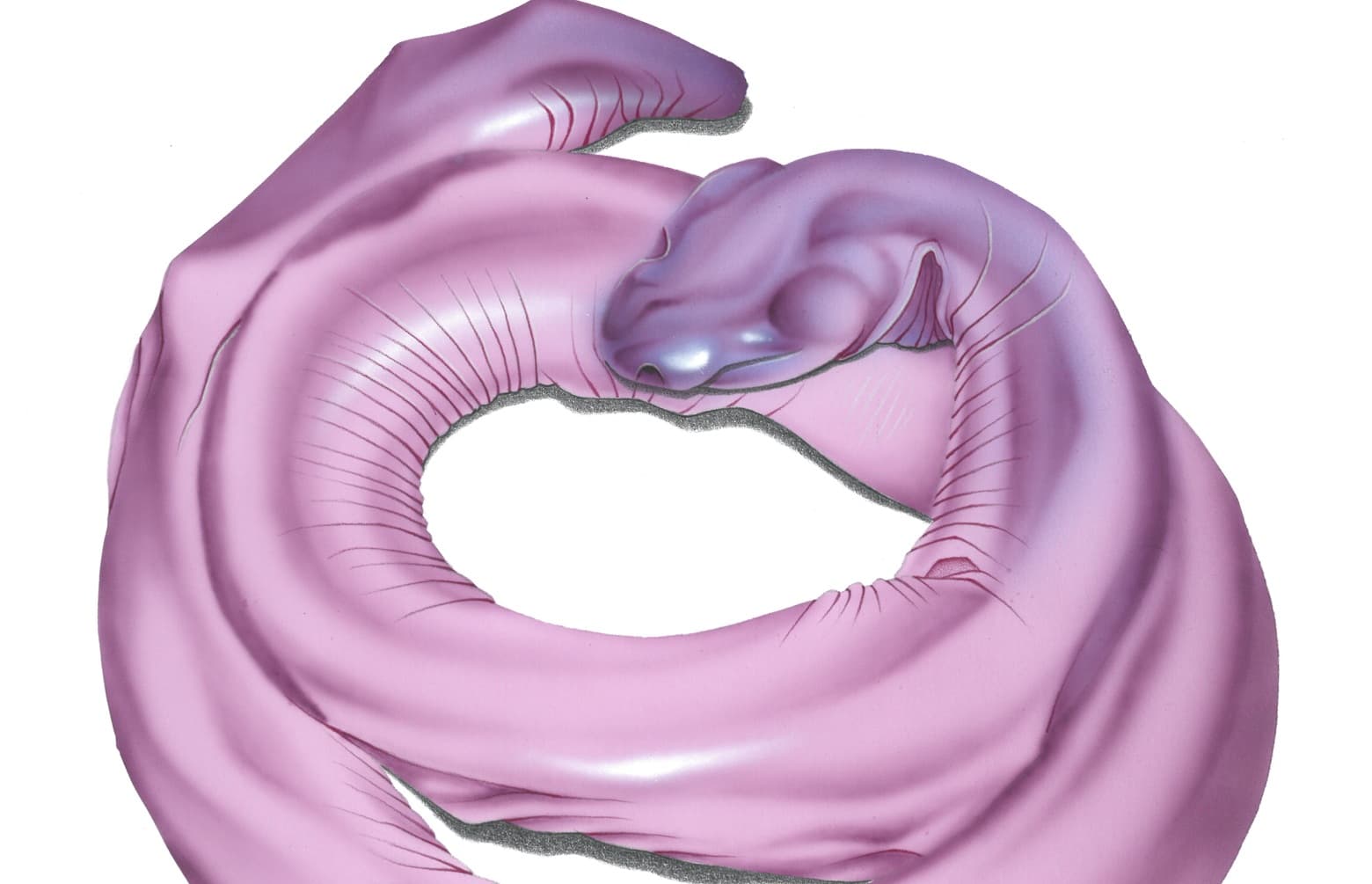
Eiselt’s Caecilian (Atretochoana eiselti) is a limbless aquatic amphibian from the Amazon basin. Despite a viral nickname and a snake-like outline, it is a caecilian rather than a snake. The species is extraordinary because adults entirely lack lungs and exchange gases through capillary-rich skin; only a small number of specimens and field observations are known. This guide separates well-supported biology from common assumptions and covers identification, range, habitat, diet, behavior, reproduction and conservation.
Identification
This large caecilian has a long limbless body divided externally by ring-like annuli, smooth skin, a broad flattened head and a fleshy dorsal fin. Its sealed internal nostrils, unusually mobile cheek region and complete absence of lungs distinguish it anatomically from other aquatic caecilians, although those internal traits cannot be checked from a casual sighting. Reliable external differences between males and females have not been established from the very small documented sample, so sex should not be inferred from size or shape.
Identification should combine body shape, markings, size, voice or movement, and location. One feature by itself can overlap with a related animal, a juvenile, or an individual in unusual light.
Photographs are most useful when they preserve scale and show several diagnostic features. Handling or repositioning a wild eiselt’s caecilian for identification can cause stress and is unnecessary.
Size and physical adaptations
Eiselt’s Caecilian typically measures 72.5–80.5 cm in the two historically measured museum specimens and weighs No dependable published adult range. The measured sample is extremely small and does not define the full size range of the species.
Its useful adaptations include complete loss of lungs, capillary-rich skin that supports cutaneous gas exchange, broad flattened head suited to an aquatic existence, sealed internal nostrils called choanae, limbless body moved by lateral undulation, fleshy dorsal fin that aids swimming. These traits work together in the animal’s normal setting rather than serving as isolated curiosities.
Published measurements may use different methods, life stages or sample locations. Comparing figures responsibly means checking what was measured rather than selecting the largest number available.
Range and distribution
Verified records come from warm turbid waters in two widely separated parts of Brazil: Baía de Marajó near the Amazon mouth and the Madeira River near Cachoeira Santo Antônio in Rondônia. Specialists expect a wider Amazonian distribution, possibly extending toward Bolivia, but that expectation is not a confirmed country record. The native range includes Brazil.
A country-level map indicates broad distribution, not continuous occupation. Climate, elevation, water, vegetation, prey, breeding sites, barriers and survey effort all affect where records occur.
Records near the edge of the range deserve careful documentation because they may reflect natural movement, improved survey coverage, accidental transport or a genuine distribution change.
Habitat
Warm, turbid, flowing or connected freshwater in the Amazon basin, including large-river environments and estuarine-influenced waters.
The few documented animals have come from aquatic settings, and the species is anatomically specialized for life in water. Its dependence on skin respiration makes water conditions and oxygen exchange especially relevant, but its depth use, shelter sites and seasonal movements remain poorly documented. Protecting a population therefore requires the feeding, shelter and breeding features that make a site usable, along with connections that allow movement.
Microhabitat matters. Shade, soil, current, moisture, shelter or host plants can determine whether a small area is usable even when the surrounding landscape appears suitable.
Diet and feeding
Eiselt’s Caecilian is a poorly documented aquatic carnivore. Important foods include aquatic invertebrates are plausible prey, small aquatic animals may be taken. No robust field study defines its normal diet. Related aquatic caecilians capture animal prey, but applying a precise menu to Atretochoana would be speculation. Its enlarged mouth and flexible cheek anatomy suggest specialized underwater feeding, a subject that still needs direct observation.
Diet changes with age, season, location and food supply. A dramatic prey record does not establish what most individuals eat most of the time; repeated field observations provide a stronger picture.
Feeding opportunities also create risk. An animal focused on prey may be less alert to predators, traffic or people, while contaminated prey can transfer pollutants through the food web.
Behavior and communication
Aquatic activity rhythm is unknown; observations are too few to define a daily schedule. Living individuals have been observed swimming with lateral body waves. Nearly every broader behavioral claim remains tentative because the species is rare in collections and has not been the subject of prolonged field study.
No species-specific communication system has been documented. Like other caecilians, it may use chemical and tactile information, but this remains an inference rather than a demonstrated fact for Atretochoana. Behavior should be interpreted in context: alarm, courtship, feeding and temperature regulation can produce very different actions from the same animal.
Daily schedules are flexible responses, not rigid rules. Weather, breeding condition, disturbance, tides or food can move activity into a different part of the day.
Reproduction and development
Reproduction has not been directly documented for this species. It is a typhlonectid caecilian, a lineage with internal fertilization and live-bearing members, but the exact gestation, litter size, birth season and parental behavior of Atretochoana eiselti should be reported as unknown until observed. Unknown; no dependable litter-size record The developmental sequence, age at independence and juvenile habitat have not been described from field observations. Family-level similarities cannot replace species evidence.
Young animals face different risks and may use different microhabitats or food than adults. Breeding success depends on adult condition, suitable sites and the survival of offspring through vulnerable early stages.
Counts of eggs or young describe reproductive output, not the number expected to reach adulthood. Mortality is normally greatest during eggs, larval or juvenile stages.
Predators and ecological role
As a large aquatic caecilian, it probably functions as a predator within Amazonian freshwater food webs and may also be eaten by larger fishes, reptiles or birds. Direct diet, predator and abundance data are too sparse to quantify its ecological role. Documented or likely predators include Large predatory fish, Caimans, Aquatic birds, Humans.
This animal is both a consumer and a food source. Its influence comes through many repeated interactions, so ecological claims should be based on measured populations rather than assumptions drawn from appearance.
Predator and prey relationships differ among places. A species can be ecologically influential without being abundant everywhere, and its role can change across its range.
Relationship with people
The species became widely known through a crude internet nickname based on body shape. That label obscures its real identity as an amphibian and can encourage misinformation. Scientifically useful encounters should be photographed without handling, georeferenced responsibly and reported to Brazilian wildlife or research authorities.
Eiselt’s caecilian is not venomous and is not known to present a meaningful danger to people. Its delicate, permeable skin can be damaged by dry hands, chemicals or removal from water, so observers should leave it where found. Responsible observation means keeping an appropriate distance, avoiding capture or feeding, protecting habitat and following local wildlife or invasive-species guidance.
Wildlife guidance should come from the responsible local agency because collection rules, reporting requests and appropriate responses differ between native and introduced ranges.
Conservation
The IUCN Red List lists Atretochoana eiselti as Data Deficient. That category means available evidence is insufficient to estimate extinction risk; it does not mean the species is secure. The reported global trend is Unknown.
Important pressures include large-river alteration and dam construction, water pollution and reduced water quality, accidental capture during fisheries or engineering work, extremely limited distribution and population data, climate-driven changes to amazonian freshwater systems. Global status can hide local decline or recovery, so current regional monitoring and habitat management remain necessary.
The most useful conservation action follows the documented pressure. Protecting breeding sites, reducing road deaths or limiting pollutants can require different tools in different populations.
Sources and further reading
- Amphibian Species of the World: Atretochoana eiselti
- ITIS: Atretochoana eiselti taxonomy
- Nussbaum and Wilkinson: a new genus of lungless tetrapod
- Wilkinson and Nussbaum: comparative morphology of Atretochoana
- FrogLog: discovery in natural habitat in Brazilian Amazonia
- IUCN Red List 2023-1 species status table
- Wikimedia Commons image and license record
