
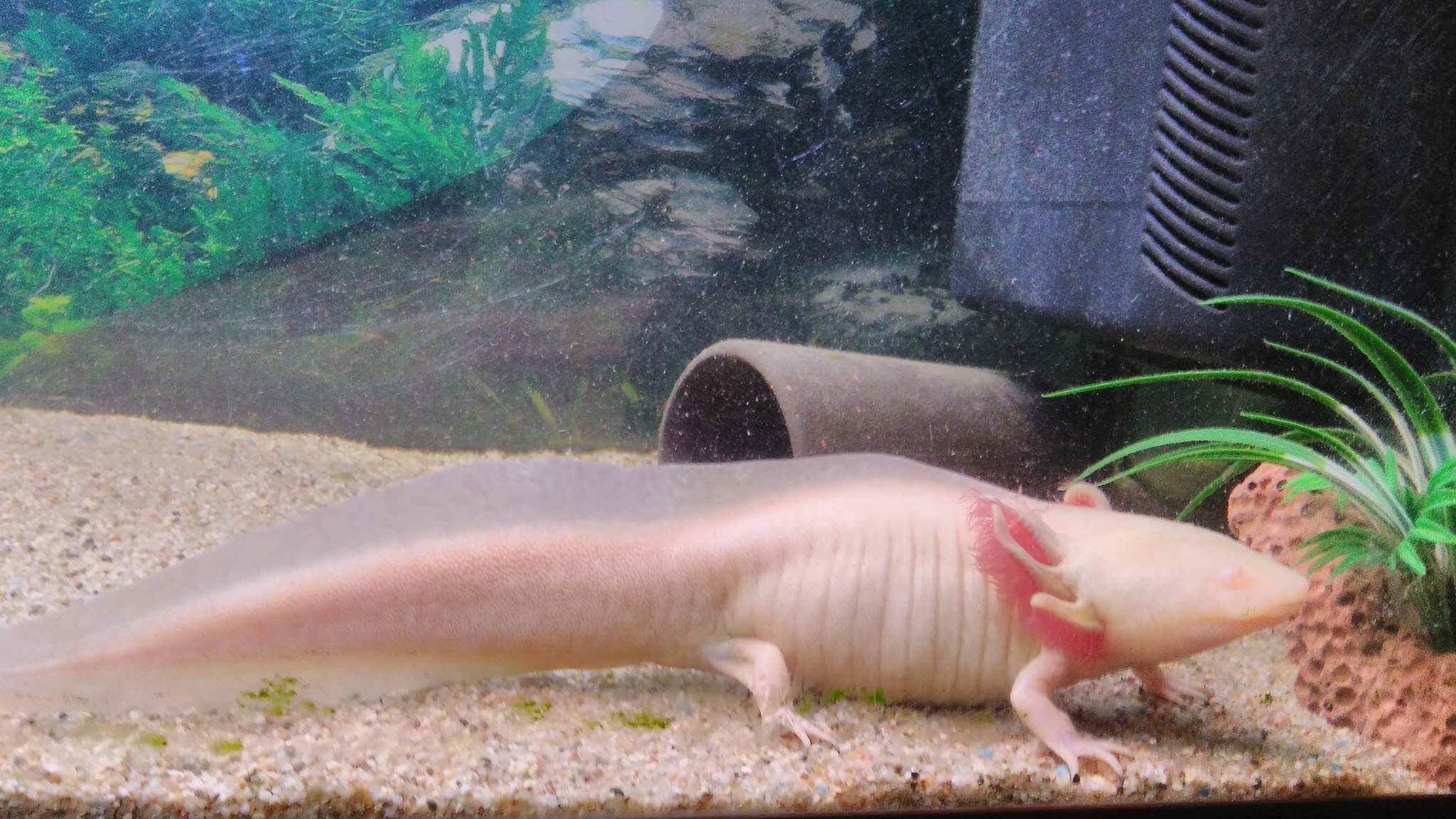
The axolotl (Ambystoma mexicanum) is a permanently aquatic salamander native to the ancient lake system of the Valley of Mexico. An adult keeps the feathery external gills, tail fin and other features normally associated with a salamander larva. This lifelong retention of juvenile traits is called paedomorphosis.
An axolotl is an amphibian, not a fish. Wild axolotls survive only in the freshwater canals and wetlands of Xochimilco in Mexico City. The familiar pale pink animals are captive color forms; wild animals are normally dark and mottled. A large captive population does not make the wild species secure: habitat loss, pollution and introduced fish have left it Critically Endangered.
What is an axolotl?
The axolotl is one species in the mole salamander family, Ambystomatidae. Most related salamanders begin life in water and later transform into land-dwelling adults. Axolotls normally become sexually mature without completing that transformation. They continue breathing through external gills, skin and lungs while remaining in water.
The word comes from Nahuatl and is culturally associated with Xolotl, a deity linked with transformation. “Mexican walking fish” is a popular nickname, but it is biologically misleading. Axolotls have four limbs and a fish-like tail fin, yet their skeleton, skin, life cycle and evolutionary history identify them as salamanders.
Appearance, colors and size
A broad, flattened head, small lidless eyes and three branched gill stalks on each side of the head give the axolotl its distinctive appearance. A fin runs from behind the head along the back and tail. Adults usually measure about 15–30 centimeters (6–12 inches), with many around 20–23 centimeters.
Wild-type axolotls are dark gray, brown or olive with mottling and metallic-looking speckles. Captive breeding has produced leucistic animals with pale bodies and dark eyes, albinos with pale eyes, golden albinos, melanoids and other combinations. A pink axolotl is usually leucistic rather than albino. Color does not create a separate species.
Mature males tend to have a more swollen cloaca, while females often develop a rounder abdomen when carrying eggs. Body shape alone is unreliable in young animals, which may not show clear sex differences.
Native habitat and range
The natural range is exceptionally small. Axolotls historically occurred in Lakes Xochimilco and Chalco, high-altitude freshwater lakes near Mexico City. Lake Chalco was drained, and Xochimilco now persists mainly as a network of canals, small wetlands and agricultural islands called chinampas.
Cool, well-oxygenated water with aquatic plants and submerged cover provides places to feed, hide and attach eggs. Urban growth changed water flow and quality, while common carp and tilapia introduced into the system compete with axolotls and eat their eggs or young. Conservation projects use refuges and restored chinampa canals to improve local habitat.
Captive axolotls occur worldwide in laboratories, zoos and private aquariums, but those populations should not be confused with the genetically and ecologically distinct wild population at Xochimilco.
Diet and feeding
Axolotls are carnivores. In the wild they take worms, insect larvae, small crustaceans, mollusks, zooplankton and other small aquatic animals. Larger individuals may catch small fish or amphibian prey, including smaller members of their own species.
An axolotl detects movement and chemical cues, approaches the prey and opens its mouth rapidly. Water and food are drawn in together by suction. Its small teeth help grip rather than chew, so prey is swallowed whole. Young axolotls feed on smaller organisms than adults and may be vulnerable to cannibalism when food or space is limited.
Behavior and senses
Axolotls are mostly solitary, bottom-oriented animals. They walk across the substrate, rest beneath plants or cover and swim with side-to-side movements of the tail when disturbed. Activity can occur by day or night, although low light suits their small eyes and natural canal habitat.
Chemical and visual signals are important during courtship and feeding. The lateral-line system detects movement and pressure changes in water. External gills wave gently as blood exchanges gases with the surrounding water, but axolotls also breathe through their skin and occasionally rise to gulp air into their lungs.
How axolotl regeneration works
Axolotls can regrow a lost limb and repair several other tissues with far less scarring than mammals. After an injury, cells cover the wound and a mass of regenerative cells called a blastema forms. Those cells multiply and rebuild structures in an organized sequence, including bone, muscle, nerves, blood vessels and skin.
Regeneration is not the same as invulnerability. Serious injuries, infection, poor water conditions and repeated damage can still kill or permanently harm an animal. Scientific research uses axolotls to study development, wound healing, spinal-cord repair and the biological signals that allow tissues to reconstruct themselves. Findings in a salamander do not automatically translate into a human treatment.
Courtship, eggs and life cycle
During courtship, a male guides a female over packets of sperm called spermatophores, which she takes into her cloaca for internal fertilization. She later attaches jelly-coated eggs individually to plants, rocks or other submerged surfaces. Published accounts commonly report roughly 100–300 eggs in wild breeding, although captive clutches can be larger.
At suitable temperatures, embryos commonly hatch after about 10–14 days. The hatchlings are independent and first rely on small aquatic prey. Limbs develop as they grow, but the gills and tail fin remain. Sexual maturity is often reached at around one year, with timing affected by temperature, food and body condition.
Most axolotls do not metamorphose naturally. Thyroid hormones can trigger transformation under experimental conditions, but deliberately forcing metamorphosis is stressful and shortens survival in many animals. It is not a normal care goal.
Conservation status and threats
The IUCN Red List classifies Ambystoma mexicanum as Critically Endangered. Its remaining wild range is fragmented and exposed to poor water quality, disease, urban development, altered hydrology and introduced carp and tilapia. The species is also listed in CITES Appendix II, which regulates international commercial trade.
Axolotls are abundant in captivity, but many captive lines descend from a limited founding population and may include historical genetic mixing with tiger salamanders. Releasing pets into Xochimilco can introduce disease or unsuitable genes and is not a conservation solution. Effective recovery centers on restoring clean, connected habitat and supporting locally managed refuges for the native population.
Axolotls in captivity
Keeping an axolotl requires specialist aquatic care. It needs cool, clean, dechlorinated freshwater, gentle filtration, secure hiding places and enough floor space. Warm water, strong current, accumulated waste and unsuitable tank mates cause stress. Gravel small enough to swallow can obstruct the digestive tract, so substrate choice matters.
Captive animals should receive appropriately sized, nutritionally suitable foods rather than wild-caught prey of unknown safety. Handling removes protective mucus and can damage delicate skin and gills; it should be limited to genuine necessity. Ownership and sale rules differ by location, so prospective keepers must check current local law and obtain animals from legal captive-bred sources.