
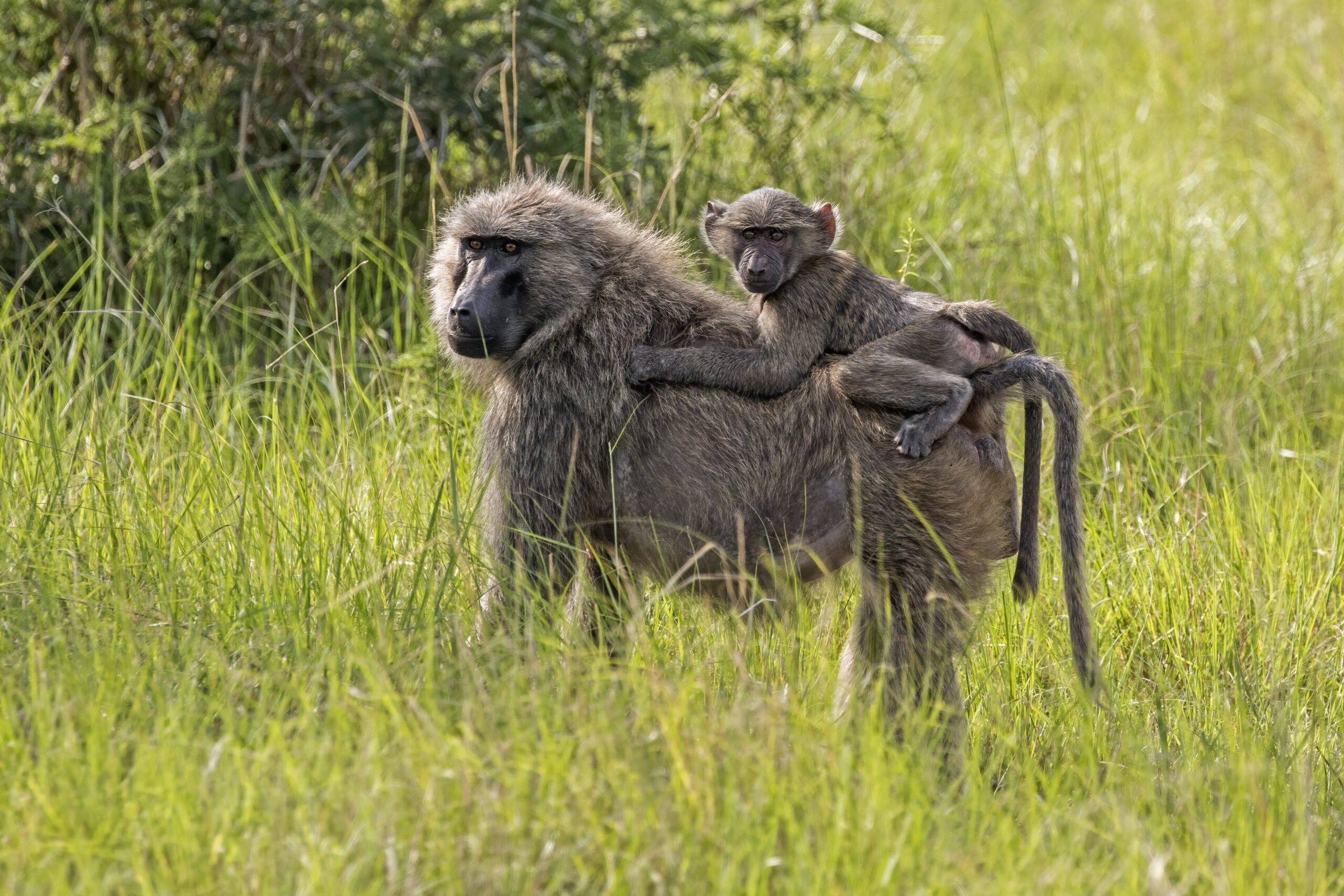
Baboons are six species of large, ground-traveling Old World monkeys in the genus Papio. They live across much of sub-Saharan Africa, with hamadryas baboons also occurring around the Red Sea in northeastern Africa and the Arabian Peninsula.
All baboons have long dog-like muzzles, powerful jaws, grasping hands and feet, and bare sitting pads called ischial callosities. They are highly social and adaptable, but their troop structure, coat color, body size, diet and conservation status differ among species.
The six living baboon species
- Olive baboon (Papio anubis) — widespread across a broad belt of Africa.
- Yellow baboon (Papio cynocephalus) — eastern and southern African savannas and woodlands.
- Hamadryas baboon (Papio hamadryas) — the Horn of Africa and southwestern Arabian Peninsula.
- Kinda baboon (Papio kindae) — a smaller-bodied species of south-central Africa.
- Guinea baboon (Papio papio) — western Africa from Senegal and neighboring countries.
- Chacma baboon (Papio ursinus) — southern Africa.
Older classifications sometimes treated these forms as subspecies of one widespread baboon. The American Society of Mammalogists’ Mammal Diversity Database recognizes six species. Neighboring species can hybridize naturally where their ranges meet, showing that evolution does not always create sharp geographic boundaries.
Appearance and body size
Baboons have sturdy bodies, long limbs and elongated muzzles containing large canine teeth. Their tails are not prehensile and cannot grip branches. Coat colors include olive, yellow-brown, gray, reddish brown and dark brown. Infants often have a contrasting dark coat that changes as they mature.
Size differs strongly by species and sex. Adult females commonly weigh roughly 10–15 kilograms, while males of larger species may weigh 20–40 kilograms. Chacma and hamadryas baboons show especially strong sexual size differences. Adult male hamadryas baboons develop a pale silver mantle around the shoulders.
The bare sitting pads support long periods on the ground and on branches. Female reproductive skin may swell visibly during the cycle. This is normal primate anatomy and communicates reproductive condition within the troop.
Range and habitat
Baboons occupy one of the broadest habitat ranges of any African primate. They live in savanna, grassland, open woodland, scrub, rocky hills, semi-desert, gallery forest and montane areas. Reliable water and safe sleeping sites such as cliffs or tall trees are important in many landscapes.
Most species are African. Hamadryas baboons also occur in Yemen and Saudi Arabia, where their ancient presence may involve historical human movement as well as natural biogeography. Species ranges meet in several regions, producing hybrid zones.
Baboons often persist near farms, towns and tourist sites because they learn quickly and can exploit human food. Adaptability does not remove risk: roads, persecution, habitat conversion and conflict can still reduce local populations.
Diet and foraging
Baboons are omnivores with a strong plant component. They eat grass blades and roots, seeds, fruit, flowers, pods, leaves and underground storage organs. Insects, eggs, small vertebrates and occasional larger prey add protein when available.
Strong fingers dig, pull and turn objects, while cheek pouches temporarily store food during rapid collection. A troop may spread across the ground while individuals search, then regroup as it travels. Diet changes with rainfall, season, habitat and opportunity.
Crops, rubbish and food handed out by people are concentrated rewards. Once baboons associate people with food, they may raid buildings or vehicles and become aggressive. Secure waste and a strict no-feeding policy protect both people and monkeys.
Troops and social systems
Baboon societies are complex. Olive, yellow, kinda and chacma baboons usually live in multi-male, multi-female troops. Female relatives form stable social cores, while males commonly leave their birth group. Rank, grooming, alliances and kin relationships shape access to food, mates and social support.
Hamadryas baboons have a layered system built from one-male units containing a leader male, females and young. Several units join into clans, bands and larger sleeping aggregations. Guinea baboons also form a multilevel society, but relationships among males are generally more tolerant.
No single description fits every troop. Group size and behavior respond to food distribution, predators, sleeping sites, population density and individual history.
Communication and intelligence
Baboons communicate through grunts, barks, screams, lip-smacking, yawns, facial expressions, posture, touch and scent. A yawn that displays the canines can be a threat rather than tiredness. Grooming removes debris and parasites while also building alliances and reducing tension.
They remember social relationships, recognize calls and learn routes and food locations. Young baboons acquire skills through play, observation and practice. Their intelligence helps them solve natural problems and also makes human-wildlife conflict difficult once food-raiding habits develop.
Baboon infants and development
Pregnancy lasts about six months, varying somewhat among species and individuals. A female usually gives birth to one infant. Twins are rare. The newborn grips the mother’s belly and later rides on her back as it becomes stronger.
Infants nurse for many months while gradually eating solid food. Mothers provide most direct care, but siblings and other troop members may inspect, carry or protect young. Social play teaches balance, fighting signals and relationships.
Females often remain in their natal troop, while males disperse as they approach maturity in most savanna species. Baboons mature slowly and can live for several decades, so adult survival and stable social knowledge matter to a troop.
Predators and defense
Leopards are major natural predators. Lions, spotted hyenas, crocodiles, pythons and large eagles may also take baboons, especially young animals. Troop members give alarm calls, rush toward danger, climb, mob smaller predators or defend one another with their large canines.
Sleeping on cliffs or in tall trees reduces nighttime risk. Ground travel in a group improves detection, but individuals at the edge may remain vulnerable. Predator pressure influences routes, feeding time and troop spacing.
Conservation and human conflict
The genus has no single conservation category. The six species require separate assessments, and national conditions differ. Guinea baboons have a more restricted western range and are listed as Near Threatened in the Mammal Diversity Database, while several other species remain widespread.
Habitat conversion, hunting, capture, roads and conflict over crops or property affect populations. All Papio species are covered by CITES Appendix II, regulating international commercial trade.
Conflict reduction works best when it removes food rewards and blocks access without injuring animals. Wildlife-proof rubbish storage, guarded crops, responsible tourism and preservation of natural feeding habitat reduce repeated encounters. Management must use the correct species and local troop ecology.