
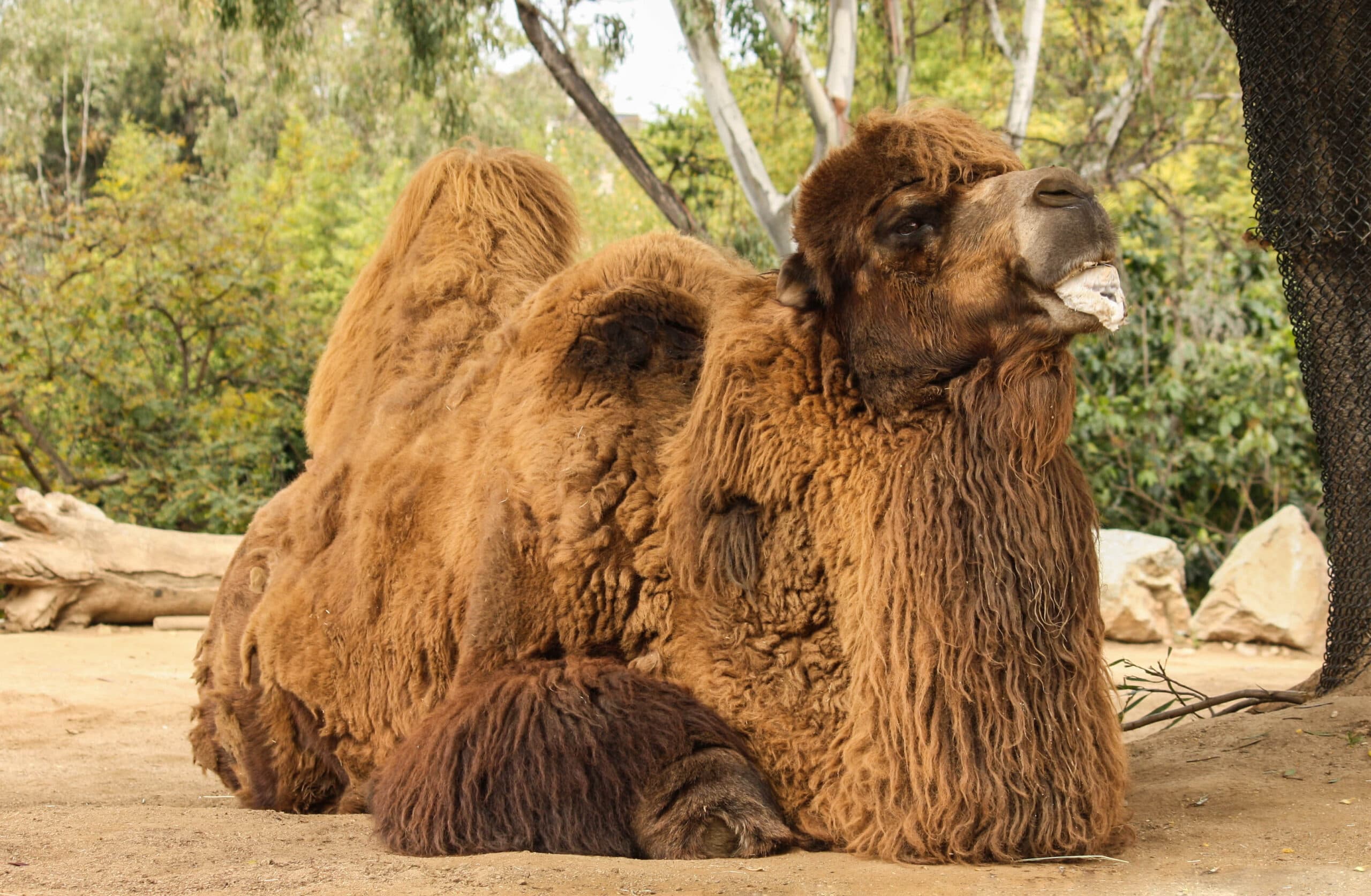
Bactrian Camel (Camelus bactrianus) is the domestic two-humped camel of the Central Asian steppe and desert. Thick winter wool, broad padded feet and the ability to tolerate dehydration help it work in climates that swing from bitter cold to intense summer heat. It is distinct from the critically endangered Wild Bactrian Camel. This guide separates well-supported biology from common assumptions and covers identification, range, habitat, diet, behavior, reproduction and conservation.
Identification
Two fat-storing humps immediately distinguish a Bactrian camel from a one-humped dromedary. The body is stocky, with a long curved neck, small ears, double rows of eyelashes, closable nostrils and broad two-toed feet resting on leathery pads. A shaggy winter coat forms long hair on the neck, humps, forelegs and head, then sheds in ragged sheets during spring. Coat colors include dark brown, sandy beige, gray, cream and white. Adult males are larger, heavier and more powerfully built than females. During the rut, males develop strong odor and display an inflatable soft-palate sac at the mouth.
Identification should combine body shape, markings, size, voice or movement, and location. One feature by itself can overlap with a related animal, a juvenile, or an individual in unusual light.
Photographs are most useful when they preserve scale and show several diagnostic features. Handling or repositioning a wild bactrian camel for identification can cause stress and is unnecessary.
Size and physical adaptations
Bactrian Camel typically measures about 2.25–3.45 m head and body and weighs commonly about 300–690 kg. Domestic breeds vary in size and build according to selection for transport, milk, meat or fiber. Shoulder height is commonly 1.8–2.3 m.
Its useful adaptations include two humps store energy-rich fat, thick winter wool is shed for summer, broad foot pads spread weight on sand and snow, closable nostrils and long lashes block dust, body temperature can fluctuate before sweating begins, oval blood cells continue circulating during dehydration, tough split lips browse thorny and salty plants, calloused pads protect the chest and joints while resting. These traits work together in the animal’s normal setting rather than serving as isolated curiosities.
Published measurements may use different methods, life stages or sample locations. Comparing figures responsibly means checking what was measured rather than selecting the largest number available.
Range and distribution
A domestic livestock species centered across Central and Inner Asia, from Mongolia and northern China through Kazakhstan and neighboring steppe and mountain regions. Herds also occur in parts of Russia, Afghanistan and Iran. Its distribution reflects herding, trade and transport rather than a natural wild range; the separate Wild Bactrian Camel survives only in small areas of Mongolia and China. The native range includes Mongolia, China, Kazakhstan, Kyrgyzstan, Uzbekistan, Tajikistan, Turkmenistan, Afghanistan, Russia, Iran.
A country-level map indicates broad distribution, not continuous occupation. Climate, elevation, water, vegetation, prey, breeding sites, barriers and survey effort all affect where records occur.
Records near the edge of the range deserve careful documentation because they may reflect natural movement, improved survey coverage, accidental transport or a genuine distribution change.
Habitat
Managed cold desert, semi-desert, dry steppe, mountain valleys and open rangeland, with seasonal camps and access to wells or snow.
Pastoral herds move among sparse grazing areas as weather and water change. In winter, camels use snow-covered steppe and shelter from wind; in summer they tolerate hot dry basins and seek water at long intervals. Broad feet perform well on sand, gravel and snow but can suffer on continually wet ground. Working animals also live near settlements, corrals, roads and caravan routes. Protecting a population therefore requires the feeding, shelter and breeding features that make a site usable, along with connections that allow movement.
Microhabitat matters. Shade, soil, current, moisture, shelter or host plants can determine whether a small area is usable even when the surrounding landscape appears suitable.
Diet and feeding
Bactrian Camel is a herbivore. Important foods include dry grasses, salt-tolerant shrubs, saxaul shoots, thorny plants, reeds and sedges, hay and crop residues, mineral salt. Bactrian camels browse and graze plants that cattle often reject, including bitter, salty and thorny vegetation. Tough lips select stems without being easily cut. They are foregut fermenters and rechew cud, but their three-compartment stomach differs from the four-part stomach of true ruminants. Managed animals need enough fiber, minerals and clean water; the ability to survive scarcity does not make chronic underfeeding humane.
Diet changes with age, season, location and food supply. A dramatic prey record does not establish what most individuals eat most of the time; repeated field observations provide a stronger picture.
Feeding opportunities also create risk. An animal focused on prey may be less alert to predators, traffic or people, while contaminated prey can transfer pollutants through the food web.
Behavior and communication
Diurnal, spending much of the day grazing, walking, working and resting to ruminate. Domestic Bactrian camels are social and commonly move in herds led or managed by people. Females and young form stable groups, while males can become solitary or highly competitive during the winter rut. Camels kneel on thick callosities for loading and rest. They remember routes and water sources, vocalize when separated and may spit, bite or kick when frightened, in pain or handled forcefully.
Deep groans, roars, grunts and soft contact calls coordinate herd members and calves. Smell becomes especially important during the rut, when males urinate on the tail, mark themselves and display to rivals. Neck posture, ears, open mouth and tail movement warn handlers before aggression. Mothers and calves identify one another by voice and scent. Behavior should be interpreted in context: alarm, courtship, feeding and temperature regulation can produce very different actions from the same animal.
Daily schedules are flexible responses, not rigid rules. Weather, breeding condition, disturbance, tides or food can move activity into a different part of the day.
Reproduction and development
Bactrian camels breed seasonally, usually during the cold months. Males in rut compete, display and may become dangerous around rivals or handlers. Females are induced ovulators, with mating triggering ovulation. After a gestation of roughly thirteen months, a female usually delivers one calf and may reproduce only every other year under traditional range conditions. Usually one calf; twins are rare A calf is born well developed and attempts to stand and nurse within hours. It follows its mother and begins sampling plants early while continuing to drink milk for more than a year in some systems. Young camels learn routes, forage and handling from the herd and herders. Growth is slow compared with smaller livestock, and heavy work should wait until bones and joints mature.
Young animals face different risks and may use different microhabitats or food than adults. Breeding success depends on adult condition, suitable sites and the survival of offspring through vulnerable early stages.
Counts of eggs or young describe reproductive output, not the number expected to reach adulthood. Mortality is normally greatest during eggs, larval or juvenile stages.
Predators and ecological role
Domestic Bactrian camels convert sparse desert vegetation into milk, meat, fiber, transport and manure. Moderate mobile grazing can distribute nutrients and use plants unavailable to other stock; excessive concentration around wells can damage slow-growing desert vegetation. Herds interact with wolves, livestock disease and the separate Wild Bactrian Camel, where hybridization can threaten the genetic integrity of wild populations. Documented or likely predators include Gray Wolf, Snow Leopard, Free-ranging Dogs, Humans.
This animal is both a consumer and a food source. Its influence comes through many repeated interactions, so ecological claims should be based on measured populations rather than assumptions drawn from appearance.
Predator and prey relationships differ among places. A species can be ecologically influential without being abundant everywhere, and its role can change across its range.
Relationship with people
Bactrian camels carried caravans along Silk Road networks and remain essential to many pastoral households. They provide milk, meat, wool, hides, manure fuel, riding and pack power. Hair is combed or collected during the spring molt and made into warm textiles. Mechanized transport reduced caravan use, but the camel still supports food security and cultural identity in harsh drylands.
Use trained handlers, approach at the shoulder where the camel can see you and never stand directly in front of the chest or behind the hind legs. Rutting males require secure separation and expert management. Loads and saddles must fit correctly, water and rest must be adequate, and veterinary care should address feet, teeth, parasites and contagious disease. Responsible observation means keeping an appropriate distance, avoiding capture or feeding, protecting habitat and following local wildlife or invasive-species guidance.
Wildlife guidance should come from the responsible local agency because collection rules, reporting requests and appropriate responses differ between native and introduced ranges.
Conservation
The IUCN does not assess the domestic Bactrian Camel as a wild species. It must not be assigned the Critically Endangered status of Camelus ferus, the genetically distinct Wild Bactrian Camel. Conservation concerns focus on traditional breeds and pastoral systems. The reported global trend is Domestic numbers vary by country and breed.
Important pressures include loss of traditional breeds and genetic diversity, pasture degradation and drought, loss of mobile pastoral knowledge, livestock disease, market decline for camel products, hybridization pressure near wild bactrian camel habitat. Global status can hide local decline or recovery, so current regional monitoring and habitat management remain necessary.
The most useful conservation action follows the documented pressure. Protecting breeding sites, reducing road deaths or limiting pollutants can require different tools in different populations.