
Basilisk Lizard (Basiliscus) refers here to the four living species in the genus Basiliscus: the common basilisk, western basilisk, green crested basilisk and brown basilisk. These long-legged iguanian lizards live near rivers, streams, swamps and forest edges from tropical Mexico through Central America into northwestern South America. They are famous for short bipedal sprints across water, but they also climb, swim and dive. Because this is a genus profile, measurements, colors and conservation assessments vary among species. This guide separates well-supported biology from common assumptions and covers identification, range, habitat, diet, behavior, reproduction and conservation.
Identification
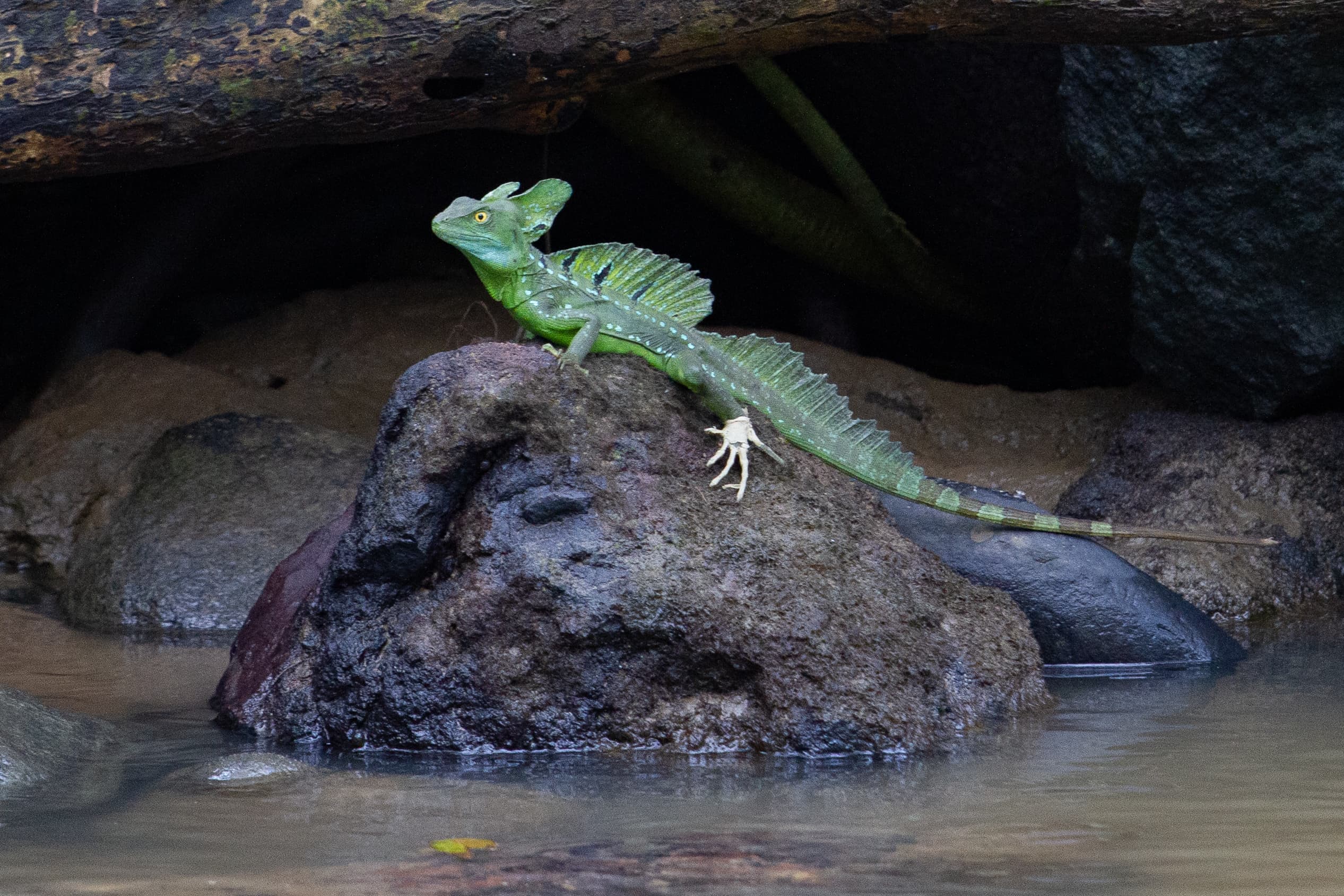
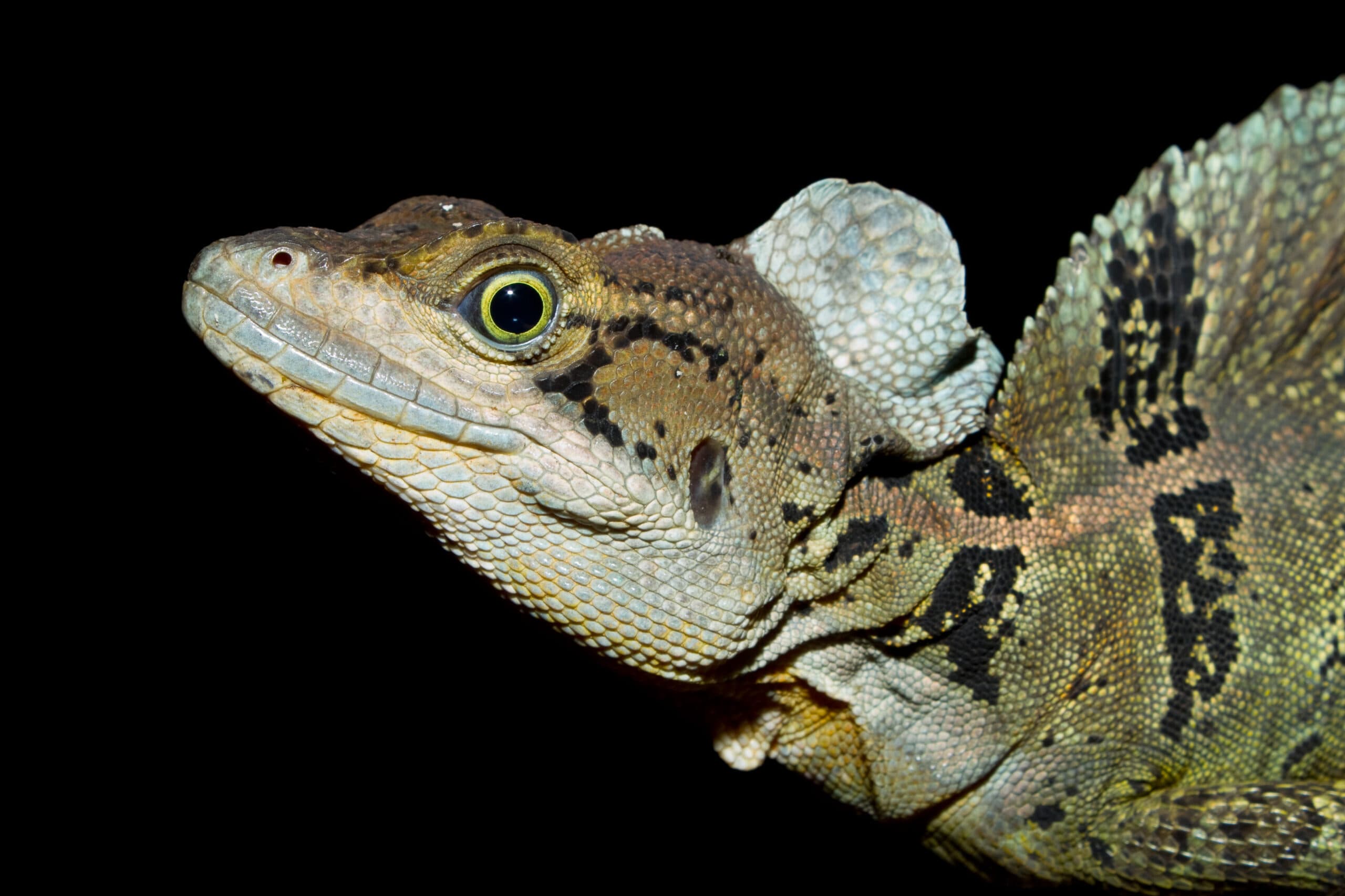
Basilisks are slender, long-tailed lizards with strong hind limbs and exceptionally long rear toes. Adult males often carry conspicuous crests on the head, back and tail, while females and juveniles have smaller crests. The green crested basilisk is vivid green; other species are generally olive, brown or gray with pale stripes, bars or spots. A basilisk beside tropical fresh water may freeze, climb, dive or launch into a two-legged escape. Males generally grow larger and develop taller head, back and tail crests. Females usually have reduced crests, but exact size and color differences vary by species.
Identification should combine body shape, markings, size, voice or movement, and location. One feature by itself can overlap with a related animal, a juvenile, or an individual in unusual light.
Photographs are most useful when they preserve scale and show several diagnostic features. Handling or repositioning a wild basilisk lizard for identification can cause stress and is unnecessary.
Size and physical adaptations
Basilisk Lizard typically measures roughly 43–80 cm total length depending on species and sex and weighs roughly 200–500 g in the common basilisk; genus-wide mass varies. Published measurements differ by species and sex, and the very long tail forms most of total length. The values shown must not be treated as limits for every basilisk.
Its useful adaptations include long hind limbs for rapid bipedal acceleration, fringed scales on elongated toes that increase contact with water, a laterally compressed tail used in swimming, strong climbing feet for branches above waterways, ability to dive and remain submerged when escaping, prominent display crests in adult males. These traits work together in the animal’s normal setting rather than serving as isolated curiosities.
Published measurements may use different methods, life stages or sample locations. Comparing figures responsibly means checking what was measured rather than selecting the largest number available.
Range and distribution
Across the genus, native range extends from tropical southern Mexico through Central America to northwestern Colombia and western Ecuador. Individual species occupy only parts of that combined range. Brown basilisks have also established introduced populations in Florida, where they should not be confused with native wildlife. The native range includes Southern Mexico, Central America, Northwestern Colombia, Western Ecuador.
A country-level map indicates broad distribution, not continuous occupation. Climate, elevation, water, vegetation, prey, breeding sites, barriers and survey effort all affect where records occur.
Records near the edge of the range deserve careful documentation because they may reflect natural movement, improved survey coverage, accidental transport or a genuine distribution change.
Habitat
Lowland rainforest, seasonal forest, river margins, swamps, canals, wooded streams and vegetated forest edges, usually close to fresh water.
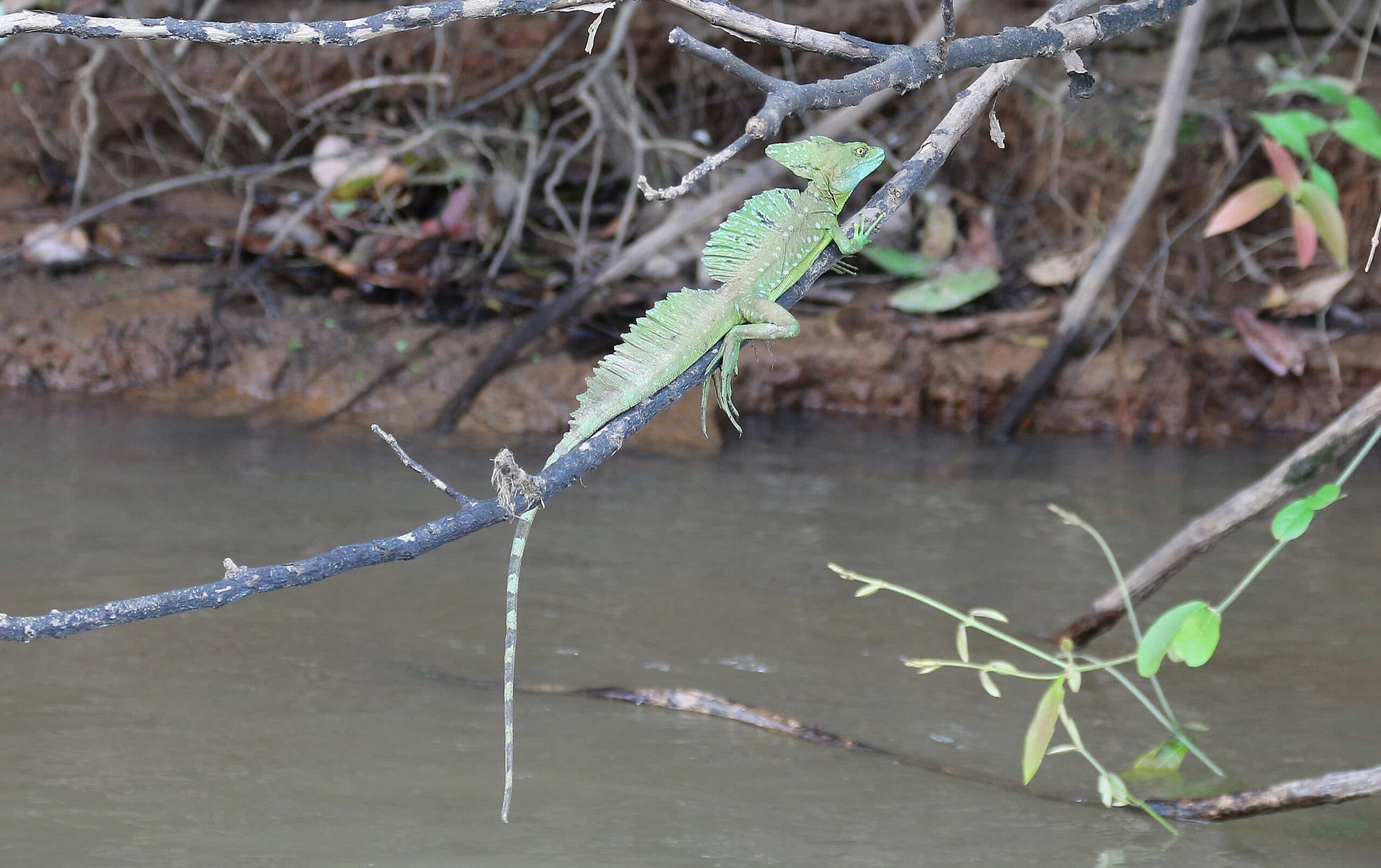
Branches, roots and rocks over water provide basking sites, lookout points and escape routes. Dense bank vegetation offers concealment and food. When threatened, a basilisk may drop into the water, sprint across the surface, swim or dive. Protecting riparian vegetation therefore preserves several connected parts of its daily habitat. Protecting a population therefore requires the feeding, shelter and breeding features that make a site usable, along with connections that allow movement.
Microhabitat matters. Shade, soil, current, moisture, shelter or host plants can determine whether a small area is usable even when the surrounding landscape appears suitable.
Diet and feeding
Basilisk Lizard is a omnivore with a strong animal-food component. Important foods include insects and other arthropods, small fish and frogs, small lizards and snakes, bird eggs or small vertebrates opportunistically, fruit, flowers and leaves. Basilisks forage by watching from low branches and moving through vegetation or along the ground. Insects and other small animals form important prey, while fruit and plant material broaden the diet. Exact proportions change with species, age, habitat and seasonal availability, so the genus should not be described with one fixed menu.
Diet changes with age, season, location and food supply. A dramatic prey record does not establish what most individuals eat most of the time; repeated field observations provide a stronger picture.
Feeding opportunities also create risk. An animal focused on prey may be less alert to predators, traffic or people, while contaminated prey can transfer pollutants through the food web.
Behavior and communication
Mostly diurnal Basilisks bask by day and remain alert near water. Their best-known escape is a rapid bipedal dash: long toes strike the surface and trap air while the foot strokes backward. Small animals can travel farther before sinking because they place less force on each step; larger adults usually manage shorter runs, then swim. They also climb readily and can stay underwater for several minutes when danger persists.
Visual signals dominate. Crests make an adult male appear larger, while head movements, posture and chasing communicate territorial or courtship intent. Color and pattern may change with age, sex and condition, but basilisk species do not all use identical displays. Behavior should be interpreted in context: alarm, courtship, feeding and temperature regulation can produce very different actions from the same animal.
Daily schedules are flexible responses, not rigid rules. Weather, breeding condition, disturbance, tides or food can move activity into a different part of the day.
Reproduction and development
Basilisks reproduce by internal fertilization and lay eggs on land. Females dig shallow nests in suitable soil, deposit a clutch and cover it. Warmth and moisture influence development. More than one clutch may be produced during a favorable season in some species. Often several to about 20 eggs, varying by species and female size Hatchlings emerge fully mobile and receive no parental care. Young basilisks are light enough to run across water especially effectively, but they face intense predation from birds, snakes, fish and larger reptiles.
Young animals face different risks and may use different microhabitats or food than adults. Breeding success depends on adult condition, suitable sites and the survival of offspring through vulnerable early stages.
Counts of eggs or young describe reproductive output, not the number expected to reach adulthood. Mortality is normally greatest during eggs, larval or juvenile stages.
Predators and ecological role
Basilisks connect aquatic edges with forest food webs. They consume insects and small vertebrates, disperse some seeds after eating fruit and provide prey for raptors, snakes, carnivorous mammals and aquatic predators. Their dependence on vegetated water margins makes them visible indicators of how riparian habitat is changing. Documented or likely predators include Birds of prey, Snakes, Large fish, Carnivorous mammals.
This animal is both a consumer and a food source. Its influence comes through many repeated interactions, so ecological claims should be based on measured populations rather than assumptions drawn from appearance.
Predator and prey relationships differ among places. A species can be ecologically influential without being abundant everywhere, and its role can change across its range.
Relationship with people
Basilisks attract wildlife watchers because of their dramatic crests and water-running escape. People should observe from a distance and avoid driving them into repeated sprints or dives. Habitat clearing, polluted waterways, road traffic and collection can cause local harm even where a species remains widespread.
Basilisks are not venomous and normally flee from people. A captured animal may scratch or bite defensively. Wild individuals should not be handled, and hands should be washed after any unavoidable contact with reptiles because they can carry Salmonella. Responsible observation means keeping an appropriate distance, avoiding capture or feeding, protecting habitat and following local wildlife or invasive-species guidance.
Wildlife guidance should come from the responsible local agency because collection rules, reporting requests and appropriate responses differ between native and introduced ranges.
Conservation
The genus has no single conservation category. Each of the four species must be assessed separately, and local populations can face habitat loss even when a species is broadly distributed. The reported global trend is No single genus-wide trend.
Important pressures include loss of riverside forest, wetland drainage and water pollution, road mortality near waterways, collection for the pet trade, introduced predators and invasive-range conflict. Global status can hide local decline or recovery, so current regional monitoring and habitat management remain necessary.
The most useful conservation action follows the documented pressure. Protecting breeding sites, reducing road deaths or limiting pollutants can require different tools in different populations.
