
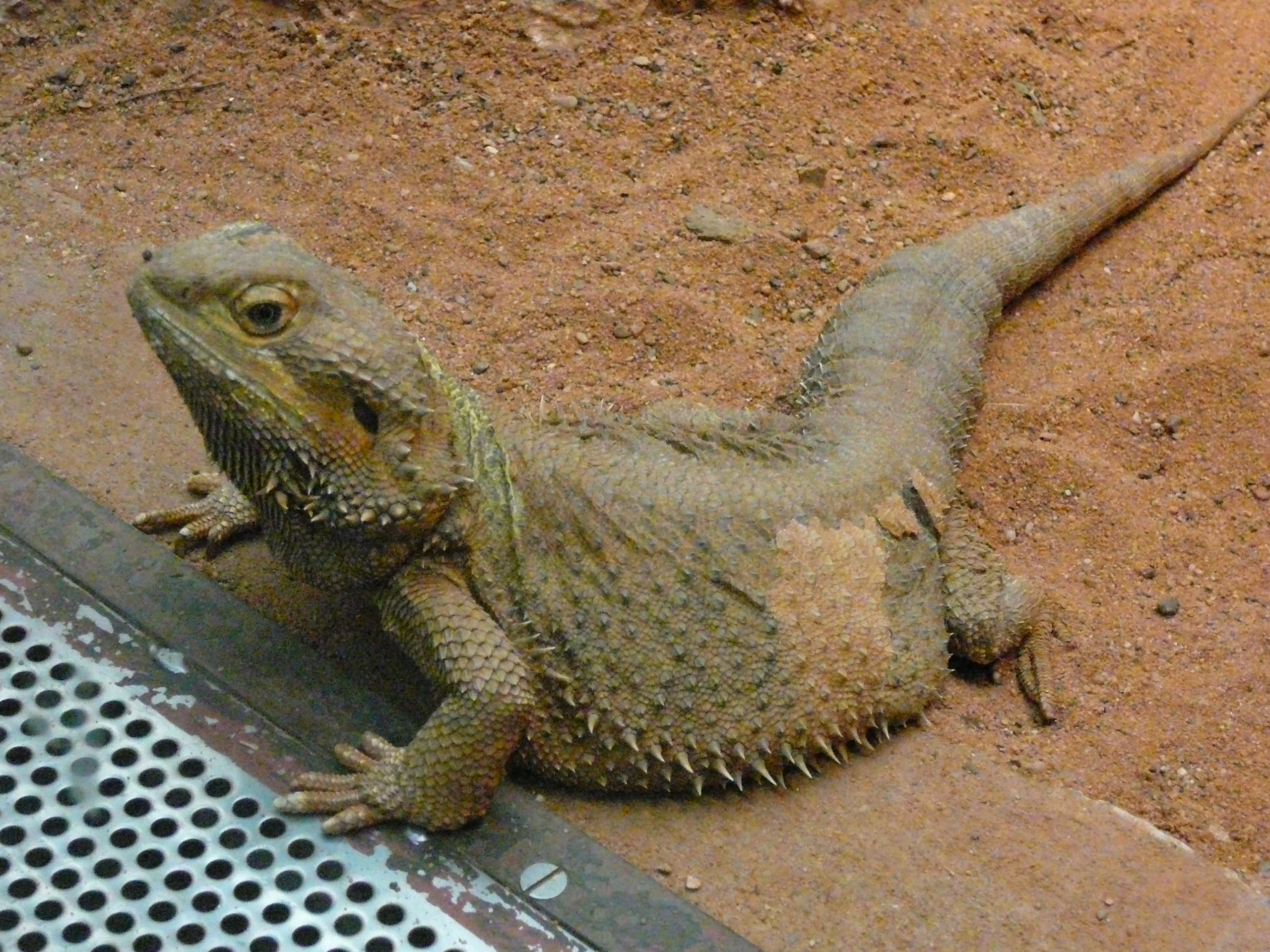
Bearded Dragon (Pogona vitticeps) is the Central Bearded Dragon, Pogona vitticeps, the species most commonly kept under the short pet name “bearded dragon.” It is a diurnal, semi-arboreal agamid native to dry inland Australia and should not be confused with the other wild species in the genus Pogona. This guide separates well-supported biology from common assumptions and covers identification, range, habitat, diet, behavior, reproduction and conservation.
Identification
A broad triangular head, flattened body, sturdy limbs and a row of pointed scales along each side identify the species. Spiny scales under the throat form the beard; the lizard expands and darkens it during threat, courtship or social display. Wild color ranges from tan and gray to yellow-brown with darker crossbands, often matching local soil. The long muscular tail makes up roughly half the total length and does not regrow if lost. Males often have broader heads, larger darkening beards, more prominent femoral pores and paired bulges behind the vent. Females usually show one central bulge, but reliable sexing requires maturity and careful examination.
Identification should combine body shape, markings, size, voice or movement, and location. One feature by itself can overlap with a related animal, a juvenile, or an individual in unusual light.
Photographs are most useful when they preserve scale and show several diagnostic features. Handling or repositioning a wild bearded dragon for identification can cause stress and is unnecessary.
Size and physical adaptations
Bearded Dragon typically measures about 33–61 cm including the tail and weighs adults commonly about 280–510 g. Captive size varies strongly with sex, age, genetics, diet and husbandry. Snout-to-vent length is roughly half total length.
Its useful adaptations include expandable spiny beard enlarges threat display, color darkening alters heat absorption and signaling, clawed toes grip bark, rock and fence posts, a broad body flattens to absorb basking heat, parietal eye senses changes in overhead light, omnivorous diet tracks variable desert food, burrowing and brumation reduce exposure to seasonal extremes. These traits work together in the animal’s normal setting rather than serving as isolated curiosities.
Published measurements may use different methods, life stages or sample locations. Comparing figures responsibly means checking what was measured rather than selecting the largest number available.
Range and distribution
Native to central and eastern mainland Australia, from inland Queensland and New South Wales through much of South Australia and into the southeastern Northern Territory. Captive populations are kept worldwide, but they are domestic breeding stocks rather than a natural introduced range. The native range includes Australia.
A country-level map indicates broad distribution, not continuous occupation. Climate, elevation, water, vegetation, prey, breeding sites, barriers and survey effort all affect where records occur.
Records near the edge of the range deserve careful documentation because they may reflect natural movement, improved survey coverage, accidental transport or a genuine distribution change.
Habitat
Arid and semi-arid woodland, mallee, scrub, grassland and desert-edge habitats with open basking sites and nearby shelter.
The lizard alternates between exposed sun and shade to control body temperature. It climbs logs, shrubs, small trees, rocks, fence posts and even picnic structures for basking and lookout points. Burrows, hollow logs and dense vegetation provide night shelter and refuge from midday heat or predators. Seasonal cold and drought can trigger reduced activity or brumation. Protecting a population therefore requires the feeding, shelter and breeding features that make a site usable, along with connections that allow movement.
Microhabitat matters. Shade, soil, current, moisture, shelter or host plants can determine whether a small area is usable even when the surrounding landscape appears suitable.
Diet and feeding
Bearded Dragon is a omnivore. Important foods include beetles and crickets, ants and termites, spiders, flowers and leaves, wild fruits, occasional small lizards. Wild individuals seize moving invertebrates and browse flowers, leaves and fruit whenever available. Young dragons tend to consume a higher proportion of animal prey to support growth; adults rely more heavily on plants. They are opportunistic rather than specialized. In captivity, balanced variety, appropriate calcium, safe leafy greens and correctly sized feeder insects matter more than copying a single wild food item.
Diet changes with age, season, location and food supply. A dramatic prey record does not establish what most individuals eat most of the time; repeated field observations provide a stronger picture.
Feeding opportunities also create risk. An animal focused on prey may be less alert to predators, traffic or people, while contaminated prey can transfer pollutants through the food web.
Behavior and communication
Diurnal, basking and foraging by day and sheltering at night. Central Bearded Dragons are usually solitary and communicate when their basking areas overlap. A dominant animal may head-bob rapidly, elevate the body and darken the beard. A smaller or subordinate dragon often responds with a slow circular arm wave and flattened posture. When threatened, the lizard expands sideways, opens the mouth and presents the black beard and spines. It generally retreats if given an escape route.
Visual display dominates: beard color, body flattening, head movement, arm waving and posture communicate sex, status and intent. Chemical cues from skin and femoral pores contribute at close range. Touch occurs during courtship and combat. The species is not highly vocal, though hissing and forced air accompany defensive gaping. Behavior should be interpreted in context: alarm, courtship, feeding and temperature regulation can produce very different actions from the same animal.
Daily schedules are flexible responses, not rigid rules. Weather, breeding condition, disturbance, tides or food can move activity into a different part of the day.
Reproduction and development
Wild breeding follows warming spring and summer conditions. A male displays and pursues a receptive female, gripping near the neck during mating. The female stores sperm and may produce several fertile clutches from one mating. She digs a tunnel or chamber in moist soil, deposits the eggs, fills the entrance and leaves; there is no parental care. Usually about 11–25 eggs, sometimes up to roughly 30 Embryos develop in parchment-shelled eggs that require suitable moisture and temperature. Hatchlings cut through the shell with an egg tooth and are independent immediately. Growth is rapid during the first year, with repeated shedding. Genetics establish sex chromosomes, but high incubation temperatures can reverse genetically male embryos into females, a major research example of temperature effects on reptile sex.
Young animals face different risks and may use different microhabitats or food than adults. Breeding success depends on adult condition, suitable sites and the survival of offspring through vulnerable early stages.
Counts of eggs or young describe reproductive output, not the number expected to reach adulthood. Mortality is normally greatest during eggs, larval or juvenile stages.
Predators and ecological role
The species consumes large numbers of insects and also browses vegetation, connecting invertebrate and plant food webs. Eggs, hatchlings and adults feed snakes, goannas, birds of prey and introduced predators. Basking lizards use fallen timber and standing dead vegetation that also support many other dry-country animals. Documented or likely predators include Brown Falcon, Black-headed Python, Lace Monitor, Dingo, Feral Cat.
This animal is both a consumer and a food source. Its influence comes through many repeated interactions, so ecological claims should be based on measured populations rather than assumptions drawn from appearance.
Predator and prey relationships differ among places. A species can be ecologically influential without being abundant everywhere, and its role can change across its range.
Relationship with people
The Central Bearded Dragon is among the world’s most popular pet reptiles and is also a model for research on development, behavior and sex determination. Australia prohibits routine commercial export of native wildlife, so international pets descend from captive breeding. Selective breeding has produced many colors and scale types; extreme morphs require scrutiny for linked welfare problems.
Wash hands after touching the lizard, enclosure, food or waste because reptiles can carry Salmonella without appearing sick. Supervise children, keep the animal away from kitchens and immunocompromised people, and never kiss it. A defensive bite can break skin but serious envenomation is not expected; clean the wound and seek medical advice if needed. Responsible observation means keeping an appropriate distance, avoiding capture or feeding, protecting habitat and following local wildlife or invasive-species guidance.
Wildlife guidance should come from the responsible local agency because collection rules, reporting requests and appropriate responses differ between native and introduced ranges.
Conservation
Australian sources list Pogona vitticeps as Least Concern and it is not nationally threatened. Local habitat loss, road mortality, illegal collection and introduced predators can still affect populations. The reported global trend is Generally stable at broad scale.
Important pressures include land clearing and habitat simplification, road mortality, predation by feral cats and foxes, illegal wild collection, loss of hollow logs and basking structure, extreme heat, drought and wildfire. Global status can hide local decline or recovery, so current regional monitoring and habitat management remain necessary.
The most useful conservation action follows the documented pressure. Protecting breeding sites, reducing road deaths or limiting pollutants can require different tools in different populations.