
Home/Animals/Reptilia/Beauty Rat Snake
Species profileIUCN: NE

Beauty Rat Snake

Elaphe taeniura

A long, fast-climbing Asian rat snake marked by dark eye stripes and a bold black-and-cream tail pattern.

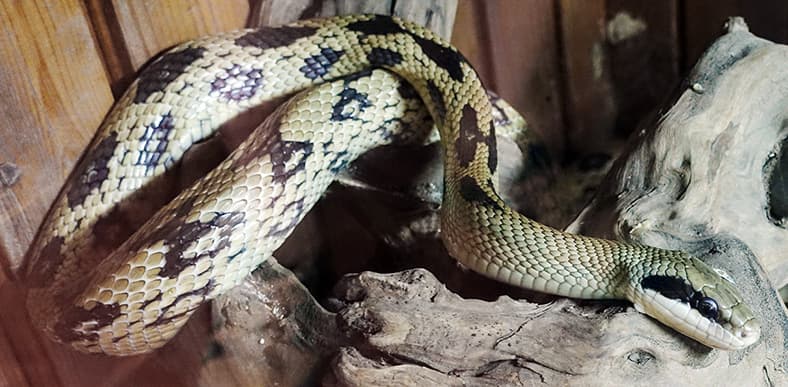
Beauty Rat Snake showing olive scales, black blotches and a dark stripe through the eye
Tiia Monto / Wikimedia Commons / CC BY-SA 3.0
๐ŸŒ Read in Language:

โšก At a Glance

Species profile
Also Known As
Beauty Snake; Striped Rat Snake; Cave Racer
Diet Category
Active nonvenomous predator of small vertebrates
Activity Rhythm
Mainly diurnal or crepuscular, with morning activity common; may hunt at night in warm weather or caves.
Wild Lifespan
Often 12โ€“18 years in managed care; wild lifespan is poorly documented
Typical Weight
commonly about 1โ€“3 kg, varying by regional form and condition
Conservation Status
NE
๐Ÿ’ก Key Biological Insight: One regional form, Ridleyโ€™s beauty snake, regularly enters limestone caves and feeds on bats, showing how widely this species adapts its hunting behavior.

๐ŸŒณ Scientific Taxonomy Hierarchy

The Reptile Database currently lists Elaphe taeniura, while much modern literature uses Orthriophis taeniurus. Both refer to the same species complex. It belongs to Colubridae and Squamata. This profile covers the species broadly while recognizing that regional forms may be revised and must not be treated as identical captive morphs.

KingdomAnimalia
PhylumChordata
ClassReptilia
OrderSquamata
FamilyColubridae
GenusElaphe
SpeciesElaphe taeniura

Distinguishing Anatomical Features

  • โœ“The slender body is yellowish, olive, brown or gray with dark blotches near the front that merge into strong longitudinal stripes toward the tail. A black stripe passes through each eye to the mouth corner. The tail is long and often shows striking black-and-cream banding. Cave-associated forms can be paler, while some mainland forms have blue-gray tones.
  • โœ“Slender body moves through branches and caves
  • โœ“Strong muscles constrict warm-blooded prey
  • โœ“Large eyes support active daytime hunting
  • โœ“Dark eye stripe reduces facial outline
  • โœ“Tail balances the snake while climbing
  • โœ“Variable pattern matches regional habitats
  • โœ“Flexible jaws swallow prey whole

๐Ÿ“ Physical Measurements

Total Lengthusually 5โ€“6.6 ft, with large individuals over 7.5 ft
Body Weightcommonly about 2.2โ€“6.6 lb
Tail LengthLong, slender and boldly striped, providing balance while climbing
WingspanNot applicable
Top SpeedNo dependable universal maximumMovement changes with context and conditions.

๐ŸŽจ Appearance & Distinctive Markings

OliveYellowBrownGrayBlackCreamOliveBlackYellow

Skin / Covering: Dry overlapping smooth scales

Sexual Dimorphism: Females are often heavier and may become longer, while males usually have proportionally longer tails. Pattern varies more by geography and age than by sex.

๐Ÿ—บ๏ธ Geographic Distribution & Habitat

The native range spans northeastern India and Bhutan east through Myanmar, southern and central China, mainland Southeast Asia and Taiwan, then south into western Malaysia, Sumatra and Borneo, with native island populations in the Ryukyus. A localized introduced population has been documented in Belgium.

Evergreen and deciduous forest, limestone cave, forest edge, bamboo, scrub, farmland, plantation, village garden, roof space and rocky hillside.

Country-level distribution map

Native rangeIntroduced range
FijiTanzaniaWestern SaharaCanadaUnited StatesKazakhstanUzbekistanPapua New GuineaIndonesia โ€” Native rangeArgentinaChileCongo - KinshasaSomaliaKenyaSudanChadHaitiDominican RepublicRussiaBahamasFalkland IslandsNorwayGreenlandFrench Southern TerritoriesTimor-LesteSouth AfricaLesothoMexicoUruguayBrazilBoliviaPeruColombiaPanamaCosta RicaNicaraguaHondurasEl SalvadorGuatemalaBelizeVenezuelaGuyanaSurinameFranceEcuadorPuerto RicoJamaicaCubaZimbabweBotswanaNamibiaSenegalMaliMauritaniaBeninNigerNigeriaCameroonTogoGhanaCรดte dโ€™IvoireGuineaGuinea-BissauLiberiaSierra LeoneBurkina FasoCentral African RepublicCongo - BrazzavilleGabonEquatorial GuineaZambiaMalawiMozambiqueEswatiniAngolaBurundiIsraelLebanonMadagascarPalestinian TerritoriesGambiaTunisiaAlgeriaJordanUnited Arab EmiratesQatarKuwaitIraqOmanVanuatuCambodia โ€” Native rangeThailand โ€” Native rangeLaos โ€” Native rangeMyanmar (Burma) โ€” Native rangeVietnam โ€” Native rangeNorth KoreaSouth KoreaMongoliaIndia โ€” Native rangeBangladeshBhutan โ€” Native rangeNepalPakistanAfghanistanTajikistanKyrgyzstanTurkmenistanIranSyriaArmeniaSwedenBelarusUkrainePolandAustriaHungaryMoldovaRomaniaLithuaniaLatviaEstoniaGermanyBulgariaGreeceTรผrkiyeAlbaniaCroatiaSwitzerlandLuxembourgBelgium โ€” Introduced rangeNetherlandsPortugalSpainIrelandNew CaledoniaSolomon IslandsNew ZealandAustraliaSri LankaChina โ€” Native rangeTaiwan โ€” Native rangeItalyDenmarkUnited KingdomIcelandAzerbaijanGeorgiaPhilippinesMalaysia โ€” Native rangeBruneiSloveniaFinlandSlovakiaCzechiaEritreaJapan โ€” Native rangeParaguayYemenSaudi ArabiaCyprusMoroccoEgyptLibyaEthiopiaDjiboutiUgandaRwandaBosnia & HerzegovinaNorth MacedoniaSerbiaMontenegroKosovoTrinidad & TobagoSouth Sudan
Highlighted countries are recorded profile locations, not precise biological range boundaries.Map boundaries: Natural Earth

๐Ÿ’ก Did You Know?

  • ๐Ÿ’กSlender body moves through branches and caves
  • ๐Ÿ’กStrong muscles constrict warm-blooded prey
  • ๐Ÿ’กLarge eyes support active daytime hunting
  • ๐Ÿ’กDark eye stripe reduces facial outline
  • ๐Ÿ’กTail balances the snake while climbing
  • ๐Ÿ’กVariable pattern matches regional habitats
  • ๐Ÿ’กFlexible jaws swallow prey whole

๐ŸŒฟ Conservation Status & Threats

IUCN: NE โ€” NE

โ€œThe species has not received a global IUCN assessment. Its enormous range should not be mistaken for proof that every regional form is secure. Habitat loss, road mortality, persecution and collection can affect local populations, while an introduced population requires separate management in Belgium.โ€

Population TrendUnknown globally; likely variable among isolated subspecies and landscapes
Wild Population EstimateNo global estimate and no unified monitoring across the species complex
CITESVerify current trade rules and any regional listings before transport

โš ๏ธ Major Threats to Beauty Rat Snake

  • โ€ขForest loss
  • โ€ขCave disturbance
  • โ€ขRoad mortality
  • โ€ขPersecution
  • โ€ขPet-trade collection
  • โ€ขRodenticide exposure
  • โ€ขTaxonomic uncertainty
  • โ€ขIntroductions outside the native range

๐Ÿ”„ Life Cycle & Reproduction

Wild vs. Captivity Lifespan Comparison

๐ŸŒฟ In the WildOften 12โ€“18 years in managed care; wild lifespan is poorly documented
๐Ÿ  In Captivity (with veterinary care)Maintain verified locality records, prevent escapes, use secure vertical space and avoid combining regional forms without a conservation reason.
Clutch / Litter SizeUsually about 6โ€“15 eggs, sometimes more in large females
Incubation / GestationRoughly 55โ€“75 days depending on temperature and humidity
Fledging / WeaningIndependent hatchling roughly 30โ€“45 cm long
Sexual MaturityUsually after 2โ€“4 years depending on climate and growth
Mating SystemInternal fertilization; egg-laying
Nesting / Den TypeProtected humid cavity, rotting wood or loose substrate

๐Ÿฆ… Behavior & Field Ecology

Active nonvenomous predator of small vertebrates

๐ŸŒ Ecological Food Web & Relationships: Beauty Rat Snakes control rodents in forest edges, farms and settlements and also link cave and surface food webs. They are prey for raptors, larger snakes and mammalian carnivores. Their broad range and regional variation make them valuable for studying biogeography, but that same complexity can hide declines in isolated forms.

Social Group SizeSolitary except during courtship or shared shelter
Activity RhythmMainly diurnal or crepuscular, with morning activity common; may hunt at night in warm weather or caves.
Feeding StrategyActive nonvenomous predator of small vertebrates

๐Ÿฅฉ Primary Prey & Preferred Diet

โœ“ Ratsโœ“ Miceโœ“ Squirrelsโœ“ Batsโœ“ Small birdsโœ“ Bird eggsโœ“ Lizards

๐Ÿ“ข Communication & Territorial Signals

  • Tongue-flick scent sampling
  • Pheromone trails
  • Hissing
  • Neck inflation
  • Tail vibration
  • Defensive striking

๐Ÿพ Wild Temperament & Traits

โ€ข Alertโ€ข Fast-movingโ€ข Strong climberโ€ข Mostly solitaryโ€ข Nonvenomousโ€ข Defensive if restrained

๐Ÿค Human Interaction & Pet Advisory

โš ๏ธ Strictly Wild Species
๐Ÿšซ

Can You Keep a Beauty Rat Snake as a Pet?

Captive-bred regional forms are kept by experienced hobbyists, but their speed, size and defensive response make them unsuitable for beginners. Legal animals need tall secure housing, climbing branches, hiding sites, a thermal gradient, moderate humidity, quarantine and veterinary care. Wild collection and mixed-line breeding can harm conservation and taxonomic records.

Domestication StatusCaptive-bred lines exist, but the species is not domesticated
Danger to HumansLow medical risk; nonvenomous bites can still cause punctures and infection
Economic & Ecotourism RoleRodent control, cave and forest food webs, biogeographic research, and education about nonvenomous snakes living near people.

โš ๏ธ Behavioral Risk Factors & Wildlife Safety

  • Fast defensive strikes can cause multiple wounds
  • Large adults have strong jaws
  • Retained teeth may require medical removal
  • Misidentification of Asian snakes is hazardous

๐ŸŒ Ecological Food Web & Relationships

๐Ÿฆ… Natural Predators (5)

Crested Serpent EagleSpilornis cheela
King CobraOphiophagus hannah
Yellow-Throated MartenMartes flavigula
Reticulated PythonMalayopython reticulatus
Domestic CatFelis catus

๐Ÿงฌ Related Species (4)

Mandarin Rat SnakeEuprepiophis mandarinusAsian forest relative
Oriental Rat SnakePtyas mucosaLarge co-occurring rat snake
Japanese Rat SnakeElaphe climacophoraJapanese relative
Corn SnakePantherophis guttatusNorth American rat snake

Beauty Rat Snake (Elaphe taeniura) is a large, nonvenomous colubrid ranging from northeastern India and China through mainland Southeast Asia to Taiwan, the Ryukyu Islands, Sumatra and Borneo. Regional populations vary strongly in color and size, and numerous subspecies have been named. The snake is an agile hunter of rodents and birds in forests, farms, caves and buildings. This guide separates well-supported biology from common assumptions and covers identification, range, habitat, diet, behavior, reproduction and conservation.

Identification

The slender body is yellowish, olive, brown or gray with dark blotches near the front that merge into strong longitudinal stripes toward the tail. A black stripe passes through each eye to the mouth corner. The tail is long and often shows striking black-and-cream banding. Cave-associated forms can be paler, while some mainland forms have blue-gray tones. Females are often heavier and may become longer, while males usually have proportionally longer tails. Pattern varies more by geography and age than by sex.

Identification should combine body shape, markings, size, voice or movement, and location. One feature by itself can overlap with a related animal, a juvenile, or an individual in unusual light.

Photographs are most useful when they preserve scale and show several diagnostic features. Handling or repositioning a wild beauty rat snake for identification can cause stress and is unnecessary.

Size and physical adaptations

Beauty Rat Snake typically measures usually 1.5โ€“2.0 m, with large individuals over 2.3 m and weighs commonly about 1โ€“3 kg, varying by regional form and condition. Some regional forms remain smaller while Taiwan and mainland populations may exceed two metres.

Its useful adaptations include slender body moves through branches and caves, strong muscles constrict warm-blooded prey, large eyes support active daytime hunting, dark eye stripe reduces facial outline, tail balances the snake while climbing, variable pattern matches regional habitats, flexible jaws swallow prey whole. These traits work together in the animal’s normal setting rather than serving as isolated curiosities.

Published measurements may use different methods, life stages or sample locations. Comparing figures responsibly means checking what was measured rather than selecting the largest number available.

Range and distribution

The native range spans northeastern India and Bhutan east through Myanmar, southern and central China, mainland Southeast Asia and Taiwan, then south into western Malaysia, Sumatra and Borneo, with native island populations in the Ryukyus. A localized introduced population has been documented in Belgium. The native range includes India, Bhutan, Myanmar, Thailand, Laos, Cambodia, Vietnam, China, Taiwan, Japan, Malaysia, Indonesia.

A country-level map indicates broad distribution, not continuous occupation. Climate, elevation, water, vegetation, prey, breeding sites, barriers and survey effort all affect where records occur.

Records near the edge of the range deserve careful documentation because they may reflect natural movement, improved survey coverage, accidental transport or a genuine distribution change.

Habitat

Evergreen and deciduous forest, limestone cave, forest edge, bamboo, scrub, farmland, plantation, village garden, roof space and rocky hillside.

Beauty rat snakes use ground cover, shrubs, trees, cave walls and human structures. They often follow rodents into farms and buildings. Crevices and hollow trees provide shelter, while edges and canopy gaps provide warm basking sites. Regional forms differ, so cave habits should not be assigned to every population. Protecting a population therefore requires the feeding, shelter and breeding features that make a site usable, along with connections that allow movement.

Microhabitat matters. Shade, soil, current, moisture, shelter or host plants can determine whether a small area is usable even when the surrounding landscape appears suitable.

Diet and feeding

Beauty Rat Snake is a active nonvenomous predator of small vertebrates. Important foods include rats, mice, squirrels, bats, small birds, bird eggs, lizards. The snake searches actively by sight and scent, climbs readily and enters cavities where rodents or birds shelter. It seizes prey with its jaws and wraps coils around mammals or birds until circulation stops. Eggs and small vertebrates may be swallowed without constriction. Cave populations can capture roosting bats.

Diet changes with age, season, location and food supply. A dramatic prey record does not establish what most individuals eat most of the time; repeated field observations provide a stronger picture.

Feeding opportunities also create risk. An animal focused on prey may be less alert to predators, traffic or people, while contaminated prey can transfer pollutants through the food web.

Behavior and communication

Mainly diurnal or crepuscular, with morning activity common; may hunt at night in warm weather or caves. This alert snake moves quickly through vegetation and may climb high when escaping. If cornered it can inflate the neck, coil the front of the body, gape, vibrate the tail and strike repeatedly. These are defensive acts. It does not seek confrontation and usually retreats when given space.

Tongue flicks collect scent for prey and mate tracking. Vision guides fast movement and hunting. Courtship uses pheromones and body contact. Gaping, neck inflation, hissing, tail vibration and strikes warn a nearby threat to withdraw. Behavior should be interpreted in context: alarm, courtship, feeding and temperature regulation can produce very different actions from the same animal.

Daily schedules are flexible responses, not rigid rules. Weather, breeding condition, disturbance, tides or food can move activity into a different part of the day.

Reproduction and development

Mating follows seasonal warming in temperate populations and may be timed by rainfall farther south. Males track female pheromones and may compete. Fertilization is internal, and females select humid protected cavities or loose substrate for egg deposition. Usually about 6โ€“15 eggs, sometimes more in large females Embryos develop in parchment-shelled eggs. Hatchlings cut the shell with an egg tooth and emerge fully independent. Juveniles often show stronger blotching than adults and shift toward longitudinal stripes as they grow. There is no extended parental care.

Young animals face different risks and may use different microhabitats or food than adults. Breeding success depends on adult condition, suitable sites and the survival of offspring through vulnerable early stages.

Counts of eggs or young describe reproductive output, not the number expected to reach adulthood. Mortality is normally greatest during eggs, larval or juvenile stages.

Predators and ecological role

Beauty Rat Snakes control rodents in forest edges, farms and settlements and also link cave and surface food webs. They are prey for raptors, larger snakes and mammalian carnivores. Their broad range and regional variation make them valuable for studying biogeography, but that same complexity can hide declines in isolated forms. Documented or likely predators include Crested Serpent Eagle, King Cobra, Yellow-Throated Marten, Reticulated Python, Domestic Cat.

This animal is both a consumer and a food source. Its influence comes through many repeated interactions, so ecological claims should be based on measured populations rather than assumptions drawn from appearance.

Predator and prey relationships differ among places. A species can be ecologically influential without being abundant everywhere, and its role can change across its range.

Relationship with people

The species benefits farms by consuming rodents but is sometimes killed when it enters buildings. Keep distance, confine pets and open an escape route, or call a trained local rescuer. Do not relocate it far from the capture site. In regions where introduced populations exist, follow wildlife-agency guidance rather than releasing captured animals.

Beauty Rat Snakes are nonvenomous, but a large defensive animal can bite repeatedly. Never grab or corner one. Wash punctures thoroughly and seek care for deep wounds, retained teeth or infection. Identification from a safe distance matters because venomous species share parts of its range. Responsible observation means keeping an appropriate distance, avoiding capture or feeding, protecting habitat and following local wildlife or invasive-species guidance.

Wildlife guidance should come from the responsible local agency because collection rules, reporting requests and appropriate responses differ between native and introduced ranges.

Conservation

The species has not received a global IUCN assessment. Its enormous range should not be mistaken for proof that every regional form is secure. Habitat loss, road mortality, persecution and collection can affect local populations, while an introduced population requires separate management in Belgium. The reported global trend is Unknown globally; likely variable among isolated subspecies and landscapes.

Important pressures include forest loss, cave disturbance, road mortality, persecution, pet-trade collection, rodenticide exposure, taxonomic uncertainty, introductions outside the native range. Global status can hide local decline or recovery, so current regional monitoring and habitat management remain necessary.

The most useful conservation action follows the documented pressure. Protecting breeding sites, reducing road deaths or limiting pollutants can require different tools in different populations.

Sources and further reading

โ“ Frequently Asked Questions

Answers to frequently asked questions verified against peer-reviewed zoological research.

No. They are nonvenomous constrictors, although a cornered adult can deliver painful defensive bites.