
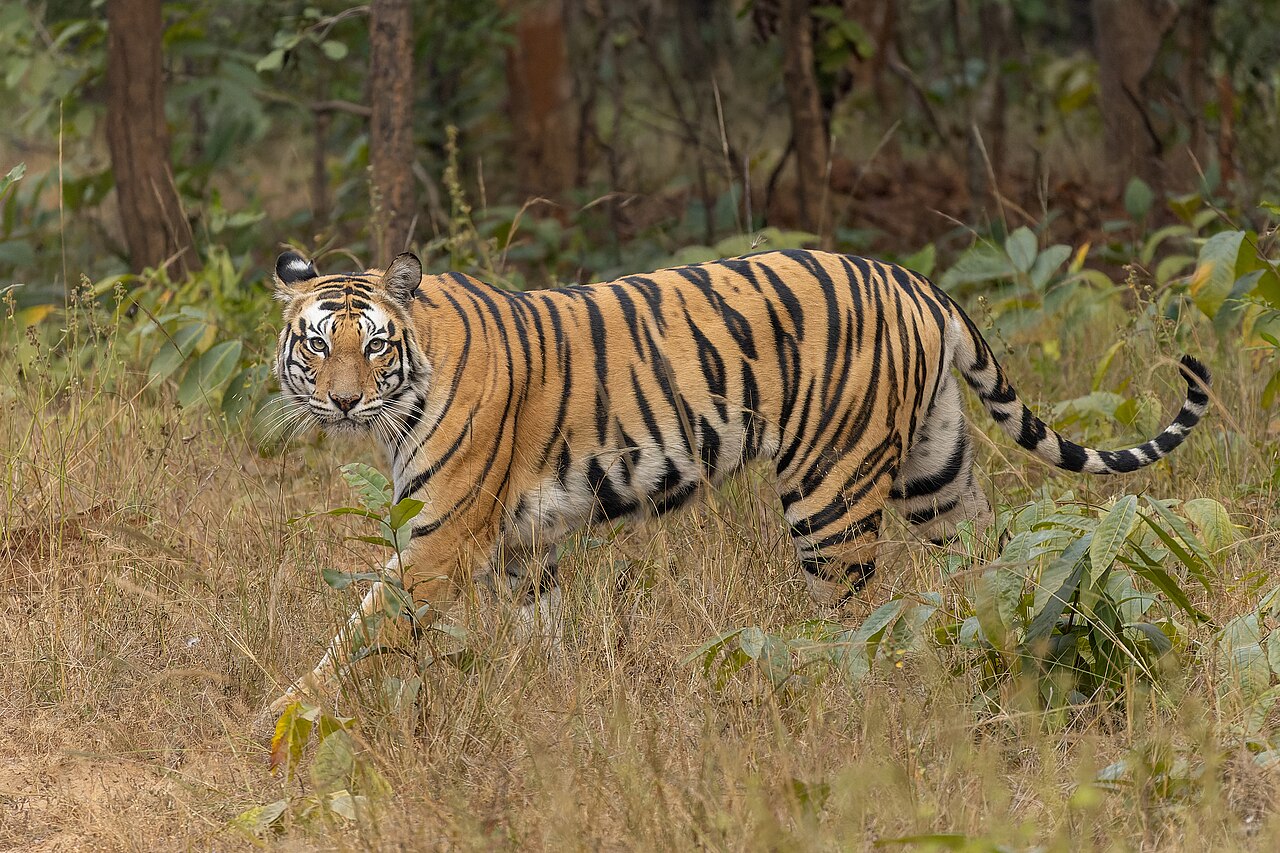
The Bengal tiger is the tiger population native to the Indian subcontinent. It is usually named Panthera tigris tigris, although modern tiger taxonomy is still discussed and different authorities may describe the mainland populations in different ways. This page uses the scientific name stored by the site and treats “Bengal tiger” as the South Asian population found in India, Nepal, Bhutan and Bangladesh.
Where do Bengal tigers live?
Bengal tigers survive in a much wider range of habitats than the phrase “jungle cat” suggests. Their range includes tropical and subtropical forests, dry deciduous woodland, alluvial grasslands and the tidal mangrove forest of the Sundarbans. Suitable habitat needs more than vegetation: tigers also require sufficient wild prey, water, cover and connected areas large enough for movement and breeding.
India is the population stronghold. The National Tiger Conservation Authority’s 2022 assessment estimated 3,682 tigers in India, with an estimated range of 3,167–3,925. That is a national tiger estimate, not a count of every animal seen and not a Bengal-only global census assembled with one method. Nepal’s separate 2022 assessment reported 355 tigers. Bhutan’s 2021–2022 survey reported 131. These dated national results should remain separate because survey areas and statistical methods differ. NTCA tiger reports; Nepal tiger assessment; Bhutan survey summary.
What does a Bengal tiger look like?
The familiar orange coat is crossed by dark vertical stripes, with white or pale fur on the cheeks, throat, belly and inner legs. Each tiger’s stripe pattern is individually distinctive, which allows researchers to identify animals in camera-trap photographs. Males are generally larger and more heavily built than females, but body size varies with sex, age, habitat and prey availability.
Measurements should be treated as ranges rather than a single “average Bengal tiger.” The Smithsonian notes that tiger size varies substantially among populations. Exceptional records also should not be presented as typical adults. Photographs can be especially misleading when the tail is excluded or there is no reliable scale. Smithsonian tiger profile.
What do Bengal tigers eat?
Bengal tigers are carnivores and primarily hunt medium-to-large mammals. Common prey in suitable South Asian habitats includes chital, sambar, wild boar, gaur and other ungulates. The exact diet changes between landscapes. A tiger in a mangrove ecosystem does not encounter the same prey community as one in a dry forest or an alluvial grassland.
Tigers usually hunt alone. They use cover to approach before making a short attack, and their powerful forelimbs help control prey. This strategy depends more on concealment, timing and proximity than on maintaining a quoted top speed. Because reliable species-specific sprint measurements are limited, this profile does not present an internet speed estimate as a measured biological constant.
Are Bengal tigers solitary?
Adult tigers generally maintain individual home ranges marked with scent, scratches and vocal signals. “Solitary” does not mean they never communicate or interact. A male’s range may overlap those of several females, neighboring animals monitor one another’s marks, and tigers may meet to mate or share space around an abundant resource. Mothers live with their dependent cubs until the young disperse.
Activity also changes with conditions. Tigers are often most active from dusk through night, but daylight activity occurs where temperature, prey behavior and human disturbance allow it. A single label such as nocturnal cannot describe every landscape.
How do Bengal tigers reproduce?
Tigers can breed throughout the year. Gestation lasts a little over three months, and litters commonly contain two to four cubs. Cubs are born dependent on their mother. She supplies milk, moves them between sheltered sites, defends them and later introduces them to meat and hunting opportunities. Young tigers usually remain with her for roughly two years before dispersing, although timing varies.
Early survival is difficult. The Smithsonian reports that approximately half of wild tiger cubs do not survive beyond their first two years. A litter size therefore cannot be converted directly into population growth. Smithsonian National Zoo.
How are Bengal tiger numbers estimated?
Modern national surveys combine field signs, habitat and prey information, camera traps and statistical models. Camera traps photograph the flanks of passing animals, and individual stripe patterns help researchers recognize recaptures. The model then estimates animals that were present but not photographed.
This explains why reports distinguish photographed individuals, a modelled estimate and an uncertainty range. India’s 2022 report, for example, identified thousands of individual tigers while producing a larger national estimate. Reporting only one number without its year, geography and method creates false precision. All India Tiger Estimation methodology.
Are Bengal tigers endangered?
The tiger species is classified as Endangered. Bengal tiger recovery is uneven: some protected landscapes have recorded growth, while habitat fragmentation, prey loss, poaching and conflict continue to threaten tigers elsewhere. A rise in one national estimate does not remove the species-level extinction risk or guarantee that every population is secure.
Connected habitat is essential because dispersing tigers must move between breeding areas. Roads, railways, intensive land use and settlements can isolate reserves or increase encounters with people and livestock. Conservation therefore includes protected-area management, prey recovery, corridor protection, anti-poaching work and measures that reduce conflict for nearby communities.
Bengal tiger and Amur tiger: are they different?
Bengal and Amur tigers are geographically and ecologically distinct populations. Some current taxonomic treatments group mainland Asian tigers within Panthera tigris tigris, while other references retain more subspecies names. Their common names remain useful for geography, conservation management and describing locally adapted populations. The scientific authority and date should be stated whenever taxonomy is central to a claim.
Frequently asked questions
Which countries have wild Bengal tigers?
The population covered here occurs in India, Nepal, Bhutan and Bangladesh.
Can Bengal tigers swim?
Yes. Tigers swim readily, and water crossings are a regular part of life in riverine and mangrove landscapes such as the Sundarbans.
Are white tigers a separate species?
No. White coloration is a rare inherited color condition, not a separate tiger species. Many white tigers in captivity descend from closely related breeding lines.
Can a Bengal tiger be kept as a pet?
No responsible household setting can meet the space, containment, diet, veterinary and welfare needs of a wild tiger. Laws differ by jurisdiction, while international commercial trade in tigers is tightly restricted under CITES Appendix I.