
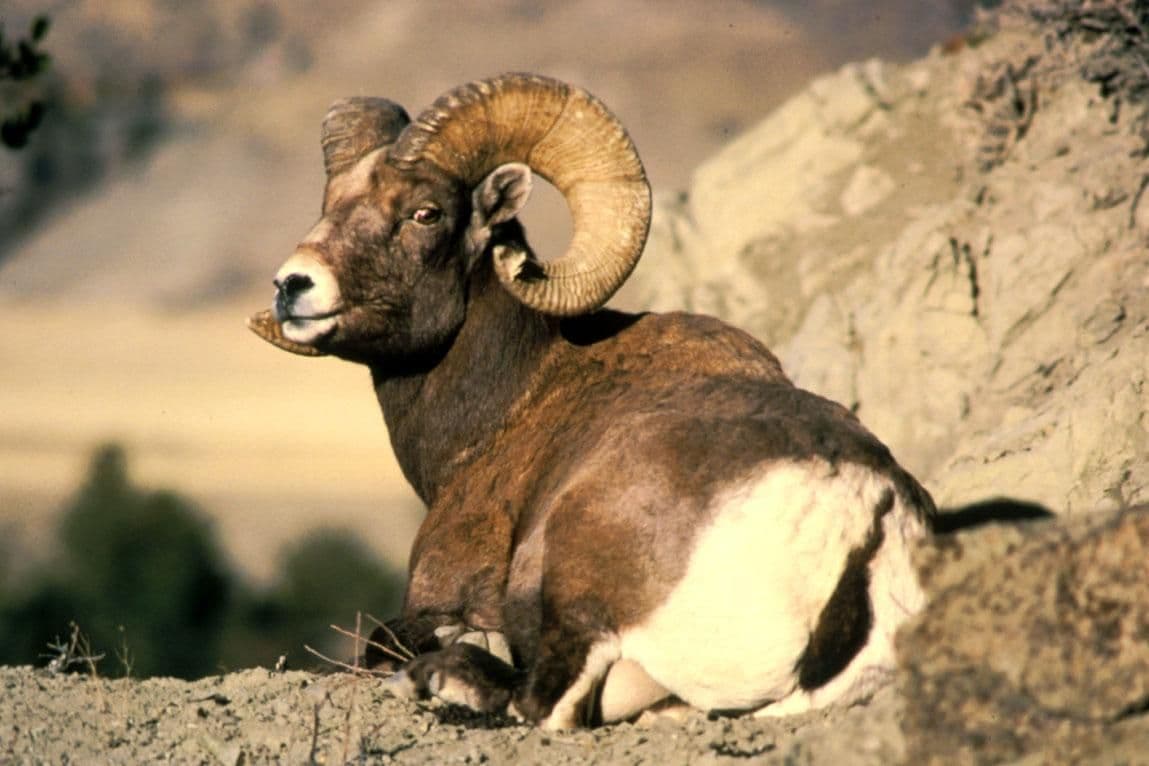
Bighorn Sheep (Ovis canadensis) is North America’s largest wild sheep. It occupies rugged mountains and desert ranges from western Canada through the United States into Mexico. The species includes mountain and desert populations, so water use, body size and seasonal movement differ across its broad range. This guide separates well-supported biology from common assumptions and covers identification, range, habitat, diet, behavior, reproduction and conservation.
Identification
The coat is tan, gray-brown or chocolate with a white muzzle, belly, rump and backs of the legs. Rams have thick horns that curl around the face and continue growing for life; older males often wear or “broom” the tips. Ewes have much shorter, slender, slightly curved horns. Wide-set eyes, strong legs and split hooves with hard rims and rough flexible centers suit life on broken rock. Rams are much larger than ewes and carry massive curled horns. Female horns are narrow and rarely form more than a partial curve.
Identification should combine body shape, markings, size, voice or movement, and location. One feature by itself can overlap with a related animal, a juvenile, or an individual in unusual light.
Photographs are most useful when they preserve scale and show several diagnostic features. Handling or repositioning a wild bighorn sheep for identification can cause stress and is unnecessary.
Size and physical adaptations
Bighorn Sheep typically measures about 150–180 cm head and body and weighs ewes about 53–91 kg; large rams about 90–145 kg. Desert bighorns are generally smaller than northern Rocky Mountain animals, and mass changes with age, season and nutrition.
Its useful adaptations include split hooves grip narrow rock edges, rough elastic foot pads conform to uneven surfaces, wide-set eyes provide broad visual coverage, a double-layered skull helps absorb horn-clash forces, large horns advertise age and competitive history, ruminant digestion extracts energy from coarse forage, learned migration routes connect seasonal ranges. These traits work together in the animal’s normal setting rather than serving as isolated curiosities.
Published measurements may use different methods, life stages or sample locations. Comparing figures responsibly means checking what was measured rather than selecting the largest number available.
Range and distribution
Mountain and desert ranges of western North America, from southern Canada through the Rocky Mountains, Great Basin, Sierra Nevada and desert Southwest into northwestern Mexico. Modern distribution is fragmented after historic disease, hunting and development eliminated many herds. Reintroductions restored bighorns to parts of their former range. The native range includes Canada, United States, Mexico.
A country-level map indicates broad distribution, not continuous occupation. Climate, elevation, water, vegetation, prey, breeding sites, barriers and survey effort all affect where records occur.
Records near the edge of the range deserve careful documentation because they may reflect natural movement, improved survey coverage, accidental transport or a genuine distribution change.
Habitat
Rocky cliffs, canyons, alpine meadows, open mountain slopes, desert ranges and foothill grasslands with escape terrain nearby.
Cliffs and broken slopes provide refuge from predators. Northern herds often migrate between high summer meadows and lower windswept winter ranges, following routes learned from older animals. Desert bighorns move among steep ranges and scattered springs, sometimes crossing open valleys that expose them to roads and development. Deep snow is difficult because they do not dig efficiently for buried forage. Protecting a population therefore requires the feeding, shelter and breeding features that make a site usable, along with connections that allow movement.
Microhabitat matters. Shade, soil, current, moisture, shelter or host plants can determine whether a small area is usable even when the surrounding landscape appears suitable.
Diet and feeding
Bighorn Sheep is a herbivore. Important foods include native grasses, sedges, forbs, shrub leaves, twigs and buds, cactus and desert succulents, mineral-rich soil or salt licks. Bighorn sheep graze when grasses are available and browse shrubs during winter or drought. As ruminants, they crop food quickly and later rechew cud from a protected resting site. Desert animals obtain moisture from plants but still depend on reliable water during hot dry periods. Mineral licks supply sodium and other elements that may be scarce in mountain vegetation.
Diet changes with age, season, location and food supply. A dramatic prey record does not establish what most individuals eat most of the time; repeated field observations provide a stronger picture.
Feeding opportunities also create risk. An animal focused on prey may be less alert to predators, traffic or people, while contaminated prey can transfer pollutants through the food web.
Behavior and communication
Mostly diurnal, feeding in morning and late afternoon and resting to ruminate during midday. Ewes, lambs and young animals form nursery bands led by experienced females. Mature rams usually live in separate bachelor groups outside the rut. Social learning preserves migration routes and knowledge of water, forage and escape terrain. During the rut, rams assess body and horn size, then may rear up, charge and collide forehead to forehead. A reinforced skull and strong neck help absorb impact, but fights still carry risk.
Bighorns rely strongly on vision and smell. Horn size, posture and approach reveal rank before combat. Rams snort and rumble during the rut; alarmed animals blow sharply. Ewes and lambs use bleats and low calls to maintain contact. Scent communicates reproductive condition and individual identity at close range. Behavior should be interpreted in context: alarm, courtship, feeding and temperature regulation can produce very different actions from the same animal.
Daily schedules are flexible responses, not rigid rules. Weather, breeding condition, disturbance, tides or food can move activity into a different part of the day.
Reproduction and development
The rut occurs mainly from autumn into early winter, with timing varying by latitude and subspecies. Rams compete for access to estrous ewes through following, guarding and horn clashes. After a gestation near six months, a ewe separates from the herd and gives birth on secluded steep terrain, usually to one lamb. Usually one lamb; twins occur when nutrition is favorable A lamb stands and follows its mother within hours. For its first days it hides or remains close on secure ledges, then joins a nursery group. Nursing continues for several months as the lamb learns migration routes, water sources and predator responses. Female young often remain with the maternal group, while males leave for bachelor bands at two to four years.
Young animals face different risks and may use different microhabitats or food than adults. Breeding success depends on adult condition, suitable sites and the survival of offspring through vulnerable early stages.
Counts of eggs or young describe reproductive output, not the number expected to reach adulthood. Mortality is normally greatest during eggs, larval or juvenile stages.
Predators and ecological role
Bighorns shape grass and shrub communities through grazing and carry nutrients between seasonal ranges. Mountain lions are their principal predator in many areas, while coyotes, bobcats, bears, wolves and golden eagles take lambs or vulnerable adults. Carcasses support scavengers. Herds are especially sensitive to respiratory disease transmitted through contact with domestic sheep or goats. Documented or likely predators include Mountain Lion, Coyote, Golden Eagle, Gray Wolf, Human.
This animal is both a consumer and a food source. Its influence comes through many repeated interactions, so ecological claims should be based on measured populations rather than assumptions drawn from appearance.
Predator and prey relationships differ among places. A species can be ecologically influential without being abundant everywhere, and its role can change across its range.
Relationship with people
Bighorn horns, meat and hides have long cultural importance for Indigenous peoples. Unregulated hunting and livestock-borne disease caused severe historic collapse. Modern recovery combines hunting regulation, habitat protection, translocation, highway crossings and separation from domestic sheep and goats. Wildlife viewing and tightly controlled hunting support some conservation programs.
Stay at least the locally required distance, never feed sheep and keep dogs leashed. Give rams extra space during the rut and ewes space during lambing. Do not block road crossings or separate an animal from its group. Livestock owners near bighorn range should follow agency disease-separation rules and report escaped domestic sheep immediately. Responsible observation means keeping an appropriate distance, avoiding capture or feeding, protecting habitat and following local wildlife or invasive-species guidance.
Wildlife guidance should come from the responsible local agency because collection rules, reporting requests and appropriate responses differ between native and introduced ranges.
Conservation
The species is globally assessed as Least Concern, but that broad category masks vulnerable and federally protected populations such as the Sierra Nevada and Peninsular bighorn forms. Local disease outbreaks can erase decades of recovery. The reported global trend is Overall variable; many restored herds are stable while others decline episodically.
Important pressures include pneumonia linked to domestic sheep and goats, habitat fragmentation and blocked migration, road collisions and urban development, drought and loss of desert water, climate-driven forage change, small-herd isolation and low genetic diversity. Global status can hide local decline or recovery, so current regional monitoring and habitat management remain necessary.
The most useful conservation action follows the documented pressure. Protecting breeding sites, reducing road deaths or limiting pollutants can require different tools in different populations.