
Home/Animals/Reptilia/Bismarck Ringed Python
Species profileIUCN: LC

Bismarck Ringed Python

Bothrochilus boa

An island python whose vivid juvenile orange-and-black rings fade into a dark, glossy adult pattern.

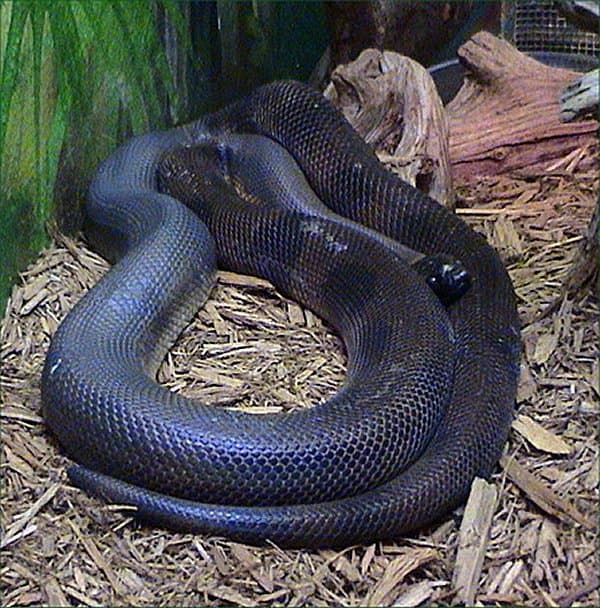
Bismarck Ringed Python coiled with glossy black and orange-brown banded scales
Dawson / Wikimedia Commons / CC BY-SA 2.5
🌐 Read in Language:

⚡ At a Glance

Species profile
Also Known As
Ringed Python; Bismarck Dwarf Python
Diet Category
Ground-level ambush predator of small vertebrates
Activity Rhythm
Mostly nocturnal or crepuscular, sheltering during the hottest daylight hours; may move after rain.
Wild Lifespan
Managed individuals may live 15–20 years; wild longevity is uncertain
Typical Weight
commonly about 1.5–4 kg in adults
Conservation Status
LC
💡 Key Biological Insight: Few snakes change appearance as dramatically: the bright orange-and-black rings of a hatchling often become muted dark brown or black as the python matures.

🌳 Scientific Taxonomy Hierarchy

Bothrochilus boa belongs to Pythonidae and order Squamata. It is the type species of Bothrochilus and has previously been placed in Liasis and Morelia. No subspecies are currently recognized. This profile applies only to Bothrochilus boa, not to the other New Guinea pythons once grouped near it.

KingdomAnimalia
PhylumChordata
ClassReptilia
OrderSquamata
FamilyPythonidae
GenusBothrochilus
SpeciesBothrochilus boa

Distinguishing Anatomical Features

  • ✓Juveniles have brilliant orange, red or golden bands alternating with glossy black rings from head to tail. As they mature, the orange darkens and the contrast fades, leaving many adults brownish-black with subdued pale rings or mottling. The head is small and only slightly distinct from the neck, the body cylindrical and muscular, and the scales smooth and glossy.
  • ✓Juvenile rings may disrupt the body outline
  • ✓Adult dark coloration suits forest-floor cover
  • ✓Muscular coils constrict prey
  • ✓Smooth scales move through leaf litter
  • ✓Forked tongue tracks chemical trails
  • ✓Slow metabolism permits long gaps between meals
  • ✓Maternal coiling protects and warms eggs

📏 Physical Measurements

Total Lengthusually 4–6 ft, with some individuals approaching 6.6 ft
Body Weightcommonly about 3.3–8.8 lb
Tail LengthModerately short, tapering and used for balance
WingspanNot applicable
Top SpeedNo dependable universal maximumMovement changes with context and conditions.

🎨 Appearance & Distinctive Markings

BlackOrangeRedBrownGoldOrangeBlackBrown

Skin / Covering: Dry overlapping smooth glossy scales

Sexual Dimorphism: Females tend to become larger and heavier. Males have proportionally longer tails and more obvious pelvic spurs, but reliable sexing should be performed only by an experienced professional.

🗺️ Geographic Distribution & Habitat

The species is endemic to northeastern Papua New Guinea’s Bismarck Archipelago, including New Britain, New Ireland, New Hanover, the Duke of York Islands, Umboi, Mioko, Tatau, Nissan Atoll and nearby islands. It is not considered native to the Solomon Islands, including Bougainville.

Humid lowland rainforest, secondary forest, forest edge, plantation, garden, dense scrub, stream margin and leaf-littered ground.

Country-level distribution map

Native range
FijiTanzaniaWestern SaharaCanadaUnited StatesKazakhstanUzbekistanPapua New Guinea — Native rangeIndonesiaArgentinaChileCongo - KinshasaSomaliaKenyaSudanChadHaitiDominican RepublicRussiaBahamasFalkland IslandsNorwayGreenlandFrench Southern TerritoriesTimor-LesteSouth AfricaLesothoMexicoUruguayBrazilBoliviaPeruColombiaPanamaCosta RicaNicaraguaHondurasEl SalvadorGuatemalaBelizeVenezuelaGuyanaSurinameFranceEcuadorPuerto RicoJamaicaCubaZimbabweBotswanaNamibiaSenegalMaliMauritaniaBeninNigerNigeriaCameroonTogoGhanaCôte d’IvoireGuineaGuinea-BissauLiberiaSierra LeoneBurkina FasoCentral African RepublicCongo - BrazzavilleGabonEquatorial GuineaZambiaMalawiMozambiqueEswatiniAngolaBurundiIsraelLebanonMadagascarPalestinian TerritoriesGambiaTunisiaAlgeriaJordanUnited Arab EmiratesQatarKuwaitIraqOmanVanuatuCambodiaThailandLaosMyanmar (Burma)VietnamNorth KoreaSouth KoreaMongoliaIndiaBangladeshBhutanNepalPakistanAfghanistanTajikistanKyrgyzstanTurkmenistanIranSyriaArmeniaSwedenBelarusUkrainePolandAustriaHungaryMoldovaRomaniaLithuaniaLatviaEstoniaGermanyBulgariaGreeceTürkiyeAlbaniaCroatiaSwitzerlandLuxembourgBelgiumNetherlandsPortugalSpainIrelandNew CaledoniaSolomon IslandsNew ZealandAustraliaSri LankaChinaTaiwanItalyDenmarkUnited KingdomIcelandAzerbaijanGeorgiaPhilippinesMalaysiaBruneiSloveniaFinlandSlovakiaCzechiaEritreaJapanParaguayYemenSaudi ArabiaCyprusMoroccoEgyptLibyaEthiopiaDjiboutiUgandaRwandaBosnia & HerzegovinaNorth MacedoniaSerbiaMontenegroKosovoTrinidad & TobagoSouth Sudan
Highlighted countries are recorded profile locations, not precise biological range boundaries.Map boundaries: Natural Earth

Recorded Native Countries & Territories:

💡 Did You Know?

  • 💡Juvenile rings may disrupt the body outline
  • 💡Adult dark coloration suits forest-floor cover
  • 💡Muscular coils constrict prey
  • 💡Smooth scales move through leaf litter
  • 💡Forked tongue tracks chemical trails
  • 💡Slow metabolism permits long gaps between meals
  • 💡Maternal coiling protects and warms eggs

🌿 Conservation Status & Threats

IUCN: LC — Least Concern

“The IUCN assesses the Bismarck Ringed Python as Least Concern. It remains widespread across several islands, but its restricted global range means habitat loss, invasive species and poorly regulated collection should still be monitored.”

Population TrendBelieved broadly stable, though comprehensive island-by-island monitoring is limited
Wild Population EstimateNo reliable global total; locally encountered in suitable habitat
CITESAppendix II

⚠️ Major Threats to Bismarck Ringed Python

  • •Forest conversion
  • •Introduced predators
  • •Road mortality
  • •Persecution
  • •Unregulated collection
  • •Island fires
  • •Loss of ground cover
  • •Climate-driven extreme weather

🔄 Life Cycle & Reproduction

Wild vs. Captivity Lifespan Comparison

🌿 In the WildManaged individuals may live 15–20 years; wild longevity is uncertain
🏠 In Captivity (with veterinary care)Keep only traceable legal captive-bred animals with quarantine, secure hides, controlled humidity and escape prevention.
Clutch / Litter SizeUsually about 5–12 eggs; reliable wild clutch data remain limited
Incubation / GestationApproximately 55–70 days under stable warm, humid conditions
Fledging / WeaningIndependent brightly banded hatchling about 30–45 cm long
Sexual MaturityLikely after about 3–4 years, depending on growth and food
Mating SystemInternal fertilization; egg-laying
Nesting / Den TypeProtected humid ground cavity, rotting log or similar shelter

🦅 Behavior & Field Ecology

Ground-level ambush predator of small vertebrates

🌐 Ecological Food Web & Relationships: Bismarck Ringed Pythons help regulate native and introduced rodents and transfer energy to raptors, monitor lizards and larger predators. As an island endemic, the species represents a distinct branch of python evolution. Its persistence depends on forest cover, ground refuges and limits on harmful introduced species.

Social Group SizeSolitary except during courtship and maternal brooding
Activity RhythmMostly nocturnal or crepuscular, sheltering during the hottest daylight hours; may move after rain.
Feeding StrategyGround-level ambush predator of small vertebrates

🥩 Primary Prey & Preferred Diet

✓ Rats✓ Mice✓ Small mammals✓ Ground birds✓ Nestlings✓ Lizards✓ Occasional frogs

📢 Communication & Territorial Signals

  • Tongue-flick scent sampling
  • Pheromones
  • Courtship contact
  • Pelvic spur stimulation
  • Hissing
  • Defensive posture

🐾 Wild Temperament & Traits

• Secretive• Mostly nocturnal• Terrestrial• Solitary• Nonvenomous• Defensive if trapped

🤝 Human Interaction & Pet Advisory

⚠️ Strictly Wild Species
🚫

Can You Keep a Bismarck Ringed Python as a Pet?

Bismarck Ringed Pythons are specialist animals, not beginner pets. Legal captive-bred individuals need secure spacious housing, deep hides, controlled warmth and humidity, clean water, appropriately sized prey and veterinary access. Wild collection from small island populations should never substitute for responsible breeding.

Domestication StatusCaptive breeding occurs, but the species is not domesticated
Danger to HumansLow venom risk because none is present; moderate injury risk from bites and constriction
Economic & Ecotourism RoleRodent control, island food webs, research on python evolution and color change, and conservation education about endemic reptiles.

⚠️ Behavioral Risk Factors & Wildlife Safety

  • Sharp recurved teeth cause punctures
  • Defensive strikes can be fast
  • Muscular adults constrict strongly
  • Incorrect handling can injure snake and person

🌐 Ecological Food Web & Relationships

🦅 Natural Predators (5)

Brahminy KiteHaliastur indus
Mangrove MonitorVaranus indicus
Black ButcherbirdMelloria quoyi
Feral PigSus scrofa
Domestic CatFelis catus

🧬 Related Species (4)

White-Lipped PythonBothrochilus albertisiiNew Guinea relative
Brown Water PythonLiasis fuscusAustralasian python relative
Children’s PythonAntaresia childreniSmaller Australian python
Amethystine PythonSimalia amethistinaLarger regional python

Bismarck Ringed Python (Bothrochilus boa) is a nonvenomous constrictor found only in Papua New Guinea’s Bismarck Archipelago and nearby islands. Hatchlings are unmistakably banded in orange or red and black, while adults become much darker and less strongly ringed. This secretive ground-dwelling python hunts small mammals in humid tropical forest, plantations and disturbed vegetation. This guide separates well-supported biology from common assumptions and covers identification, range, habitat, diet, behavior, reproduction and conservation.

Identification

Juveniles have brilliant orange, red or golden bands alternating with glossy black rings from head to tail. As they mature, the orange darkens and the contrast fades, leaving many adults brownish-black with subdued pale rings or mottling. The head is small and only slightly distinct from the neck, the body cylindrical and muscular, and the scales smooth and glossy. Females tend to become larger and heavier. Males have proportionally longer tails and more obvious pelvic spurs, but reliable sexing should be performed only by an experienced professional.

Identification should combine body shape, markings, size, voice or movement, and location. One feature by itself can overlap with a related animal, a juvenile, or an individual in unusual light.

Photographs are most useful when they preserve scale and show several diagnostic features. Handling or repositioning a wild bismarck ringed python for identification can cause stress and is unnecessary.

Size and physical adaptations

Bismarck Ringed Python typically measures usually 1.2–1.8 m, with some individuals approaching 2 m and weighs commonly about 1.5–4 kg in adults. Published wild measurements are limited, and body mass changes with sex, feeding and reproductive condition.

Its useful adaptations include juvenile rings may disrupt the body outline, adult dark coloration suits forest-floor cover, muscular coils constrict prey, smooth scales move through leaf litter, forked tongue tracks chemical trails, slow metabolism permits long gaps between meals, maternal coiling protects and warms eggs. These traits work together in the animal’s normal setting rather than serving as isolated curiosities.

Published measurements may use different methods, life stages or sample locations. Comparing figures responsibly means checking what was measured rather than selecting the largest number available.

Range and distribution

The species is endemic to northeastern Papua New Guinea’s Bismarck Archipelago, including New Britain, New Ireland, New Hanover, the Duke of York Islands, Umboi, Mioko, Tatau, Nissan Atoll and nearby islands. It is not considered native to the Solomon Islands, including Bougainville. The native range includes Papua New Guinea.

A country-level map indicates broad distribution, not continuous occupation. Climate, elevation, water, vegetation, prey, breeding sites, barriers and survey effort all affect where records occur.

Records near the edge of the range deserve careful documentation because they may reflect natural movement, improved survey coverage, accidental transport or a genuine distribution change.

Habitat

Humid lowland rainforest, secondary forest, forest edge, plantation, garden, dense scrub, stream margin and leaf-littered ground.

The python spends much of its time beneath logs, roots, debris or dense ground cover, emerging to follow rodent scent or cross warm open patches. It can occupy modified landscapes where cover and prey remain, but island populations are still bounded by limited land area and vulnerable to introduced predators. Protecting a population therefore requires the feeding, shelter and breeding features that make a site usable, along with connections that allow movement.

Microhabitat matters. Shade, soil, current, moisture, shelter or host plants can determine whether a small area is usable even when the surrounding landscape appears suitable.

Diet and feeding

Bismarck Ringed Python is a ground-level ambush predator of small vertebrates. Important foods include rats, mice, small mammals, ground birds, nestlings, lizards, occasional frogs. The python waits along prey routes or follows chemical trails through leaf litter. It strikes, anchors itself with muscular coils and constricts mammals or birds until circulation stops. Small prey may be swallowed quickly. Digestion is slow, allowing long intervals between meals when island prey is scarce.

Diet changes with age, season, location and food supply. A dramatic prey record does not establish what most individuals eat most of the time; repeated field observations provide a stronger picture.

Feeding opportunities also create risk. An animal focused on prey may be less alert to predators, traffic or people, while contaminated prey can transfer pollutants through the food web.

Behavior and communication

Mostly nocturnal or crepuscular, sheltering during the hottest daylight hours; may move after rain. A wild individual usually remains hidden or tries to retreat. When cornered it may coil tightly, hiss and strike. Juveniles can be especially defensive, while calm behavior in captivity depends on secure cover and careful husbandry. It is primarily terrestrial but can climb low vegetation or rough trunks.

Tongue flicking transfers scent to the vomeronasal organ for prey and mate location. Courtship uses pheromones, body contact and male pelvic spurs. Hissing, tight coiling and an S-shaped neck warn a threat. The species does not use vocal social calls. Behavior should be interpreted in context: alarm, courtship, feeding and temperature regulation can produce very different actions from the same animal.

Daily schedules are flexible responses, not rigid rules. Weather, breeding condition, disturbance, tides or food can move activity into a different part of the day.

Reproduction and development

Males locate females by scent and use pelvic spurs during courtship. Fertilization is internal. Females lay eggs in protected humid sites and coil around the clutch, reducing moisture loss and helping regulate temperature. Usually about 5–12 eggs; reliable wild clutch data remain limited The brooding female remains wrapped around the eggs and generally does not feed. Hatchlings slit the shell with an egg tooth and emerge brightly ringed, independent and capable of taking small vertebrate prey. Their colors darken progressively with age.

Young animals face different risks and may use different microhabitats or food than adults. Breeding success depends on adult condition, suitable sites and the survival of offspring through vulnerable early stages.

Counts of eggs or young describe reproductive output, not the number expected to reach adulthood. Mortality is normally greatest during eggs, larval or juvenile stages.

Predators and ecological role

Bismarck Ringed Pythons help regulate native and introduced rodents and transfer energy to raptors, monitor lizards and larger predators. As an island endemic, the species represents a distinct branch of python evolution. Its persistence depends on forest cover, ground refuges and limits on harmful introduced species. Documented or likely predators include Brahminy Kite, Mangrove Monitor, Black Butcherbird, Feral Pig, Domestic Cat.

This animal is both a consumer and a food source. Its influence comes through many repeated interactions, so ecological claims should be based on measured populations rather than assumptions drawn from appearance.

Predator and prey relationships differ among places. A species can be ecologically influential without being abundant everywhere, and its role can change across its range.

Relationship with people

The snake benefits island communities by consuming rodents. Most encounters should be resolved by giving it an escape route and keeping pets away. Killing is unnecessary and reduces a native predator. Any international trade must be legal, documented and consistent with Papua New Guinea export rules and CITES controls.

This python is nonvenomous, but a defensive bite can cause punctures and a large individual can constrict. Do not grab a wild snake. Wash bites, control bleeding and seek care for deep wounds or retained teeth. Large captive snakes should be handled with another experienced adult present. Responsible observation means keeping an appropriate distance, avoiding capture or feeding, protecting habitat and following local wildlife or invasive-species guidance.

Wildlife guidance should come from the responsible local agency because collection rules, reporting requests and appropriate responses differ between native and introduced ranges.

Conservation

The IUCN assesses the Bismarck Ringed Python as Least Concern. It remains widespread across several islands, but its restricted global range means habitat loss, invasive species and poorly regulated collection should still be monitored. The reported global trend is Believed broadly stable, though comprehensive island-by-island monitoring is limited.

Important pressures include forest conversion, introduced predators, road mortality, persecution, unregulated collection, island fires, loss of ground cover, climate-driven extreme weather. Global status can hide local decline or recovery, so current regional monitoring and habitat management remain necessary.

The most useful conservation action follows the documented pressure. Protecting breeding sites, reducing road deaths or limiting pollutants can require different tools in different populations.

Sources and further reading

❓ Frequently Asked Questions

Answers to frequently asked questions verified against peer-reviewed zoological research.

They are endemic to Papua New Guinea’s Bismarck Archipelago, including New Britain, New Ireland and several smaller islands.