
The Black-faced Antbird is a small forest bird whose life unfolds close to the ground beneath the Amazon canopy. Its scientific name is Myrmoborus myotherinus, and current checklists place it in Thamnophilidae, the typical antbird family. It is often easier to locate by voice than by sight because pairs move through shadowed foliage, vine tangles, and low branches. Despite the family name, this bird does not live mainly on ants. It searches for insects and other small arthropods and may sometimes exploit prey disturbed by larger animals.
Identification and appearance
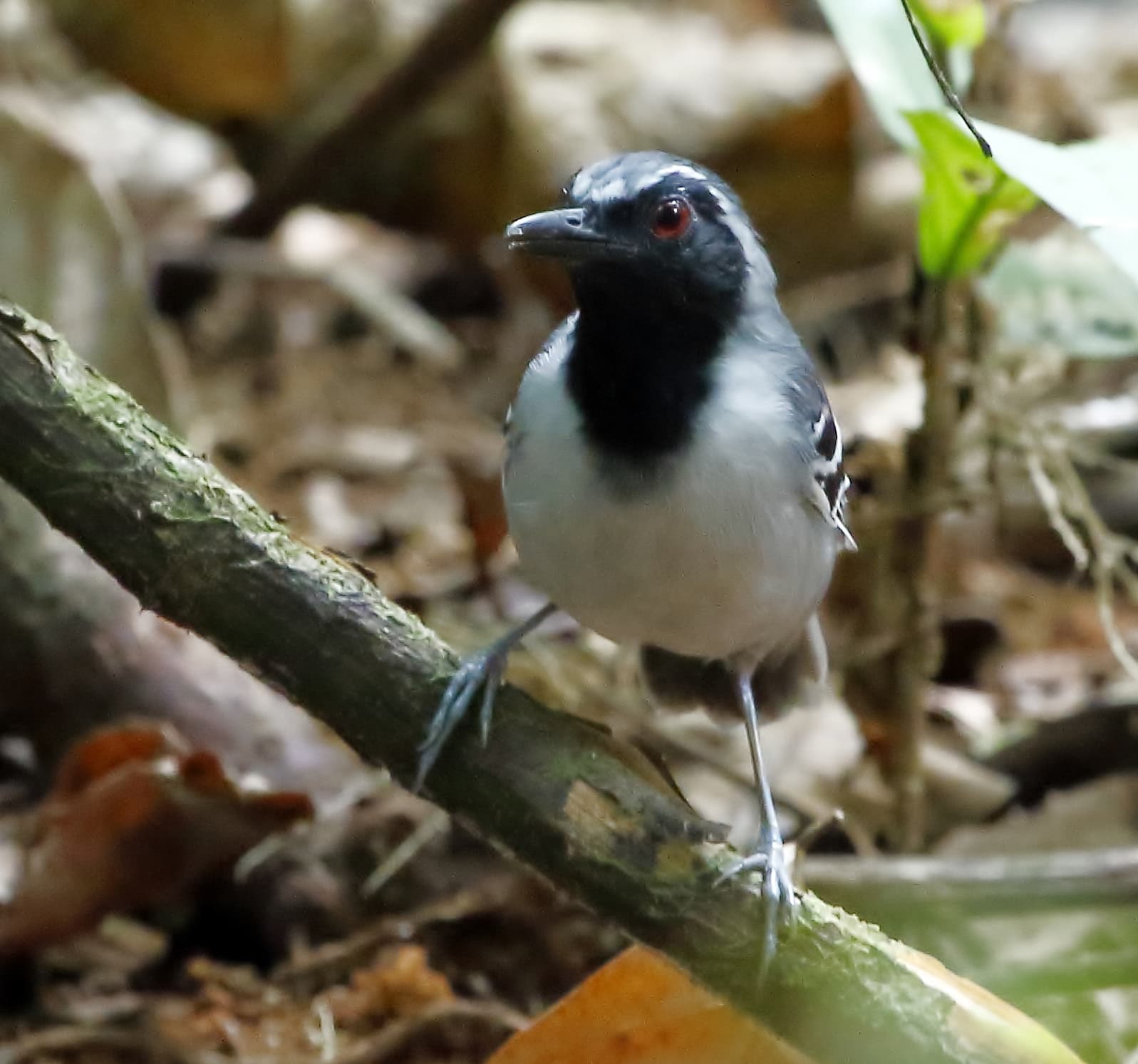
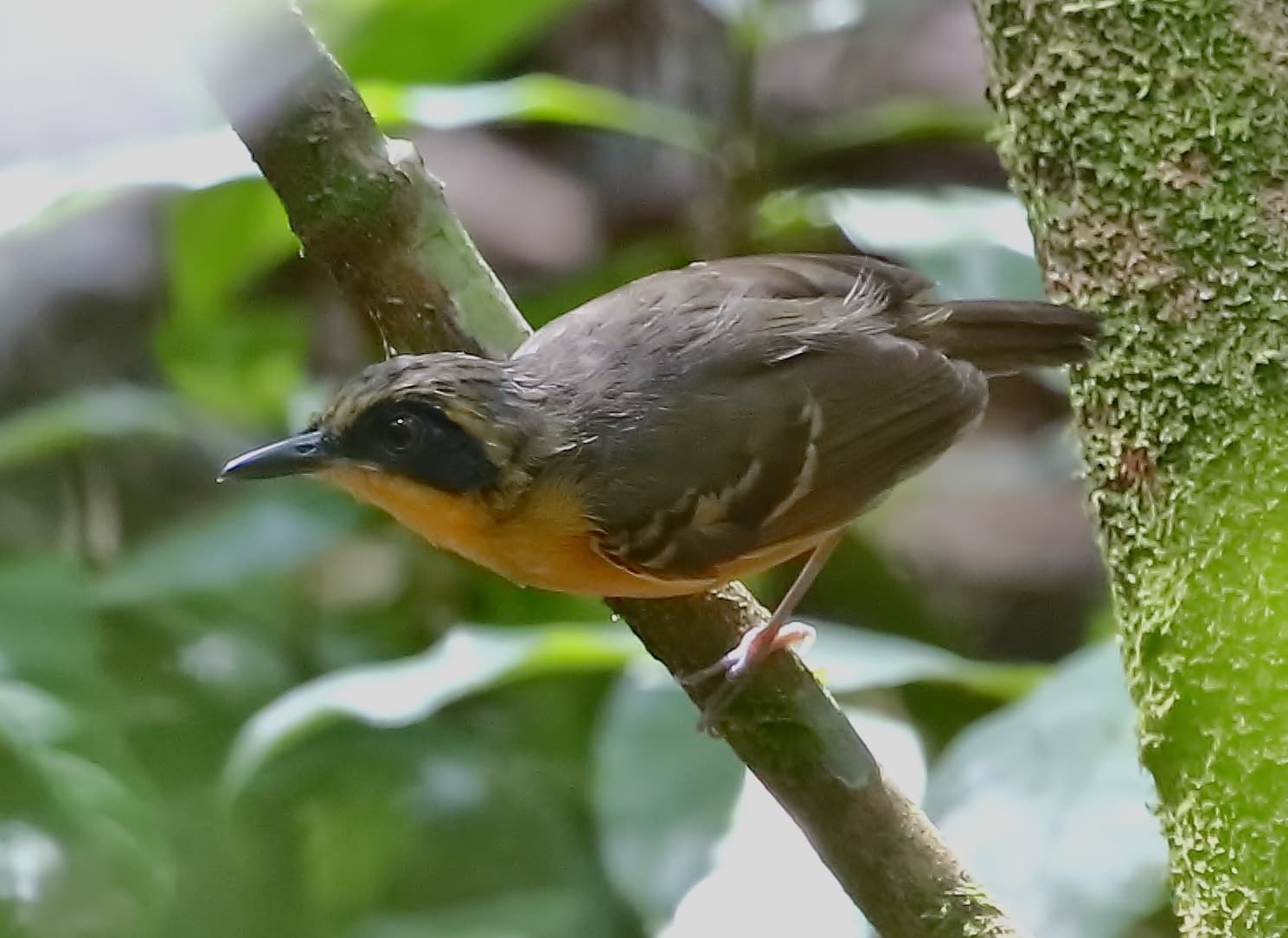
Adult males give the species its English name. They are largely gray above, with a deep black face and throat set against paler gray underparts. White patches on the wings can flash when the bird changes position, although they may remain hidden while it is perched. Females look very different: they are warmer brown above and rich rufous or ochre below, with a darker face and wings. Both sexes have a compact body, fairly short tail, sturdy legs, and a straight bill suited to picking small prey from vegetation.
Sexual dimorphism makes a pair look almost like two different species to a beginner. Lighting adds another challenge. In the dim understory, a male may appear nearly black, while a female’s warm plumage can blend into dead leaves. The bird’s posture, low forest level, and repeated calls are therefore useful identification clues. Regional subspecies differ somewhat in plumage, so observers should compare birds with the form expected in that part of the range.
Range and forest habitat
Black-faced Antbirds are resident in tropical South America. Their broad range extends through Amazonian portions of Colombia, Ecuador, Peru, Bolivia, and Brazil. They occur mainly in humid lowland forest and foothill forest, including mature woodland, tall secondary growth, forest edges, and dense vegetation around treefalls. They are not birds of open country, and a country-level map should not be read as evidence that they occupy every place within those borders.
Within a forest, the species spends most of its time in the understory. Tangled vines, saplings, low palms, and leaf-litter margins provide feeding surfaces and cover. This preference helps the bird avoid exposure, but it also makes populations sensitive to changes that simplify the understory. Selective logging, fire, roads, and conversion of forest can alter humidity and vegetation structure even where some trees remain.
Diet and foraging
The Black-faced Antbird is an insectivore. It takes insects, spiders, and other small arthropods from leaves, twigs, bark, and the ground layer. A bird may hop between low perches, pause to scan, and then reach, peck, or make a short flight to seize prey. It can also inspect curled leaves and debris where invertebrates shelter. The exact mix of prey changes with season, locality, and availability.
Some antbirds regularly attend army-ant swarms, where columns of ants flush insects and other animals from hiding. The Black-faced Antbird can take advantage of disturbed prey, but it is not an obligate army-ant follower. Pairs forage independently throughout their territories and may also join mixed-species flocks. The distinction matters: the name “antbird” describes a family relationship, not a diet made chiefly of ants.
Behavior, voice, and territory
Black-faced Antbirds usually occur alone or in pairs. A pair maintains contact through calls while dense vegetation blocks direct sight. Their song consists of a clear series of whistles that changes in pace and emphasis. Local birds may answer a neighbor, and male and female vocal exchanges help coordinate movement and defend a territory. Careful listening is often the best way to detect the species without disturbing it.
Daily activity takes place during daylight, especially through the quieter morning hours. The birds move deliberately rather than making long flights. Short, rounded wings suit quick movement between nearby stems, while strong feet provide secure grips on angled branches. When alarmed they may flick their wings, retreat deeper into cover, or call from a concealed perch.
Breeding and life cycle
Published details of breeding vary across this widespread species and remain incomplete for some regions. Like other typical antbirds, the Black-faced Antbird forms a pair bond and builds a small cup nest in low vegetation. Antbird clutches are generally small, and both parents commonly share important nesting duties. Exact timing depends on local rainfall, food supply, and latitude rather than one breeding season across the entire Amazon Basin.
Eggs and nestlings face predation from snakes, small mammals, and forest birds. Parents reduce risk by keeping visits brief and using vegetation that conceals the nest. Young birds leave the nest before they have the endurance of adults and remain dependent while their flight skills and foraging ability develop. Reliable species-specific estimates for incubation, fledging age, maturity, and lifespan are limited, so precise numbers should not be guessed.
Ecological role and relationships
By eating arthropods, Black-faced Antbirds participate in the movement of energy through the forest understory. They are also prey for larger birds, snakes, and small carnivorous mammals. Their presence can indicate that low forest layers still provide enough structure and food for specialized insect-eating birds. Mixed-species flocking may improve prey detection and awareness of danger, although each participating species keeps its own feeding style.
The species belongs to the genus Myrmoborus, alongside birds such as the White-lined Antbird and White-browed Antbird. Similar-looking antbirds can overlap geographically, but plumage, voice, habitat, and range help separate them. Taxonomic work also recognizes several geographic subspecies within M. myotherinus. The Integrated Taxonomic Information System treats the species as valid and documents its placement in Thamnophilidae.
Conservation and responsible observation
BirdLife lists the Black-faced Antbird as Least Concern, reflecting its broad distribution rather than an absence of threats. The species remains dependent on forest, and local numbers can fall where clearing, mining, roads, agriculture, or severe fires remove or dry the understory. Protected areas and large connected forest blocks help maintain territories and allow movement between populations. Long-term monitoring is valuable because broad-ranging species can decline locally before a global category changes.
Birdwatchers can help by staying on established paths, keeping a respectful distance, and limiting playback. Repeated recorded calls may draw territorial birds away from feeding or nesting. Photographs should show free-living birds without capture, handling, baiting, cages, or restraint. Community science records submitted through platforms such as eBird can improve knowledge of distribution when locations and identifications are carefully documented.