
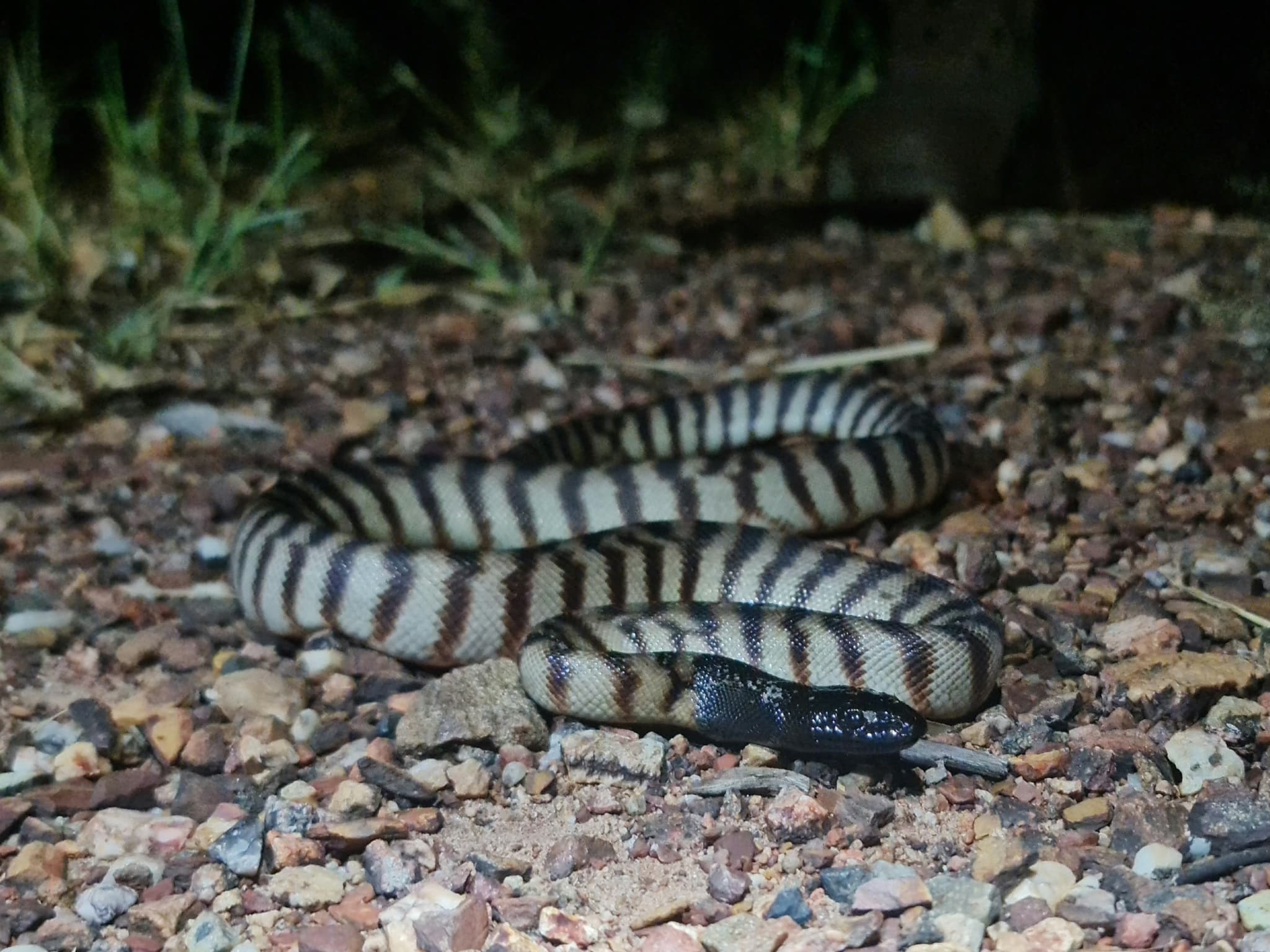
Black-Headed Python (Aspidites melanocephalus) is a large nonvenomous snake distributed across northern Australia. Its shiny black head and neck contrast sharply with a cream, yellow, tan or reddish body crossed by dark bands. Unlike most pythons, it lacks obvious heat-sensing pits along the lips and specializes heavily on reptiles, including venomous snakes. It spends much of its time underground in burrows or deep soil cracks and is most active at night or in cooler conditions. This guide separates well-supported biology from common assumptions and covers identification, range, habitat, diet, behavior, reproduction and conservation.
Identification
The head and neck are glossy black, usually without the pale lip markings seen in many other pythons. The body is muscular and patterned with numerous irregular dark brown or black bands on a cream, yellow, orange-brown or reddish ground. The belly is pale and may carry dark spots. The snout is rounded, the head is not dramatically wider than the neck, and the scales are smooth and shiny. Adult females are generally heavier and may grow longer than males, while males have relatively longer tails and paired reproductive organs. Color and head pattern do not reliably identify sex.
Identification should combine body shape, markings, size, voice or movement, and location. One feature by itself can overlap with a related animal, a juvenile, or an individual in unusual light.
Photographs are most useful when they preserve scale and show several diagnostic features. Handling or repositioning a wild black-headed python for identification can cause stress and is unnecessary.
Size and physical adaptations
Black-Headed Python typically measures usually 1.5–2.5 m, with exceptional individuals around 3 m and weighs commonly about 3–7 kg in large adults. Size varies across the broad range, and unusually large captive or wild individuals should not be treated as typical.
Its useful adaptations include black head absorbs heat while the body stays sheltered, strong wedge-shaped snout assists burrowing, muscular coils subdue reptile prey, smooth scales reduce friction underground, reptile-focused diet exploits arid prey, egg brooding stabilizes incubation, low water loss supports dry habitats. These traits work together in the animal’s normal setting rather than serving as isolated curiosities.
Published measurements may use different methods, life stages or sample locations. Comparing figures responsibly means checking what was measured rather than selecting the largest number available.
Range and distribution
Widespread across the northern third of Australia, from the Pilbara and Kimberley of Western Australia through the Northern Territory to inland and coastal Queensland. It does not occupy every place within that broad country-level map, and local occurrence depends on shelter and prey. The native range includes Australia.
A country-level map indicates broad distribution, not continuous occupation. Climate, elevation, water, vegetation, prey, breeding sites, barriers and survey effort all affect where records occur.
Records near the edge of the range deserve careful documentation because they may reflect natural movement, improved survey coverage, accidental transport or a genuine distribution change.
Habitat
Tropical woodland, savanna, grassland, rocky hills, spinifex country, cracking-clay plains, dry shrubland and the margins of humid coastal forest.
Individuals spend long periods inside mammal or monitor burrows, termite structures, hollow logs, rock crevices and deep soil cracks. They can excavate or enlarge loose soil shelters. Underground refuges buffer heat and dryness, while the black head allows partial basking near an entrance without exposing the banded body. Protecting a population therefore requires the feeding, shelter and breeding features that make a site usable, along with connections that allow movement.
Microhabitat matters. Shade, soil, current, moisture, shelter or host plants can determine whether a small area is usable even when the surrounding landscape appears suitable.
Diet and feeding
Black-Headed Python is a reptile-specialist constrictor. Important foods include skinks, monitor lizards, dragons, geckos, venomous snakes, other pythons, occasional mammals and birds. Most prey are reptiles, an unusual emphasis among large pythons. The snake seizes prey with recurved teeth and restrains it with muscular coils. It can eat venomous snakes but is not automatically immune to every venom or bite. Small mammals and ground birds form a smaller portion of reported diet.
Diet changes with age, season, location and food supply. A dramatic prey record does not establish what most individuals eat most of the time; repeated field observations provide a stronger picture.
Feeding opportunities also create risk. An animal focused on prey may be less alert to predators, traffic or people, while contaminated prey can transfer pollutants through the food web.
Behavior and communication
Primarily nocturnal, with surface and basking activity shifting with season and temperature. A Black-Headed Python usually retreats when disturbed and relies on underground shelter by day. It travels at night to locate reptile prey and may enter burrows where other snakes or lizards are confined. When threatened it can hiss, pull the neck into an S-curve and bite, but it has no venom. Road surfaces attract individuals seeking warmth and create collision risk.
A forked tongue delivers scent particles to the vomeronasal organ, allowing the python to track prey and potential mates. Vision and ground vibration provide close-range information. Courtship uses scent, alignment and tactile stimulation, while hissing and defensive posture warn an approaching threat. Behavior should be interpreted in context: alarm, courtship, feeding and temperature regulation can produce very different actions from the same animal.
Daily schedules are flexible responses, not rigid rules. Weather, breeding condition, disturbance, tides or food can move activity into a different part of the day.
Reproduction and development
Mating generally occurs from July through September. Males follow female scent and may compete for access. Females lay eggs in a protected underground chamber or similar refuge and coil tightly around the clutch, guarding it through development. Usually 6–18 large eggs The female’s brooding coils protect the eggs and help regulate their temperature. Hatchlings cut the shell with an egg tooth, remain briefly in the nest and then disperse without feeding from a parent. They begin with small lizards and snakes appropriate to their size.
Young animals face different risks and may use different microhabitats or food than adults. Breeding success depends on adult condition, suitable sites and the survival of offspring through vulnerable early stages.
Counts of eggs or young describe reproductive output, not the number expected to reach adulthood. Mortality is normally greatest during eggs, larval or juvenile stages.
Predators and ecological role
Black-Headed Pythons are major predators of lizards and snakes across northern Australian food webs. They may suppress abundant reptile prey and themselves feed raptors, large monitors and feral predators. Their use of burrows links their survival to intact soils and the animals that create underground shelter. Documented or likely predators include Wedge-Tailed Eagle, Whistling Kite, Perentie, Feral Cat, Dingo.
This animal is both a consumer and a food source. Its influence comes through many repeated interactions, so ecological claims should be based on measured populations rather than assumptions drawn from appearance.
Predator and prey relationships differ among places. A species can be ecologically influential without being abundant everywhere, and its role can change across its range.
Relationship with people
People often mistake the black head for a dangerous elapid, but this python is nonvenomous. It should still be left alone because large individuals can bite. On roads, slow down and allow the snake to cross without handling it. Native reptile possession in Australia is regulated by state or territory licensing, and animals must come from legal captive-bred sources.
Keep several body lengths away and never grab the head or tail. If a bite occurs, move out of range, wash the wound and seek medical care for deep punctures, retained teeth, heavy bleeding or infection. A bite without envenomation does not require pressure immobilisation, but uncertain snake identification warrants emergency advice. Responsible observation means keeping an appropriate distance, avoiding capture or feeding, protecting habitat and following local wildlife or invasive-species guidance.
Wildlife guidance should come from the responsible local agency because collection rules, reporting requests and appropriate responses differ between native and introduced ranges.
Conservation
The IUCN Red List classifies the Black-Headed Python as Least Concern because it remains widespread across northern Australia and occurs in many habitat types. Local losses can still result from road mortality, habitat degradation, fire changes, introduced predators and deliberate killing. The reported global trend is Stable overall, with local pressures and incomplete monitoring.
Important pressures include road mortality, deliberate killing, habitat degradation, inappropriate fire regimes, feral cats and foxes, loss of burrows and shelter, illegal collection. Global status can hide local decline or recovery, so current regional monitoring and habitat management remain necessary.
The most useful conservation action follows the documented pressure. Protecting breeding sites, reducing road deaths or limiting pollutants can require different tools in different populations.