
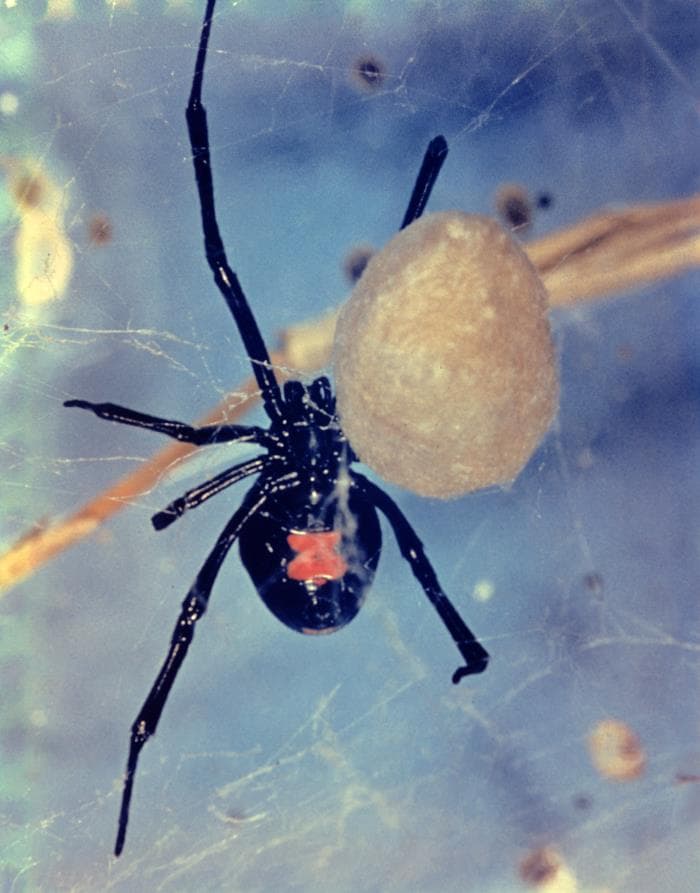
What is a black widow spider?
Black widow spider is a common name for several dark-colored widow spiders in the genus Latrodectus, part of the cobweb-spider family Theridiidae. The name does not identify one species everywhere. North America alone has southern, northern and western black widows, while related widow spiders occur across temperate and tropical regions worldwide. Australia’s redback and New Zealand’s katipō are members of the same genus, though their everyday names differ.
This profile therefore treats black widows as a genus-level group. Measurements, markings, seasonality and conservation must be tied to a named species rather than presented as universal facts. Even the number of recognized Latrodectus species has changed as taxonomists compare anatomy and genetic evidence. The familiar southern black widow, Latrodectus mactans, serves as the representative species in the photograph and several examples below.
How to identify black widows safely
Adult females of the best-known black widow species have a rounded abdomen, slender legs and a glossy dark body. A red or orange hourglass-like mark may appear underneath the abdomen. That mark is useful but not universal: its shape can be broken, reduced or absent, and some species retain red dorsal markings. Juveniles and males are usually smaller and can show pale bands or red and white patterning rather than the classic plain-black appearance.
For the southern black widow, Penn State Extension gives an adult female body length of roughly 8–13 millimeters, with a leg span near 25–35 millimeters. Males are much smaller. Those figures should not be transferred to every widow species. Color alone is also unreliable, because many harmless cobweb spiders are dark. Identification should use location, body form, web, markings and—when safety matters—a qualified local expert. Never handle a suspected widow to inspect its underside.
Web, shelter and daily behavior
Widows build irregular three-dimensional cobwebs rather than circular orb webs. Strong supporting lines lead into a sheltered retreat, while sticky capture threads intercept crawling insects. The spider often remains concealed during daylight and becomes more active after dark. A female commonly hangs upside down in the web, which can expose the colored underside of her abdomen.
Suitable sites are dry or protected spaces close to prey: beneath stones and logs, inside vacant burrows, around woodpiles, in sheds, garages, barns and other quiet cavities. CDC guidance emphasizes undisturbed material and clutter as common encounter points. Black widows are not hunting people. Bites usually occur when a spider is pressed against skin, trapped in clothing or footwear, or disturbed while a person reaches into its retreat.
What black widows eat
Black widows are predators of insects and other small arthropods. When vibrations signal trapped prey, the spider approaches across its web, immobilizes the animal with silk and delivers venom through its fangs. Digestive fluids break tissues down outside the spider’s body, and the resulting liquid is consumed. Flies, beetles, grasshoppers, woodlice, millipedes and other spiders may be taken when their size and local habitat make them available.
This predation gives widows the same broad ecological role as many other spiders: they convert abundant invertebrate prey into food for higher levels of a local food web. Widow spiders themselves can be eaten by birds, reptiles, small mammals, other spiders and specialized wasps. Their presence does not mean an area is ecologically unhealthy, although a spider in a frequently used human space may require cautious removal.
Mating, egg sacs and spiderlings
A mature male follows chemical and vibrational information toward a female’s web. Courtship can involve plucking or cutting silk and producing signals that differ from struggling prey. The popular story that every female kills her mate is false. Sexual cannibalism can occur, but males may escape and sometimes mate again. Its frequency depends on species, condition and circumstances.
After mating, a female encloses eggs in a silk sac and guards it within the web. Clutch size, number of sacs and development time vary. Emerging spiderlings disperse and pass through a series of molts before maturity. Young widows frequently have lighter, more complex patterns that darken as they grow. Females generally live longer than males, but there is no responsible single lifespan for the entire genus.
Venom and what a bite can do
Widow venom is adapted to subdue small prey, but an envenomating bite can cause the human syndrome called latrodectism. The CDC Yellow Book describes severe pain, muscle cramps or spasms, sweating, restlessness, vomiting and other systemic symptoms after some bites. Effects vary, and not every suspected spider bite is correctly identified. Death is rare with modern care, but severe symptoms can be temporarily debilitating.
Seek medical advice promptly after a confirmed or strongly suspected widow bite, especially for a child, older adult, pregnant person or anyone developing intense pain, breathing difficulty, widespread cramping or other systemic symptoms. The CDC/NIOSH first-aid guidance advises washing with soap and water, applying a cool damp cloth or wrapped ice, elevating the area when possible and seeking professional medical attention. Do not cut the wound, apply a tourniquet or attempt to remove venom.
Preventing encounters around homes and workplaces
Prevention focuses on avoiding unseen contact. Wear gloves and long sleeves when moving firewood, stones, outdoor furniture or stored materials. Shake out shoes, gloves, towels and clothing that have been left in sheds or garages. Reduce clutter, seal gaps where practical and keep frequently handled items away from undisturbed corners. Use a flashlight rather than placing an unprotected hand into a dark recess.
If a widow is found in an occupied area, keep children and pets away. A pest-management professional or experienced local authority can advise on safe removal. Outdoors and away from routine contact, automatic killing is not always necessary. CDC material notes that most spiders are harmless and that widows tend to bite defensively when disturbed, not pursue people.
Distribution and conservation
The genus Latrodectus occurs in warm temperate and tropical regions across much of the world. Individual species have distinct native distributions, and trade has carried some widow spiders beyond their original ranges. Southern black widows occur across much of the eastern and southern United States; western black widows occupy western North America; Mediterranean, African, Asian, Australian and South American species fill other regions.
There is no single IUCN conservation category for “black widow spiders” as a group. Many are locally common, while a narrow-range species can face very different pressures. New Zealand’s katipō, for example, depends on threatened coastal-dune habitat and cannot be represented by the abundance of widespread relatives. Habitat and status claims must remain species-specific.