
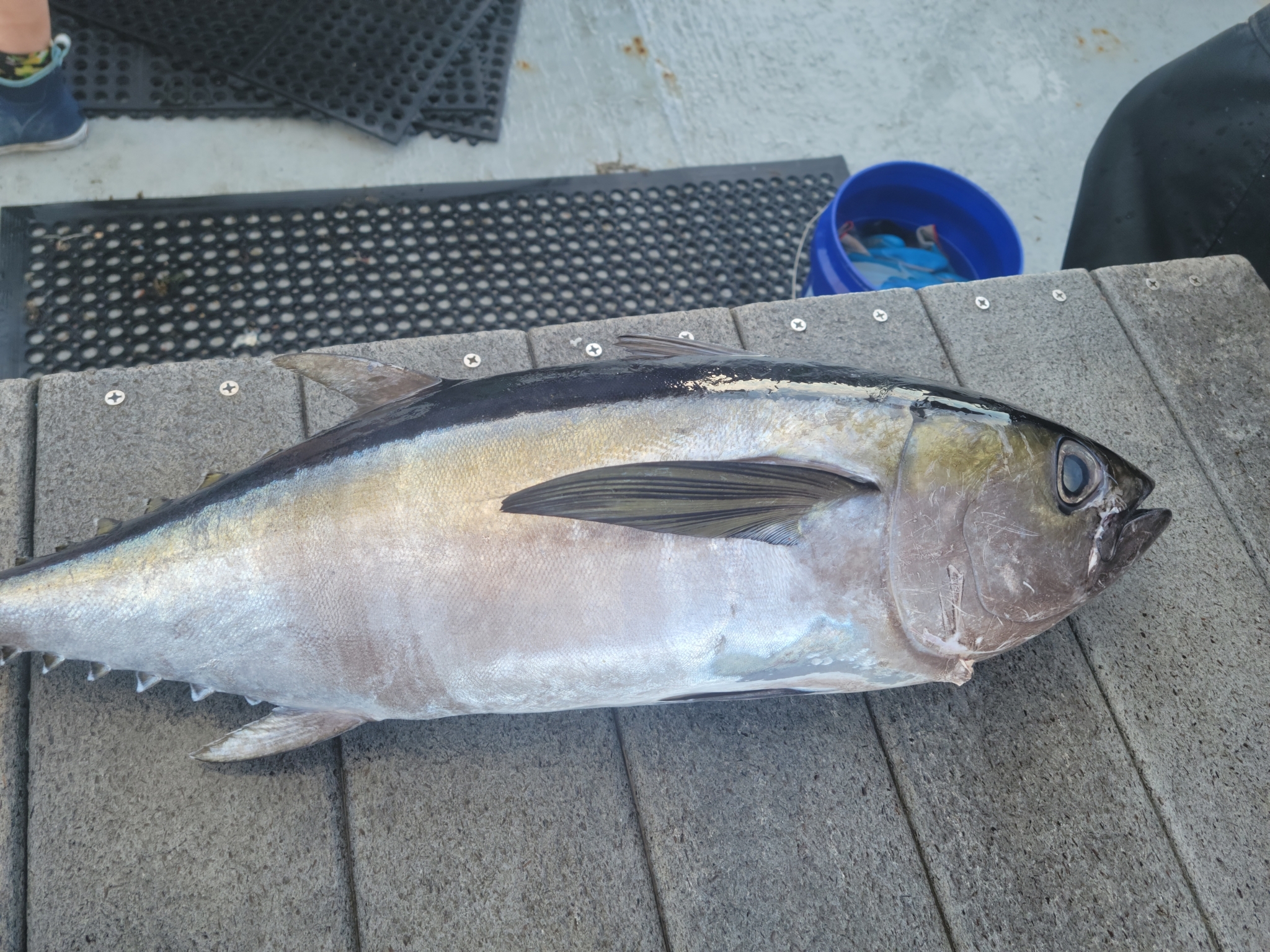
Blackfin Tuna (Thunnus atlanticus) is a streamlined ocean predator found only in tropical and warm-temperate parts of the western Atlantic. It is the smallest member of the genus Thunnus, yet it has the same muscular crescent tail, narrow tail base and rows of finlets that make tunas efficient long-distance swimmers. Blackfin often mix with skipjack schools and support valuable recreational and regional food fisheries. This guide separates well-supported biology from common assumptions and covers identification, range, habitat, diet, behavior, reproduction and conservation.
Identification
The body is deep but strongly streamlined, bluish black across the back, silvery gray on the sides and milky white below. The first dorsal fin is dusky, while the second dorsal and anal fins are dark with a silver sheen. Small finlets behind them are uniformly dusky, sometimes edged white and showing only a trace of yellow. Faint vertical bars and lower-flank spots may appear. Males and females are externally similar; mature females may be heavier-bodied when carrying eggs.
Identification should combine body shape, markings, size, voice or movement, and location. One feature by itself can overlap with a related animal, a juvenile, or an individual in unusual light.
Photographs are most useful when they preserve scale and show several diagnostic features. Handling or repositioning a wild blackfin tuna for identification can cause stress and is unnecessary.
Size and physical adaptations
Blackfin Tuna typically measures Common fork length about 72 cm; maximum reported about 108 cm and weighs Maximum published about 20.6 kg. Most landed fish are well below the published maximum; size varies with region and fishing pressure.
Its useful adaptations include fusiform body reduces drag, lunate tail produces sustained thrust, finlets control turbulence behind dorsal and anal fins, retractable fins streamline rapid swimming, countershading conceals fish from above and below, specialized circulation keeps swimming muscles warmer than surrounding water. These traits work together in the animal’s normal setting rather than serving as isolated curiosities.
Published measurements may use different methods, life stages or sample locations. Comparing figures responsibly means checking what was measured rather than selecting the largest number available.
Range and distribution
The species occupies tropical and warm-temperate western Atlantic waters from the northeastern United States and Bermuda through the Gulf of Mexico, Bahamas and Caribbean, then along Central and South America to Brazil. It is oceanic and highly mobile, but may approach islands, shelf edges, reefs and current boundaries where prey concentrates. The native range includes United States, Bermuda, Bahamas, Mexico, Caribbean islands, Central America, Northern and eastern South America.
A country-level map indicates broad distribution, not continuous occupation. Climate, elevation, water, vegetation, prey, breeding sites, barriers and survey effort all affect where records occur.
Records near the edge of the range deserve careful documentation because they may reflect natural movement, improved survey coverage, accidental transport or a genuine distribution change.
Habitat
Warm epipelagic ocean water, generally near the surface to about 50 m, around current edges, island slopes and offshore banks.
Blackfin search open water in coordinated schools. They gather around fronts, floating Sargassum, baitfish concentrations, offshore banks and drop-offs where currents bring food upward. Young fish remain within productive surface layers, while adults also take deeper prey and travel between feeding and spawning areas. Spawning grounds lie offshore rather than in coastal nursery habitat. Protecting a population therefore requires the feeding, shelter and breeding features that make a site usable, along with connections that allow movement.
Microhabitat matters. Shade, soil, current, moisture, shelter or host plants can determine whether a small area is usable even when the surrounding landscape appears suitable.
Diet and feeding
Blackfin Tuna is a carnivorous pelagic predator. Important foods include small schooling fishes, squid, shrimp, crabs and crab larvae, amphipods, stomatopod larvae. A school searches rapidly through the upper ocean and attacks compact prey patches from several directions. Blackfin take surface baitfish but also feed deeper and consume organisms associated with Sargassum and reefs. Historical stomach studies found fishes dominant by volume, with squid and a variety of pelagic crustaceans also important. Diet shifts with local prey and fish size.
Diet changes with age, season, location and food supply. A dramatic prey record does not establish what most individuals eat most of the time; repeated field observations provide a stronger picture.
Feeding opportunities also create risk. An animal focused on prey may be less alert to predators, traffic or people, while contaminated prey can transfer pollutants through the food web.
Behavior and communication
Active day and night, with feeding intensity shaped by prey, light, temperature and currents. Blackfin Tuna are continuous, powerful swimmers that form schools with their own species and with Skipjack Tuna. Coordinated schooling lowers individual predation risk and improves access to patchy prey. Fish may drive bait toward the surface, attracting seabirds and larger predators. Their movements follow warm water and productive ocean features rather than fixed home territories.
Like other schooling fishes, blackfin use vision, water movement detected by the lateral line and close changes in speed and direction to coordinate. Chemical cues may help locate food, while pressure and vibration reveal nearby prey and predators. There is no evidence of parental calling or pair communication. Behavior should be interpreted in context: alarm, courtship, feeding and temperature regulation can produce very different actions from the same animal.
Daily schedules are flexible responses, not rigid rules. Weather, breeding condition, disturbance, tides or food can move activity into a different part of the day.
Reproduction and development
Adults release eggs and sperm into offshore open water. Spawning timing varies by latitude: NOAA reports a long Florida season from April through November with a May peak, and a Gulf of Mexico season from June through September. A female can spawn batches during favorable warm conditions rather than investing all eggs at once. Many thousands of tiny pelagic eggs released in batches; exact output varies with female size Fertilized eggs drift in the plankton and hatch into small transparent larvae. Larvae initially eat zooplankton, then shift toward larger prey as the jaws and swimming system develop. Juveniles grow rapidly, join schools and progressively assume the muscular tuna body. No adult guards eggs or young.
Young animals face different risks and may use different microhabitats or food than adults. Breeding success depends on adult condition, suitable sites and the survival of offspring through vulnerable early stages.
Counts of eggs or young describe reproductive output, not the number expected to reach adulthood. Mortality is normally greatest during eggs, larval or juvenile stages.
Predators and ecological role
Blackfin connect small fishes, squid and crustaceans to larger ocean predators. They concentrate energy acquired from scattered plankton-based food webs and become prey for billfishes, sharks, dolphins and large predatory fishes. Their mixed schools create feeding opportunities for seabirds and other hunters. Fisheries remove them for fresh, frozen, canned, dried or salted products and for sport. Documented or likely predators include Blue Marlin, Large Sharks, Common Dolphinfish, Marine Mammals.
This animal is both a consumer and a food source. Its influence comes through many repeated interactions, so ecological claims should be based on measured populations rather than assumptions drawn from appearance.
Predator and prey relationships differ among places. A species can be ecologically influential without being abundant everywhere, and its role can change across its range.
Relationship with people
Blackfin Tuna supports recreational trolling and regional commercial fishing throughout the Caribbean, Gulf and southeastern United States. Anglers must identify the species correctly and follow current local rules, because tuna regulations and reporting requirements vary. Fishing methods should minimize bycatch, lost gear and waste, and retained fish should be iced promptly for food safety.
Its speed, sharp fin spines, hooks and heavy tackle can injure people. Handle a landed fish with wet hands or suitable tools, keep fingers clear of the mouth and hooks, and check current seafood advisories for local guidance on mercury and consumption. Responsible observation means keeping an appropriate distance, avoiding capture or feeding, protecting habitat and following local wildlife or invasive-species guidance.
Wildlife guidance should come from the responsible local agency because collection rules, reporting requests and appropriate responses differ between native and introduced ranges.
Conservation
The Blackfin Tuna is assessed as Least Concern on the IUCN Red List. Its relatively fast growth, warm-water distribution and broad western Atlantic range offer resilience compared with some larger tunas, but regional catch data and biological monitoring remain important because local fisheries can be intense and the species crosses many jurisdictions. The reported global trend is Not clearly quantified across the entire range.
Important pressures include heavy local fishing pressure, bycatch in pelagic fisheries, climate-driven shifts in warm-water habitat, declines in prey abundance, marine pollution and lost fishing gear, incomplete regional catch reporting. Global status can hide local decline or recovery, so current regional monitoring and habitat management remain necessary.
The most useful conservation action follows the documented pressure. Protecting breeding sites, reducing road deaths or limiting pollutants can require different tools in different populations.
