
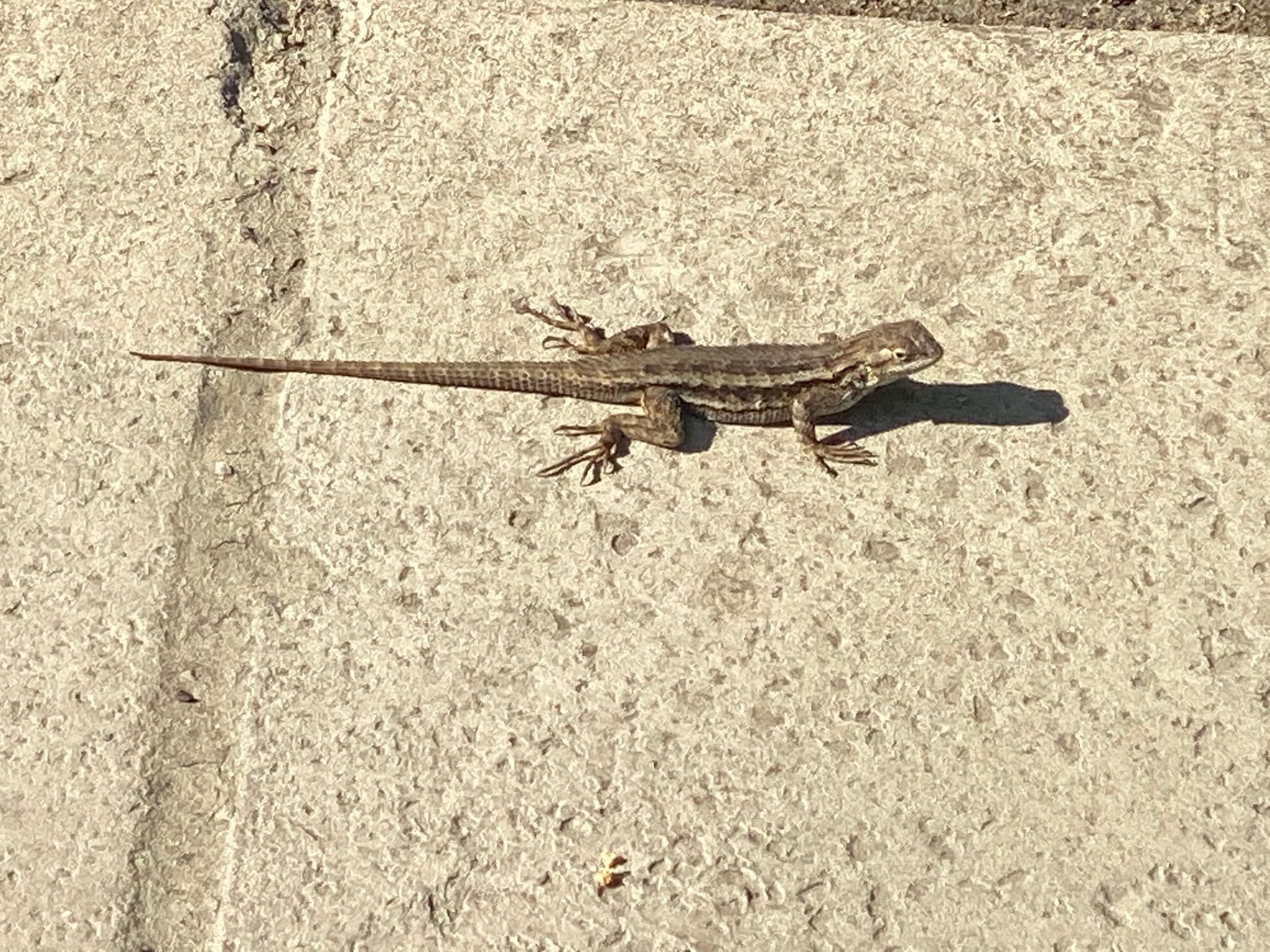
Blue Belly Lizard (Sceloporus occidentalis) is the familiar Western Fence Lizard, a medium-sized spiny lizard found from Washington and Idaho south through California and northern Baja California. It basks on fences, logs, rocks and tree trunks, then darts into cover when approached. Males display intense blue throat and belly patches during push-up signals used in territory and courtship. This guide separates well-supported biology from common assumptions and covers identification, range, habitat, diet, behavior, reproduction and conservation.
Identification
The back is gray, tan or brown with rough, keeled scales and paired rows of dark and pale marks. Adult males have bright blue patches on the sides of the belly and throat, often bordered by black; females may show weak blue or none. Yellow or orange occurs under the hind thighs. Color can darken in cool conditions to improve heat absorption. Males usually have brighter, more extensive blue patches, larger heads and more prominent femoral pores. Females are often duller and develop a fuller abdomen when carrying eggs.
Identification should combine body shape, markings, size, voice or movement, and location. One feature by itself can overlap with a related animal, a juvenile, or an individual in unusual light.
Photographs are most useful when they preserve scale and show several diagnostic features. Handling or repositioning a wild blue belly lizard for identification can cause stress and is unnecessary.
Size and physical adaptations
Blue Belly Lizard typically measures adult snout-to-vent length 5.6–8.6 cm; total length commonly 12–21 cm and weighs commonly about 10–25 g. Tail loss and regrowth make total length variable, so biologists usually compare snout-to-vent length.
Its useful adaptations include keeled scales protect the body, darkening skin speeds warming, blue patches signal rivals and mates, tail autotomy distracts predators, strong claws grip bark and rock, elevated perches improve prey detection, behavioral basking regulates body temperature. These traits work together in the animal’s normal setting rather than serving as isolated curiosities.
Published measurements may use different methods, life stages or sample locations. Comparing figures responsibly means checking what was measured rather than selecting the largest number available.
Range and distribution
The native range extends from Washington, Oregon and Idaho through California, Nevada and Utah to northern Baja California, with marginal records in adjacent western states. Distribution is patchy in the Pacific Northwest and deserts, where the species follows rocky, wooded or riparian habitat. The native range includes United States, Mexico.
A country-level map indicates broad distribution, not continuous occupation. Climate, elevation, water, vegetation, prey, breeding sites, barriers and survey effort all affect where records occur.
Records near the edge of the range deserve careful documentation because they may reflect natural movement, improved survey coverage, accidental transport or a genuine distribution change.
Habitat
Open woodland, oak savanna, conifer edge, chaparral, grassland, rocky slope, river corridor, coastal driftwood, fence line, woodpile and sunny urban garden.
A suitable site combines sunny vertical basking structures with nearby cracks, logs, shrubs or leaf litter for escape and night shelter. In treeless areas the lizard depends on rocks, fences or wood. Eggs require loose, insulated soil, so paving and shoreline armoring can remove important nesting habitat. Protecting a population therefore requires the feeding, shelter and breeding features that make a site usable, along with connections that allow movement.
Microhabitat matters. Shade, soil, current, moisture, shelter or host plants can determine whether a small area is usable even when the surrounding landscape appears suitable.
Diet and feeding
Blue Belly Lizard is a active hunter of terrestrial invertebrates. Important foods include beetles, ants, flies, grasshoppers, spiders, ticks, scorpions. From an elevated perch the lizard scans for movement, rushes to seize prey with its jaws and returns to cover or a lookout. Insects dominate the diet, with spiders and other arthropods taken opportunistically. Prey changes with season and local availability; occasional cannibalism or tiny vertebrate prey has been reported but is not typical.
Diet changes with age, season, location and food supply. A dramatic prey record does not establish what most individuals eat most of the time; repeated field observations provide a stronger picture.
Feeding opportunities also create risk. An animal focused on prey may be less alert to predators, traffic or people, while contaminated prey can transfer pollutants through the food web.
Behavior and communication
Diurnal, active on warm sunny days from spring into autumn; cold-region populations shelter or brumate through winter. Individuals alternate basking with short feeding runs. Males defend small territories using head bobs, push-ups, side displays and chases. A threatened lizard races around the far side of a trunk, hides in a crevice or sheds its tail if seized. It may bite when handled but normally avoids people.
Vision dominates social communication. Push-ups, head bobs, flattened posture and flashes of blue signal sex, condition and ownership of a perch. Chemical cues from skin and femoral glands may assist recognition at close range. Rustling and vibration warn of approaching predators. Behavior should be interpreted in context: alarm, courtship, feeding and temperature regulation can produce very different actions from the same animal.
Daily schedules are flexible responses, not rigid rules. Weather, breeding condition, disturbance, tides or food can move activity into a different part of the day.
Reproduction and development
Males establish display perches in spring and court females with repeated visual signals. Fertilization is internal. Females dig shallow nests in loose soil and may produce more than one clutch in warm parts of the range. Usually 3–17 eggs, often 4–10 Hatchlings emerge in late summer or early autumn in cooler regions and earlier where seasons are long. They receive no parental care, hunt tiny insects immediately and grow rapidly when prey is abundant. Tail loss can divert energy from growth and reproduction.
Young animals face different risks and may use different microhabitats or food than adults. Breeding success depends on adult condition, suitable sites and the survival of offspring through vulnerable early stages.
Counts of eggs or young describe reproductive output, not the number expected to reach adulthood. Mortality is normally greatest during eggs, larval or juvenile stages.
Predators and ecological role
Blue Belly Lizards consume large numbers of insects and spiders and are prey for birds, snakes and mammals. Their bodies feed juvenile ticks, yet a blood factor can clear Lyme-disease bacteria from those ticks in parts of California. They are also widely used in research on temperature regulation, territorial behavior, physiology and landscape genetics. Documented or likely predators include American Kestrel, California Kingsnake, Roadrunner, Coyote, Domestic Cat.
This animal is both a consumer and a food source. Its influence comes through many repeated interactions, so ecological claims should be based on measured populations rather than assumptions drawn from appearance.
Predator and prey relationships differ among places. A species can be ecologically influential without being abundant everywhere, and its role can change across its range.
Relationship with people
These lizards are harmless garden insect predators. Watch from a distance, leave basking structures and avoid glue traps or broad-spectrum pesticides. Cats should be kept indoors or supervised. Never move a lizard across long distances because populations are locally adapted and collection may require permits.
The species is nonvenomous and poses no meaningful danger. A restrained animal may bite or scratch, and handling can cause tail loss. If accidental contact breaks skin, wash with soap and water. Do not handle a lizard simply for identification; photographs from a distance are safer. Responsible observation means keeping an appropriate distance, avoiding capture or feeding, protecting habitat and following local wildlife or invasive-species guidance.
Wildlife guidance should come from the responsible local agency because collection rules, reporting requests and appropriate responses differ between native and introduced ranges.
Conservation
The Western Fence Lizard is globally Least Concern and common across much of its broad range. Small edge populations can still be lost through shoreline armoring, urban development, oak-prairie succession and removal of basking or nesting structures. The reported global trend is Generally stable, with localized declines at fragmented range edges.
Important pressures include habitat development, shoreline armoring, loss of oak savanna, removal of logs and rocks, road mortality, pesticides, free-ranging cats, wild collection. Global status can hide local decline or recovery, so current regional monitoring and habitat management remain necessary.
The most useful conservation action follows the documented pressure. Protecting breeding sites, reducing road deaths or limiting pollutants can require different tools in different populations.
Sources and further reading
- Washington Department of Fish and Wildlife: Western Fence Lizard
- California Department of Fish and Wildlife: Western Fence Lizard Life History
- U.S. Geological Survey: Western Fence Lizard Range Map
- California Conservation Genomics Project: Sceloporus occidentalis
- U.S. Forest Service: Western Fence Lizard