
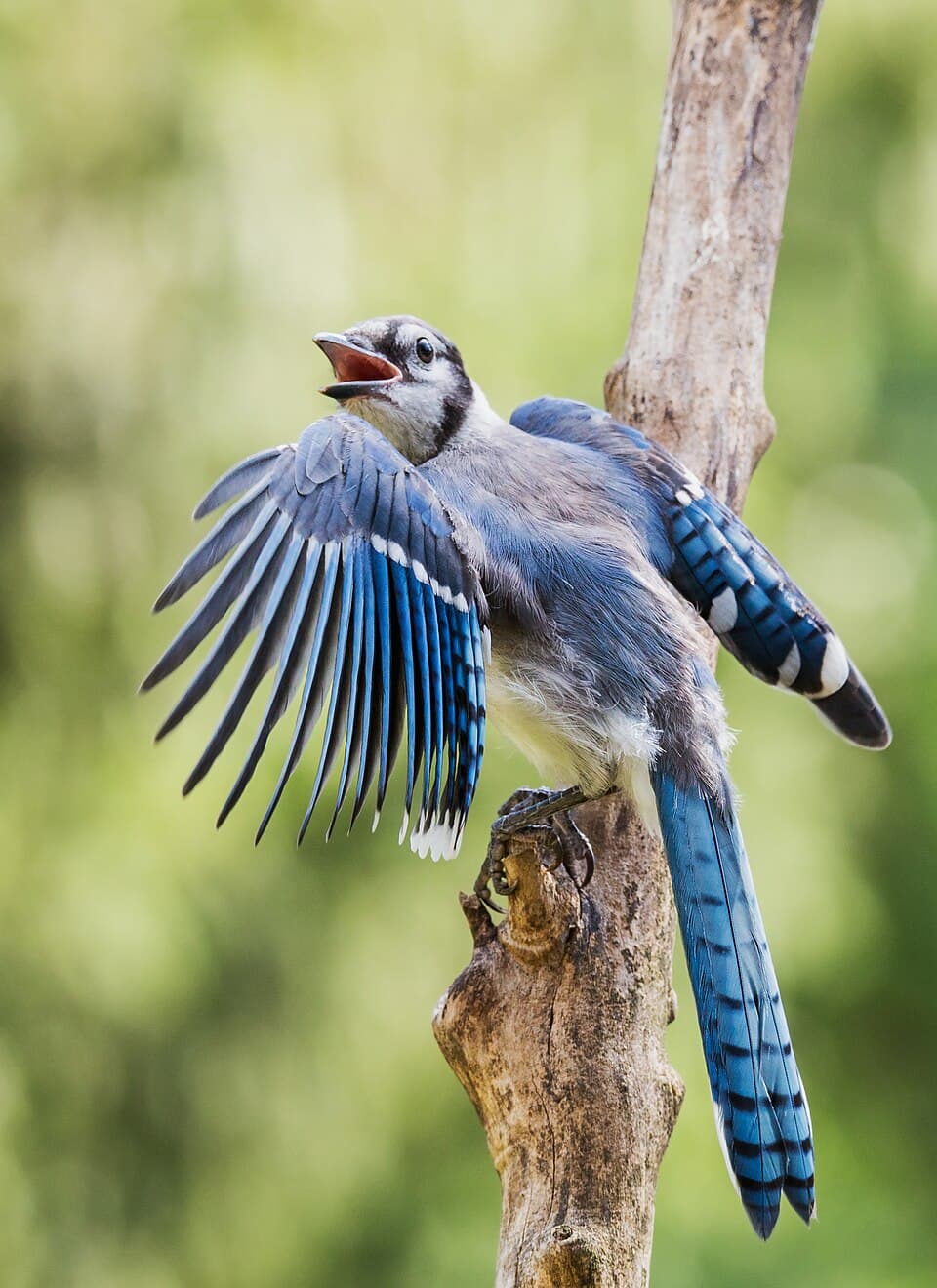
Blue Jay (Cyanocitta cristata) is a crested songbird native to eastern and central North America. Its blue upperparts, white underside, black necklace and barred wings are instantly recognizable, but its behavior is even more distinctive. Blue Jays cache thousands of acorns, mimic hawks, maintain close family bonds and use a broad vocabulary of calls. Some remain in one area all year while others migrate unpredictably. This guide separates well-supported biology from common assumptions and covers identification, range, habitat, diet, behavior, reproduction and conservation.
Identification
A Blue Jay has a prominent crest, blue back, blue-and-black barred wings and tail, white face and underparts, and a black bridle across the face, nape and throat. The stout dark bill handles acorns and other hard foods. The crest rises during excitement or aggression and lies flat during calm social contact. The blue is structural color created when feather tissues scatter light; the underlying pigment is brown melanin. Males average slightly larger, but the sexes look alike and cannot usually be separated by plumage.
Identification should combine body shape, markings, size, voice or movement, and location. One feature by itself can overlap with a related animal, a juvenile, or an individual in unusual light.
Photographs are most useful when they preserve scale and show several diagnostic features. Handling or repositioning a wild blue jay for identification can cause stress and is unnecessary.
Size and physical adaptations
Blue Jay typically measures About 22–30 cm and weighs About 65–109 g. A large, sturdy songbird with broad rounded wings and a long rounded tail.
Its useful adaptations include stout bill opens acorns and seeds, expandable throat and upper esophagus carry food, strong feet hold nuts while hammering, structural feathers scatter blue light, flexible calls include accurate mimicry, excellent spatial memory retrieves caches, mobile crest signals emotional state, broad wings support agile forest flight. These traits work together in the animal’s normal setting rather than serving as isolated curiosities.
Published measurements may use different methods, life stages or sample locations. Comparing figures responsibly means checking what was measured rather than selecting the largest number available.
Range and distribution
Native from southern Canada through the eastern and central United States, mainly east of the Rocky Mountains, with range expansion into parts of the northwest. Some populations and individuals remain resident; others move south in autumn and north in spring. Migration varies from year to year and is not determined simply by age. The native range includes Canada, United States.
A country-level map indicates broad distribution, not continuous occupation. Climate, elevation, water, vegetation, prey, breeding sites, barriers and survey effort all affect where records occur.
Records near the edge of the range deserve careful documentation because they may reflect natural movement, improved survey coverage, accidental transport or a genuine distribution change.
Habitat
Deciduous and mixed forest, especially oak woodland, forest edges, parks, suburbs, shelterbelts and wooded towns.
Blue Jays favor broken woodland with mast-producing trees rather than closed forest interiors. Oaks provide acorns for immediate food and winter caches. Dense branches support cup nests, while openings and lawns offer insects and scattered seeds. Suburban landscapes can suit jays when mature native trees remain, feeders are managed safely and cats are kept indoors. Protecting a population therefore requires the feeding, shelter and breeding features that make a site usable, along with connections that allow movement.
Microhabitat matters. Shade, soil, current, moisture, shelter or host plants can determine whether a small area is usable even when the surrounding landscape appears suitable.
Diet and feeding
Blue Jay is a omnivore. Important foods include acorns, beechnuts, sunflower seeds, corn, fruits, beetles, caterpillars, snails, occasional eggs or nestlings. Blue Jays forage in trees, shrubs and on the ground. They hold nuts in their feet and strike them with the bill, glean insects from foliage and visit feeders. A flexible throat pouch lets one bird transport several acorns per trip. Jays judge nut quality, cache sound acorns in soil and leaf litter, and later recover many by memory. Nest predation occurs, but extensive stomach studies found bird remains in only a small fraction of individuals.
Diet changes with age, season, location and food supply. A dramatic prey record does not establish what most individuals eat most of the time; repeated field observations provide a stronger picture.
Feeding opportunities also create risk. An animal focused on prey may be less alert to predators, traffic or people, while contaminated prey can transfer pollutants through the food web.
Behavior and communication
Diurnal, active from dawn through daylight; some individuals migrate by day. Blue Jays travel alone, in pairs, family groups or loose flocks. Pairs often remain together throughout the year and share nest work and chick care. They mob hawks, owls and other threats with loud calls, alerting many neighboring birds. At feeders they can appear assertive, yet larger woodpeckers, grackles and squirrels often displace them. Their partial migration remains unusually variable and poorly understood.
The familiar harsh jeer is only one element of a large repertoire. Blue Jays whistle, click, rattle, squeak and produce soft musical notes during close social contact. They imitate Red-tailed and Red-shouldered Hawks, perhaps to warn other jays or sometimes clear competitors from food. Crest position, body posture and wing movements add visual information. Behavior should be interpreted in context: alarm, courtship, feeding and temperature regulation can produce very different actions from the same animal.
Daily schedules are flexible responses, not rigid rules. Weather, breeding condition, disturbance, tides or food can move activity into a different part of the day.
Reproduction and development
Pairs form long-lasting monogamous bonds. Both birds select a site and build an open cup, although the male often gathers more material and the female does more construction. Only the female incubates, while the male brings her food. Both feed the chicks after hatching and continue caring for fledglings for weeks. Usually 2–7 eggs Chicks hatch naked, blind and helpless. The female broods them closely for the first days while the male supplies food. Nestlings develop feathers rapidly and usually leave at 17–21 days, sometimes wandering on branches shortly before full flight. Parents continue feeding the fledged brood for at least a month and sometimes two, while young learn calls, foraging and caching skills.
Young animals face different risks and may use different microhabitats or food than adults. Breeding success depends on adult condition, suitable sites and the survival of offspring through vulnerable early stages.
Counts of eggs or young describe reproductive output, not the number expected to reach adulthood. Mortality is normally greatest during eggs, larval or juvenile stages.
Predators and ecological role
Blue Jays connect forests through seed dispersal. They carry acorns away from parent trees and fail to retrieve some caches, allowing oaks to establish in new sites. They also consume insects, scavenge carrion and serve as prey. Alarm and mobbing calls help mixed bird communities detect predators. Their abundance can reflect mast crops, forest-edge structure and survival in human-dominated landscapes. Documented or likely predators include Cooper’s Hawk, Great Horned Owl, Raccoon, Domestic Cat.
This animal is both a consumer and a food source. Its influence comes through many repeated interactions, so ecological claims should be based on measured populations rather than assumptions drawn from appearance.
Predator and prey relationships differ among places. A species can be ecologically influential without being abundant everywhere, and its role can change across its range.
Relationship with people
Blue Jays readily use towns, parks and bird feeders, making them familiar neighbors and useful subjects for education and citizen science. Native oaks, clean water and properly placed feeders support them. Feeders should be cleaned regularly, seed kept dry and windows treated to reduce collisions. Keeping cats indoors protects jays and other wildlife. A feathered fledgling on the ground is usually still being cared for and should not be removed unless injured or in immediate danger.
Blue Jays pose little risk to people. Nesting adults may scold, swoop or peck when a person approaches young, so give the site room. Never handle a bird with bare hands; contact a licensed rehabilitator for an injured individual. Wash hands after cleaning feeders to reduce transmission of bird pathogens. Responsible observation means keeping an appropriate distance, avoiding capture or feeding, protecting habitat and following local wildlife or invasive-species guidance.
Wildlife guidance should come from the responsible local agency because collection rules, reporting requests and appropriate responses differ between native and introduced ranges.
Conservation
The IUCN lists the Blue Jay as Least Concern because it remains widespread and numerous. Long-term monitoring nevertheless indicates regional declines, so the global category should not be interpreted as absence of pressure. Window collisions, cats, disease, habitat simplification and changes in mast crops affect local survival. The reported global trend is Declining in some long-term surveys but still widespread.
Important pressures include domestic cats, window collisions, habitat loss and simplification, west nile virus, vehicle strikes, contaminated feeders, climate-driven changes in food crops. Global status can hide local decline or recovery, so current regional monitoring and habitat management remain necessary.
The most useful conservation action follows the documented pressure. Protecting breeding sites, reducing road deaths or limiting pollutants can require different tools in different populations.