
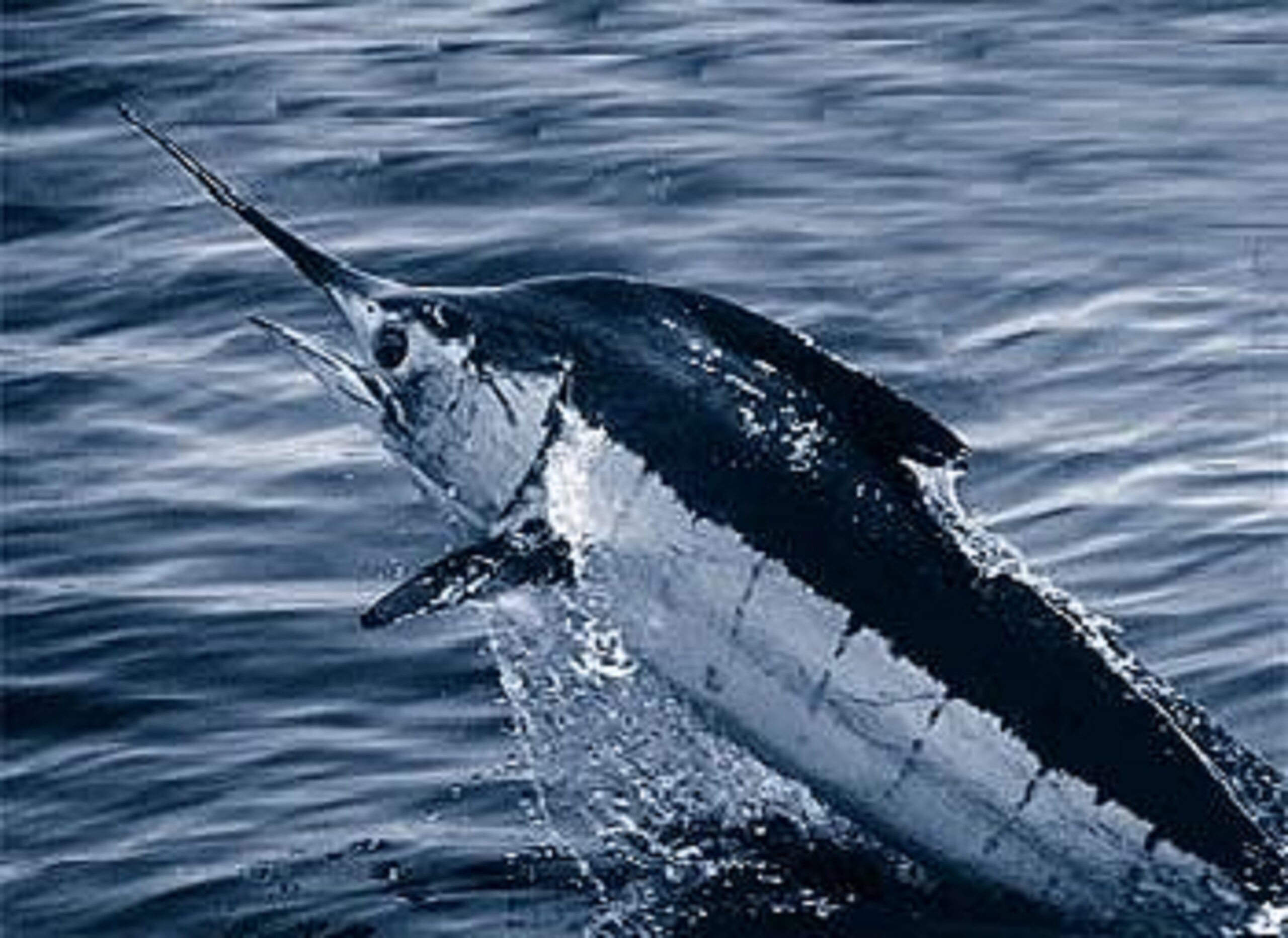
Blue Marlin (Makaira nigricans) is the largest marlin and one of the ocean’s most recognizable predatory fishes. It spends most of its life in warm blue water, traveling alone across tropical and subtropical seas while hunting tuna, mackerel, squid and other pelagic prey. This guide separates well-supported biology from common assumptions and covers identification, range, habitat, diet, behavior, reproduction and conservation.
Identification
The upper jaw extends into a long, round spear. The streamlined body is cobalt blue above, silvery white below and may show about fifteen pale vertical bars when the fish is excited. A high pointed crest begins the first dorsal fin, which then drops sharply and continues low along the back. Pectoral fins are long and narrow, pelvic fins slender, and the crescent tail sits on a narrow peduncle reinforced by paired keels. Unlike the sailfish, the dorsal fin never forms a huge sail. Females grow dramatically larger and live longer than males. Males rarely exceed about 2.1 m, while large females can surpass 4 m and many hundreds of kilograms. Color and fin form do not reliably reveal sex in a free-swimming fish.
Identification should combine body shape, markings, size, voice or movement, and location. One feature by itself can overlap with a related animal, a juvenile, or an individual in unusual light.
Photographs are most useful when they preserve scale and show several diagnostic features. Handling or repositioning a wild blue marlin for identification can cause stress and is unnecessary.
Size and physical adaptations
Blue Marlin typically measures commonly 2–3.5 m, with exceptional females near 4.3 m total length and weighs large females may exceed 450 kg, with exceptional records approaching 900 kg. The bill is included in total length. Females account for nearly all exceptionally large “grander” marlin, and most fish are far below the maximum.
Its useful adaptations include a streamlined body and crescent tail produce efficient thrust, the bill slashes or stuns schooling prey, retractable fins reduce drag during fast swimming, specialized tissue warms the eyes and brain, countershading conceals the fish in open water, paired tail keels stabilize high-speed turns, color cells rapidly intensify vertical body bars. These traits work together in the animal’s normal setting rather than serving as isolated curiosities.
Published measurements may use different methods, life stages or sample locations. Comparing figures responsibly means checking what was measured rather than selecting the largest number available.
Range and distribution
Worldwide in tropical and subtropical parts of the Atlantic, Indian and Pacific oceans, with seasonal movements into warm temperate water. The native range includes United States, Mexico, Bahamas, Cuba, Dominican Republic, Brazil, Portugal, Spain, Morocco, Cabo Verde, South Africa, Mozambique, Mauritius, India, Sri Lanka, Maldives, Indonesia, Philippines, Taiwan, Japan, Australia, New Zealand, French Polynesia, Ecuador, Panama.
A country-level map indicates broad distribution, not continuous occupation. Climate, elevation, water, vegetation, prey, breeding sites, barriers and survey effort all affect where records occur.
Records near the edge of the range deserve careful documentation because they may reflect natural movement, improved survey coverage, accidental transport or a genuine distribution change.
Habitat
Open-ocean epipelagic water, current edges, seamounts, island slopes and productive fronts, usually above 200 m but capable of deeper dives.
Blue marlin favor warm, well-oxygenated blue water and spend much time in the upper ocean. Satellite tags show frequent vertical movement: fish often stay nearer the surface at night and dive deeper during daylight while foraging. Temperature, oxygen, currents and prey control the depth available. They gather loosely around current boundaries, seamounts and islands where tuna and other prey concentrate, but they do not form permanent schools. Protecting a population therefore requires the feeding, shelter and breeding features that make a site usable, along with connections that allow movement.
Microhabitat matters. Shade, soil, current, moisture, shelter or host plants can determine whether a small area is usable even when the surrounding landscape appears suitable.
Diet and feeding
Blue Marlin is a carnivore. Important foods include tuna, mackerel, dolphinfish, flying fish, bonito, squid, small billfish, other open-ocean fishes. The marlin accelerates into or alongside a school and uses its bill to slash or strike prey, then circles back to swallow injured fish head-first. It can also take individual squid or larger fish without a visible bill strike. Diet studies show that fishes dominate in many regions, but squid become important where deep scattering layers or currents bring them within reach. Feeding is strongest during daylight in many tagged individuals.
Diet changes with age, season, location and food supply. A dramatic prey record does not establish what most individuals eat most of the time; repeated field observations provide a stronger picture.
Feeding opportunities also create risk. An animal focused on prey may be less alert to predators, traffic or people, while contaminated prey can transfer pollutants through the food web.
Behavior and communication
Active day and night, with most active foraging and deeper dives during daylight in many regions. Usually solitary, a blue marlin can cross national boundaries and entire ocean regions. It uses surface currents and temperature fronts, alternating steady travel with repeated dives. A hooked fish may leap repeatedly, but spectacular jumping is an escape response rather than normal travel. Body bars can brighten rapidly during excitement, feeding or capture because pigment cells respond to nerves and hormones.
No sound-based social system is known. Visual cues, body position and rapid changes in stripes may signal arousal at close range, though much color change probably reflects physiological state rather than deliberate messaging. Vision and the lateral line detect prey movement, while smell and other senses help orient in featureless open water. Behavior should be interpreted in context: alarm, courtship, feeding and temperature regulation can produce very different actions from the same animal.
Daily schedules are flexible responses, not rigid rules. Weather, breeding condition, disturbance, tides or food can move activity into a different part of the day.
Reproduction and development
Spawning occurs in warm surface waters. A female releases batches of buoyant eggs while one or more males release sperm, so fertilization is external. Large females can produce millions of eggs in a season, often in repeated spawning events. High egg production offsets extreme mortality among drifting eggs and larvae; it does not mean that most offspring survive. Several million buoyant eggs across repeated spawning batches Transparent larvae drift in surface plankton and initially eat tiny zooplankton before switching early to fish larvae. Growth is exceptionally fast: NOAA notes lengths of roughly 0.9–1.8 m within the first one or two years. Males may mature near age two and females around three to four years. Females continue growing far beyond typical male size and can live about twice as long.
Young animals face different risks and may use different microhabitats or food than adults. Breeding success depends on adult condition, suitable sites and the survival of offspring through vulnerable early stages.
Counts of eggs or young describe reproductive output, not the number expected to reach adulthood. Mortality is normally greatest during eggs, larval or juvenile stages.
Predators and ecological role
The blue marlin is a major predator of tuna-sized fishes and squid in the upper ocean, linking small schooling prey with one of the largest bony fishes. Juveniles themselves feed larger pelagic predators, while adults may be attacked by great white and mako sharks. Marlin movements also connect productivity at fronts, islands and open-ocean waters, and their carcasses transfer nutrients to scavengers and deep communities. Documented or likely predators include Shortfin Mako, Great White Shark, Humans, Larger Pelagic Fish.
This animal is both a consumer and a food source. Its influence comes through many repeated interactions, so ecological claims should be based on measured populations rather than assumptions drawn from appearance.
Predator and prey relationships differ among places. A species can be ecologically influential without being abundant everywhere, and its role can change across its range.
Relationship with people
Blue marlin support valuable recreational fisheries and are also retained or discarded by commercial longline fleets targeting tuna and swordfish. Tag-and-release programs reveal migrations, but capture can still cause injury, exhaustion or post-release mortality. Management operates by ocean stock and cannot be summarized by one global trend. Consumers should follow local mercury guidance because large predatory fish accumulate methylmercury.
The bill, tail and body weight can seriously injure fishers. A hooked marlin should be handled only by experienced crews using species-appropriate release tools. Swimmers rarely encounter one at close range, but should never approach or attempt to touch a large wild billfish. Boat operators should avoid chasing feeding fish or cutting across bait schools. Responsible observation means keeping an appropriate distance, avoiding capture or feeding, protecting habitat and following local wildlife or invasive-species guidance.
Wildlife guidance should come from the responsible local agency because collection rules, reporting requests and appropriate responses differ between native and introduced ranges.
Conservation
The IUCN Red List classifies the blue marlin as Vulnerable globally. Fishing pressure differs between the Atlantic, Pacific and Indian oceans, so current stock assessments and regional management must guide conservation rather than a single catch trend. The reported global trend is Decreasing globally in the IUCN assessment, with regional stock trends differing.
Important pressures include commercial pelagic longline bycatch and retention, recreational fishing mortality, overfishing in some ocean stocks, post-release mortality, climate-driven shifts in temperature, oxygen and prey, marine debris and lost fishing gear. Global status can hide local decline or recovery, so current regional monitoring and habitat management remain necessary.
The most useful conservation action follows the documented pressure. Protecting breeding sites, reducing road deaths or limiting pollutants can require different tools in different populations.