
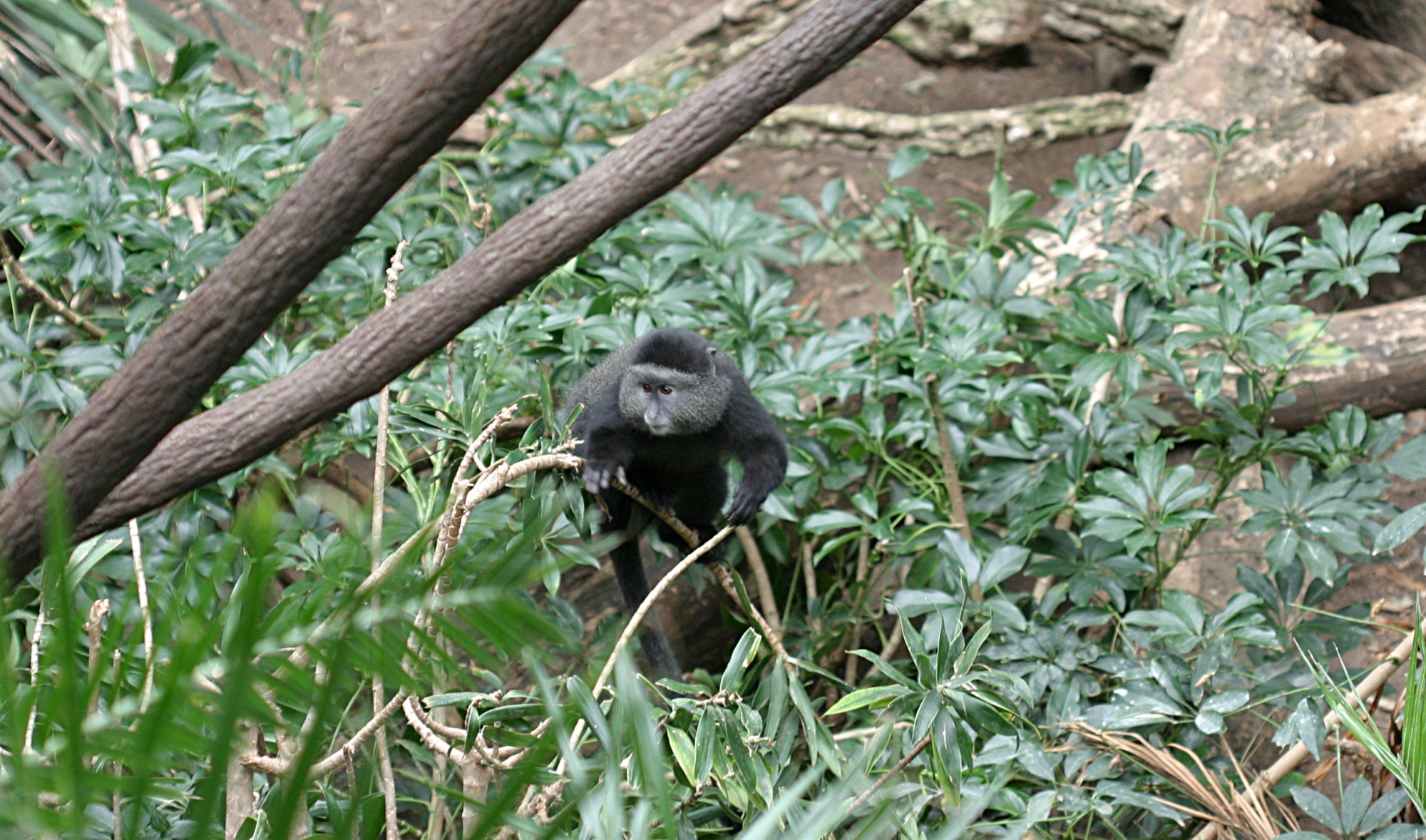
Blue Monkey (Cercopithecus mitis) is an Old World monkey of humid forests in central, eastern and parts of southern Africa. Its name can be misleading: the coat is usually slate gray, charcoal or olive rather than bright blue. A pale diadem across the forehead, darker limbs and a long balancing tail make it recognizable. Blue Monkeys spend much of the day in trees, where females and young form stable groups and search for fruit, leaves and invertebrates. This guide separates well-supported biology from common assumptions and covers identification, range, habitat, diet, behavior, reproduction and conservation.
Identification
The face is dark and nearly bare, framed by gray cheek fur and a conspicuous pale or whitish band of forward-pointing hairs above the brow. The crown, shoulders and back are grizzled gray to blue-gray, while arms and legs tend to be darker. Regional subspecies differ in collar, throat, rump and crown markings. The tail is longer than the body and is carried behind the animal as it crosses branches. Adult males are substantially larger than females and have larger canine teeth; coat patterns are broadly similar within the same population.
Identification should combine body shape, markings, size, voice or movement, and location. One feature by itself can overlap with a related animal, a juvenile, or an individual in unusual light.
Photographs are most useful when they preserve scale and show several diagnostic features. Handling or repositioning a wild blue monkey for identification can cause stress and is unnecessary.
Size and physical adaptations
Blue Monkey typically measures Head and body about 40–70 cm and weighs Females commonly about 3.5–4.5 kg; males about 6–9 kg. Body size and markings differ among regional forms, and published measurements often describe particular subspecies.
Its useful adaptations include long tail provides balance in the canopy, grasping hands and feet hold branches, cheek pouches store food during rapid foraging, forward-facing eyes support depth perception, flexible diet tracks seasonal forest foods, alarm calls distinguish immediate threats. These traits work together in the animal’s normal setting rather than serving as isolated curiosities.
Published measurements may use different methods, life stages or sample locations. Comparing figures responsibly means checking what was measured rather than selecting the largest number available.
Range and distribution
Blue Monkeys occupy a broad but discontinuous belt of African forest. Populations occur from the Congo Basin and Albertine Rift east to Kenya and Tanzania, then south through montane and coastal forest systems into southeastern Africa. Distribution depends on the taxonomic treatment of regional subspecies, so maps should be read as the wider species complex rather than a claim that every form occurs throughout the range. The native range includes Angola, Burundi, Democratic Republic of the Congo, Kenya, Malawi, Mozambique, Rwanda, South Africa, Tanzania, Uganda, Zambia, Zimbabwe.
A country-level map indicates broad distribution, not continuous occupation. Climate, elevation, water, vegetation, prey, breeding sites, barriers and survey effort all affect where records occur.
Records near the edge of the range deserve careful documentation because they may reflect natural movement, improved survey coverage, accidental transport or a genuine distribution change.
Habitat
Humid lowland, riverine, coastal and montane forest with tall trees, shade and reliable water.
Most activity takes place in the middle and upper canopy, although animals descend when food, water or safe travel routes make it worthwhile. Mature forest provides fruiting trees, sleeping sites and continuous branch pathways. Blue Monkeys can use secondary forest, forest edges and wooded gardens when canopy cover remains, but they are less suited to open country. In fragmented landscapes, narrow riparian strips may connect otherwise isolated groups. Protecting a population therefore requires the feeding, shelter and breeding features that make a site usable, along with connections that allow movement.
Microhabitat matters. Shade, soil, current, moisture, shelter or host plants can determine whether a small area is usable even when the surrounding landscape appears suitable.
Diet and feeding
Blue Monkey is a primarily frugivorous omnivore. Important foods include ripe and unripe fruit, young leaves and leaf buds, flowers and nectar, seeds, bark and gums, insects and other small invertebrates. Groups travel between fruiting trees and spread through the canopy while feeding. Fruit often supplies most energy, but young leaves, flowers, seeds and animal prey buffer seasonal shortages. Cheek pouches let a monkey collect food quickly in a contested tree and process it from a safer perch. By swallowing fruit and later depositing seeds, blue monkeys can help move plants through the forest, although some seeds are crushed and digested.
Diet changes with age, season, location and food supply. A dramatic prey record does not establish what most individuals eat most of the time; repeated field observations provide a stronger picture.
Feeding opportunities also create risk. An animal focused on prey may be less alert to predators, traffic or people, while contaminated prey can transfer pollutants through the food web.
Behavior and communication
Diurnal, with feeding and travel concentrated through daylight hours. Blue Monkeys are agile quadrupedal climbers and leapers. A typical social unit contains several related adult females, their offspring and one resident adult male, though group size and composition change with habitat and season. Females maintain long-term bonds and dominance relationships. Males may live alone or in bachelor associations outside breeding opportunities. When food is abundant, groups can tolerate or join other primates in mixed-species feeding parties.
Calls coordinate a group hidden by foliage and warn of predators or rival males. Adult males produce loud booming calls that advertise presence over long distances. Short barks and other alarms prompt listeners to scan or flee, while facial expressions, body posture and grooming operate at close range. Infants use calls and contact behavior to remain near their mothers. Behavior should be interpreted in context: alarm, courtship, feeding and temperature regulation can produce very different actions from the same animal.
Daily schedules are flexible responses, not rigid rules. Weather, breeding condition, disturbance, tides or food can move activity into a different part of the day.
Reproduction and development
Breeding timing varies across the wide range and often follows local food cycles. A receptive female mates with the resident male and may also encounter outside males during group takeovers or seasonal movement. Gestation produces one infant in most cases. The newborn clings to its mother’s belly, then rides and explores progressively farther as coordination improves. Female relatives may inspect or briefly handle infants, but the mother supplies milk and most transport. Usually one infant Infants begin with close maternal contact, add solid food while still nursing and learn travel routes and food choices by following the group. Juvenile play develops balance and social skills. Females commonly remain in their birth group, preserving maternal kin lines, while males disperse as they approach maturity.
Young animals face different risks and may use different microhabitats or food than adults. Breeding success depends on adult condition, suitable sites and the survival of offspring through vulnerable early stages.
Counts of eggs or young describe reproductive output, not the number expected to reach adulthood. Mortality is normally greatest during eggs, larval or juvenile stages.
Predators and ecological role
Blue Monkeys connect several forest processes. They consume fruit and disperse some intact seeds, browse leaves and flowers, and prey on insects. Crowned eagles and leopards can hunt them, while large snakes may threaten young animals. Their vigilance may benefit mixed-species groups of monkeys and birds. In turn, their need for connected canopy makes local presence a useful sign that forest structure still supports arboreal wildlife. Documented or likely predators include Crowned Eagle, Leopard, African Rock Python.
This animal is both a consumer and a food source. Its influence comes through many repeated interactions, so ecological claims should be based on measured populations rather than assumptions drawn from appearance.
Predator and prey relationships differ among places. A species can be ecologically influential without being abundant everywhere, and its role can change across its range.
Relationship with people
Forest clearing, logging, farm expansion and road building divide canopy habitat and isolate local groups. Monkeys may raid fruit crops at forest edges, creating conflict with growers, and some populations are hunted for meat. Protection works best when it keeps large forest blocks linked, supports local livelihoods and prevents hunting in sensitive areas. Responsible visitors should watch quietly, keep food secured and never encourage close contact.
Observe from a distance and never feed wild monkeys. Feeding changes behavior, promotes aggression and allows respiratory and gastrointestinal diseases to pass between people and primates. Keep doors, bags and food secured in places where monkeys visit lodges or gardens. Responsible observation means keeping an appropriate distance, avoiding capture or feeding, protecting habitat and following local wildlife or invasive-species guidance.
Wildlife guidance should come from the responsible local agency because collection rules, reporting requests and appropriate responses differ between native and introduced ranges.
Conservation
The Blue Monkey is assessed globally as Least Concern because it remains widespread across many protected forests. That broad category masks local losses where forests are cleared, fragmented or heavily hunted. Some named subspecies have much smaller ranges and may face greater risk than the species-level assessment suggests. The reported global trend is Decreasing overall, with local trends differing among regions and subspecies.
Important pressures include deforestation and canopy fragmentation, hunting for bushmeat, crop conflict and retaliation, selective logging, roads and settlement expansion, disease transmission at feeding sites. Global status can hide local decline or recovery, so current regional monitoring and habitat management remain necessary.
The most useful conservation action follows the documented pressure. Protecting breeding sites, reducing road deaths or limiting pollutants can require different tools in different populations.
