
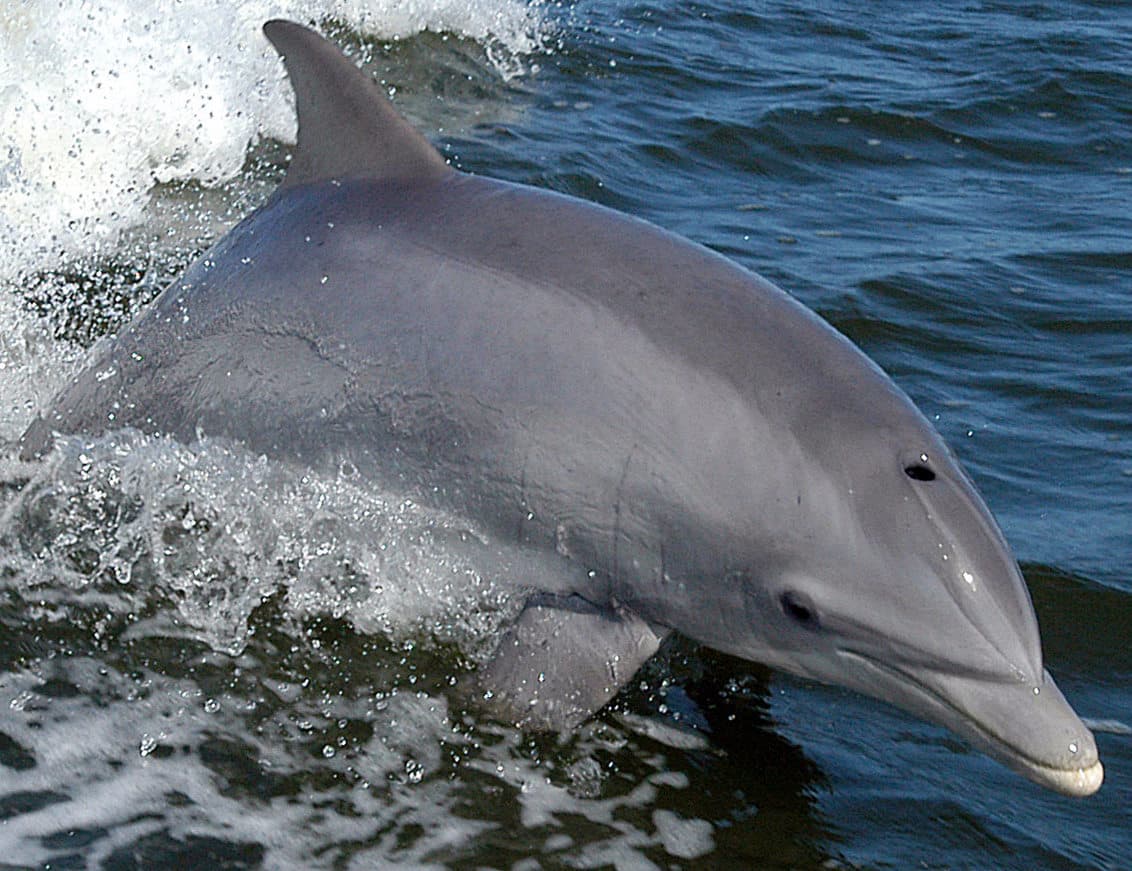
Common Bottlenose Dolphin (Tursiops truncatus) is a robust toothed whale found in warm and temperate oceans worldwide. Its short, thick beak gives the species its familiar name. Common Bottlenose Dolphins live in flexible fission-fusion societies, use individually distinctive whistles and hunt with echolocation. Populations differ in body size, habitat and behavior, and recent taxonomy separates some coastal western North Atlantic dolphins as Tamanend’s Bottlenose Dolphin. This guide separates well-supported biology from common assumptions and covers identification, range, habitat, diet, behavior, reproduction and conservation.
Identification
The body is streamlined with a rounded forehead called a melon, a distinct short beak, curved dorsal fin, pointed flippers and horizontal tail flukes. Color grades from dark gray on the back to lighter gray flanks and a pale belly. Offshore animals are often larger and more robust than nearshore forms. Dorsal-fin nicks and scars are unique enough for researchers to identify individuals in photographs. Adult males are typically larger and heavier than females, especially in offshore populations.
Identification should combine body shape, markings, size, voice or movement, and location. One feature by itself can overlap with a related animal, a juvenile, or an individual in unusual light.
Photographs are most useful when they preserve scale and show several diagnostic features. Handling or repositioning a wild common bottlenose dolphin for identification can cause stress and is unnecessary.
Size and physical adaptations
Common Bottlenose Dolphin typically measures Adults commonly 1.8–4 m depending on population and weighs About 135–635 kg depending on sex and population. Size varies markedly among regions and coastal versus offshore populations.
Its useful adaptations include melon focuses echolocation clicks, blowhole permits rapid surface breathing, streamlined body reduces drag, blubber stores energy and limits heat loss, countershading conceals the body, sensitive lower jaw receives returning echoes, hemoglobin and myoglobin store oxygen, conical teeth grip slippery prey. These traits work together in the animal’s normal setting rather than serving as isolated curiosities.
Published measurements may use different methods, life stages or sample locations. Comparing figures responsibly means checking what was measured rather than selecting the largest number available.
Range and distribution
Widely distributed in tropical, subtropical and warm-temperate Atlantic, Pacific and Indian oceans, including the Mediterranean. Range is marine and cannot be represented fully by country borders. Animals occupy offshore continental-shelf and oceanic waters; some populations also use coasts, though western North Atlantic nearshore dolphins may belong to Tursiops erebennus. The native range includes United States, Mexico, Brazil, Argentina, South Africa, Australia, New Zealand, Japan, India, Spain, Portugal, France, Italy, Greece, Türkiye, Morocco.
A country-level map indicates broad distribution, not continuous occupation. Climate, elevation, water, vegetation, prey, breeding sites, barriers and survey effort all affect where records occur.
Records near the edge of the range deserve careful documentation because they may reflect natural movement, improved survey coverage, accidental transport or a genuine distribution change.
Habitat
Continental shelf, shelf edge, open ocean, coastal bays, lagoons and productive waters around islands and banks.
Habitat varies by population. Offshore dolphins travel across deep water and shelf breaks where currents concentrate squid and fish. Other groups use bays and sounds, following tides through channels and seagrass margins. Home ranges may overlap neighboring communities but show long-term site fidelity. Water temperature, prey, depth, salinity, vessel traffic and sound all influence local distribution. Protecting a population therefore requires the feeding, shelter and breeding features that make a site usable, along with connections that allow movement.
Microhabitat matters. Shade, soil, current, moisture, shelter or host plants can determine whether a small area is usable even when the surrounding landscape appears suitable.
Diet and feeding
Common Bottlenose Dolphin is a carnivore. Important foods include schooling fish, bottom fish, squid, octopus, shrimp and other crustaceans. Dolphins locate prey with vision, passive listening and echolocation. They swallow smaller fish whole, usually head first, because conical teeth grip rather than chew. Hunting tactics vary: groups herd fish into tight balls, individuals pin prey against mud banks, strike fish with tail flukes or follow trawlers. Sponge carrying protects the beak during bottom probing in certain Australian communities.
Diet changes with age, season, location and food supply. A dramatic prey record does not establish what most individuals eat most of the time; repeated field observations provide a stronger picture.
Feeding opportunities also create risk. An animal focused on prey may be less alert to predators, traffic or people, while contaminated prey can transfer pollutants through the food web.
Behavior and communication
Active throughout day and night, with feeding, travel, socializing and rest varying by tide and prey. Common Bottlenose Dolphins live in fission-fusion societies in which subgroup membership changes over hours or days. Females often associate with calves and familiar females, while males may form alliances lasting decades. Dolphins bow-ride, leap, rub, chase and play with objects, but these behaviors also communicate or improve movement. They sleep one brain hemisphere at a time so breathing remains voluntary.
Each dolphin develops a signature whistle that functions like an acoustic label. Individuals copy another’s whistle when addressing it. Pulsed calls, jaw claps, body contact, postures and leaps convey motivation. Echolocation click trains accelerate into buzzes as a dolphin closes on prey. Sound is central underwater, so intense human noise can mask communication and disrupt feeding. Behavior should be interpreted in context: alarm, courtship, feeding and temperature regulation can produce very different actions from the same animal.
Daily schedules are flexible responses, not rigid rules. Weather, breeding condition, disturbance, tides or food can move activity into a different part of the day.
Reproduction and development
Mating can occur throughout the year with regional peaks. Males court females alone or in alliances and may guard a receptive female. After roughly twelve months, the mother delivers one calf tail-first in the water. Other dolphins may accompany her, but she provides the milk and most direct care. One calf; twins are exceptionally rare A newborn surfaces immediately to breathe and swims in the mother’s slipstream. It drinks fat-rich milk from mammary slits and remains in close echelon position. Calves nurse for years while learning prey, routes, calls and community-specific hunting techniques. Females reproduce slowly, usually leaving several years between calves.
Young animals face different risks and may use different microhabitats or food than adults. Breeding success depends on adult condition, suitable sites and the survival of offspring through vulnerable early stages.
Counts of eggs or young describe reproductive output, not the number expected to reach adulthood. Mortality is normally greatest during eggs, larval or juvenile stages.
Predators and ecological role
These dolphins are upper-level predators that connect fish, squid and crustacean food webs. They compete with sharks and other cetaceans and provide prey for large sharks and Killer Whales. Foraging behavior can redistribute fish schools and scavengers. As long-lived coastal sentinels, their contaminant loads, disease and reproduction reveal ecosystem health. Documented or likely predators include Tiger Shark, Bull Shark, Great White Shark, Killer Whale.
This animal is both a consumer and a food source. Its influence comes through many repeated interactions, so ecological claims should be based on measured populations rather than assumptions drawn from appearance.
Predator and prey relationships differ among places. A species can be ecologically influential without being abundant everywhere, and its role can change across its range.
Relationship with people
Common Bottlenose Dolphins are central to marine tourism, research and public education, but popularity creates risks. Feeding teaches animals to approach boats, beg and steal bait, increasing propeller strikes, entanglement and retaliation. Responsible viewing keeps distance, avoids chasing or encircling groups and never feeds or swims toward wild dolphins. Fisheries can reduce bycatch with gear changes and careful handling protocols.
Wild dolphins are strong predators, not tame performers. They can ram, bite or injure swimmers, particularly when fed, crowded or protecting calves. Observe from legal distances, never touch or feed them, avoid separating group members and follow local marine-mammal rules. Entangled animals require trained responders because line, hooks and a struggling dolphin can be lethal. Responsible observation means keeping an appropriate distance, avoiding capture or feeding, protecting habitat and following local wildlife or invasive-species guidance.
Wildlife guidance should come from the responsible local agency because collection rules, reporting requests and appropriate responses differ between native and introduced ranges.
Conservation
The IUCN lists the Common Bottlenose Dolphin as Least Concern globally, but it consists of many stocks with different trends and threats. Some small resident communities are depleted or exposed to heavy fishing, pollution and disturbance. Conservation decisions must therefore assess each population rather than rely only on the global category. The reported global trend is Unknown globally and variable among stocks.
Important pressures include fishing-gear entanglement, chemical contaminants, biotoxins and disease, vessel strikes, ocean noise, illegal feeding and harassment, oil spills and habitat alteration. Global status can hide local decline or recovery, so current regional monitoring and habitat management remain necessary.
The most useful conservation action follows the documented pressure. Protecting breeding sites, reducing road deaths or limiting pollutants can require different tools in different populations.